Navigating steel procurement requires balancing lead time and MOQ considerations to optimize your supply chain. Whether comparing mill MOQ vs trader MOQ steel or evaluating standard vs custom steel lead time, procurement managers must ask the right questions to mitigate risks. This guide explores critical factors like steel manufacturing lead time, minimum order quantities for steel rods, and effective lead time planning to help project managers, buyers, and decision-makers streamline operations while maintaining quality and cost-efficiency in structural steel sourcing.
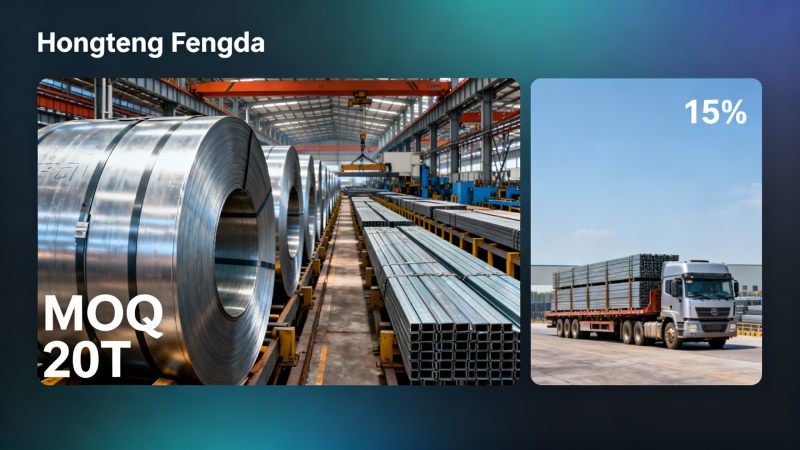
Understanding Lead Time and MOQ in Steel Procurement
Lead time and Minimum Order Quantity (MOQ) are two pivotal factors in steel procurement that directly impact project timelines and budgets. Lead time refers to the duration between placing an order and receiving the steel products, while MOQ defines the smallest quantity a supplier is willing to produce or sell. For instance, 316 Stainless Steel Plate may have different lead times and MOQs depending on whether sourced directly from mills or traders. Procurement managers must evaluate these parameters carefully to avoid delays and excess inventory costs.
Mill MOQ vs Trader MOQ: Key Differences
When sourcing steel products like angle steel or channel steel, buyers often face the choice between purchasing directly from mills or through traders. Mills typically enforce higher MOQs due to production efficiencies, whereas traders offer flexibility with lower MOQs but may charge premium prices. For example, a mill might require a minimum order of 20 tons for steel beams, while a trader could accommodate 5 tons. However, traders may extend lead times as they rely on mill production schedules. Understanding these trade-offs helps procurement teams make informed decisions aligned with project needs.
Standard vs Custom Steel Lead Time Considerations
Standard steel products like cold formed steel profiles generally have shorter lead times since they are produced in bulk and kept in inventory. Customized components, however, require additional design, tooling, and production time—extending lead times by weeks or even months. Projects requiring specialized 316 Stainless Steel Plate dimensions or finishes must factor this into their schedules. Procurement managers should collaborate closely with suppliers like Hongteng Fengda to align expectations and explore expedited options when necessary.
Critical Questions Procurement Managers Should Ask Suppliers
To mitigate risks in steel procurement, buyers must ask suppliers specific questions about lead times and MOQs:
- What is the typical lead time for standard vs custom orders?
- Can MOQs be negotiated based on long-term partnership potential?
- How does seasonality or raw material availability impact lead times?
- What certifications (e.g., ASTM, EN) do your products hold?
- Do you offer inventory management or just-in-time delivery options?
Why Choose Hongteng Fengda for Your Steel Procurement Needs?
As a professional structural steel manufacturer and exporter, Hongteng Fengda combines competitive MOQs with reliable lead times to serve global clients. Our modern facilities and strict quality control ensure compliance with international standards like ASTM and EN. Whether you need standard steel beams or customized components, we provide end-to-end solutions to reduce sourcing risks and optimize your supply chain. Contact us today to discuss your project requirements and discover how we can support your success.
Related recommendations
 The Ultimate Procurement Hub: How a Full-Spectrum Steel Portfolio Empowers Global Industrial SuccessIt covers a wide range of steel products, including steel plates, steel coils, profiles, and steel gratings, to meet diverse needs.
 The Vertical Integration Advantage: Why Full-Process Production is the Gold Standard for Global Steel SourcingIt possesses complete production technologies and equipment for coking, sintering, steelmaking, and rolling, forming a systematic production system.
 The Global Steel Pulse: Bridging Continents with Precision Engineering and Unrivaled Supply Chain ExcellenceOur products sell well throughout China and are exported to North America, Europe, the Middle East, and other parts of the world, covering a wide market.
 Velocity of Value: How Precision Processing and Rapid-Response Logistics Redefine the Global Steel Supply ChainEquipped with advanced leveling equipment and relying on a robust logistics system, we can respond to customer needs at any time.
Please give us a message


Please enter what you want to find