Installing Galvanised Steel Sheet for Agricultural Storage Buildings
When constructing durable agricultural storage buildings, project managers must prioritize materials that withstand harsh environmental conditions. Installing a high-quality galvanised steel sheet is essential for ensuring long-term structural integrity and superior corrosion resistance. Yet, the performance of the cladding system is rarely determined by the steel alone; it is dictated by the precision of the installation, the management of thermal dynamics, and the control of on-site execution risks. In facilities exposed to high humidity, corrosive fertilizers, and extreme thermal cycling, the difference between a multi-decade service life and premature structural degradation lies entirely in how the system is assembled and sealed.
### Substrate Tolerances and Load Distribution
The foundational requirement for a successful steel sheet installation is the dimensional accuracy of the secondary steelwork. Agricultural storage buildings, which often span large widths to accommodate heavy machinery or bulk storage, rely on purlins and girts to support the cladding. If these structural members deviate from specified alignment tolerances, the steel sheets will bridge gaps rather than resting on a continuous bearing surface.
When a sheet bridges a depressed purlin, localized stress is introduced. Under the daily thermal expansion and contraction typical in agricultural environments, these stressed areas will fatigue. This fatigue manifests as "oil-canning"—a visible popping in and out of the sheet pan—which eventually leads to fastener pull-out or tearing around the fastener holes. Before installation begins, project managers must mandate the verification of purlin straightness and elevation using string lines or laser levels. Shimming or adjusting the secondary steelwork to ensure a flat, continuous plane is a non-negotiable prerequisite that prevents costly remedial work later in the project lifecycle.
### Laying Sequences and Capillary Management
The physical orientation and sequence of sheet laying directly impact the building’s weathertightness. Sheets must always be installed starting from the leeward side—the side opposite to the prevailing wind—and progressing towards the windward side. This ensures that side laps overlap in the direction of the wind, preventing wind-driven rain from being forced into the joints under pressure.
In agricultural storage, where internal climate control, dust containment, or pest exclusion is critical, side laps must address capillary action. Water can wick upwards through tight, unsealed vertical joints, bypassing the primary water barriers. Using closed-cell foam tape or specific lap sealants at the eaves, ridges, and end laps breaks this capillary path. Project managers must specify the exact sealant type compatible with the galvanised coating. Incompatible sealants can cause chemical reactions that accelerate the breakdown of the zinc layer, turning a localized sealing solution into a widespread corrosion problem.
### Fastening Mechanics and Thermal Expansion
Steel expands and contracts significantly with temperature fluctuations. A galvanised roof sheet on an agricultural shed can experience temperature swings exceeding 40°C between winter nights and summer days. If fasteners are driven tightly into standard round holes without accounting for this movement, the sheets will buckle, or the holes will elongate, compromising the structural envelope.
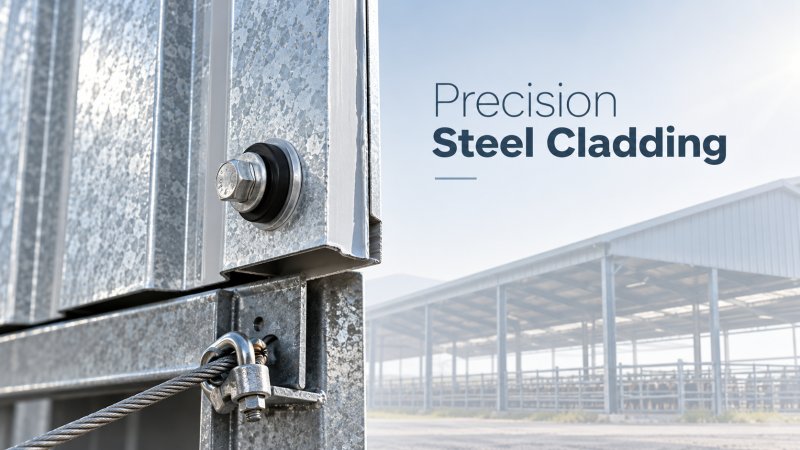
The standard engineering solution involves the use of slotted, oversized holes at the sheet ends and fixed points, allowing longitudinal movement. For intermediate purlin lines, standard holes are used, but the fastening technique requires strict site supervision. Fasteners must be driven perfectly perpendicular to the sheet surface. The EPDM (Ethylene Propylene Diene Monomer) washer must be compressed to form a watertight seal, but the metal washer should not be over-tightened to the point of dimpling the steel sheet excessively.
The correct torque creates a slight, uniform compression of the EPDM without distorting the steel pan. Over-driving crushes the EPDM, extruding it from under the washer and destroying the seal, while under-driving fails to compress the sealant adequately. Site supervisors must ensure that screw guns are equipped with adjustable, depth-sensitive clutches to maintain consistent torque across thousands of fasteners, eliminating human error in the tightening process.
 ### Cut Edges, Swarf, and Corrosion Protection
Despite meticulous planning, on-site cutting of galvanised steel sheet is often unavoidable for accommodating roof vents, pipe penetrations, or complex intersections. When the sheet is cut, the exposed steel edge loses its protective zinc layer. In the highly corrosive environment of an agricultural storage building—particularly where bulk fertilizers or animal by-products are stored—this bare edge will oxidize rapidly. More critically, the rust will creep under the adjacent zinc layer, undermining the protection of the surrounding intact coating.
All cut edges must be treated immediately. The standard practice requires the removal of any cutting swarf (metal debris) followed by the application of a high-quality, zinc-rich paint containing at least 90% zinc dust in the dry film. Project managers must enforce a strict "clean as you go" policy on the roof. Metal drill swarf left on the surface will rust quickly, staining the sheet and creating localized corrosion points that mimic coating failure. Mandating the use of magnetic sweepers at the end of each shift is a practical and necessary site management requirement.
### Integration of Auxiliary Tensioning Systems
Beyond the primary structural envelope, agricultural storage buildings frequently require internal or external auxiliary systems. These include heavy-duty ventilation ducts, automated shading nets, suspended lighting grids, or temporary safety harness lines. These systems impose dynamic loads and require reliable tensioning mechanisms to function correctly over time.
While the main structure relies on rigid steel framing, auxiliary components benefit from flexible, high-tensile elements. For instance, when installing external shading or supporting suspended ductwork, specifying the correct 0.7mm 0.8mm 1.2mm 1.6mm 1.8mm 2mm diameter Galvanized Steel Wire Rope ensures that the tensioning system maintains structural stability without adding excessive dead load to the primary purlins. The zinc coating on these ropes provides the necessary corrosion resistance to match the lifespan of the main building envelope, preventing premature failure of the auxiliary supports and ensuring that maintenance cycles for the tensioning systems align with those of the primary cladding.
### Quality Assurance and Handover Protocols
The final installation quality dictates the maintenance costs and operational reliability of the building over its lifecycle. Relying solely on a final walkthrough is insufficient for identifying systemic installation errors. Project managers should implement a staged inspection protocol, verifying critical parameters as the installation progresses across different roof bays or wall sections.
Inspections must systematically verify fastener alignment and washer compression, the integrity of lap sealants and flashings, the proper treatment of all cut edges, and the absence of metal swarf or deep surface scratches. Any scratches to the galvanised coating caused during handling, lifting, or installation must be touched up immediately with zinc-rich paint. Leaving minor scratches untreated in an aggressive agricultural environment will lead to premature coating breakdown, creating maintenance liabilities that could have been avoided with disciplined on-site execution. By focusing on these technical and operational details, project managers ensure that the agricultural storage facility delivers the durability and performance required for its intended use.
Previous page: Already the first one
Next page: Already the last one
Please give us a message


Please enter what you want to find