Choosing the right stainless steel pipe manufacturer affects quality consistency, delivery stability, and total sourcing cost. To judge a supplier well, it helps to understand each production step clearly.
From raw material control to forming, welding, testing, and export packing, every stage shapes final pipe performance. A reliable stainless steel pipe manufacturer builds confidence through process discipline and traceable quality.
Why process visibility matters when selecting a stainless steel pipe manufacturer
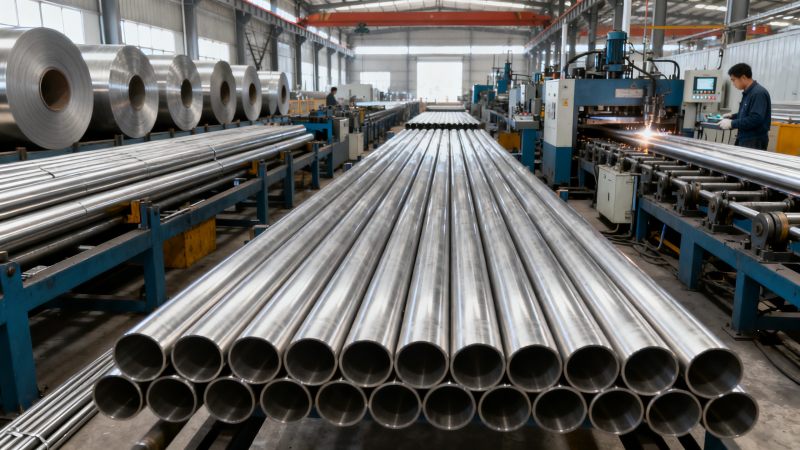
Steel products often look similar at first glance. Real differences appear in dimensional accuracy, weld integrity, corrosion resistance, and how well deliveries match technical requirements and project schedules.
A dependable stainless steel pipe manufacturer does not rely on claims alone. It shows standard compliance, production records, inspection methods, and export capability with consistent execution.
This process-based approach is also useful when evaluating broader steel supply partners. Companies serving structural steel, coils, beams, and profiles often share similar quality management principles.
Core process checklist inside a stainless steel pipe manufacturer
- Verify raw material grades, mill certificates, and heat numbers before production starts, ensuring the stainless steel pipe manufacturer can maintain traceability from coil or billet to finished pipes.
- Check whether incoming material undergoes thickness, width, surface, and chemistry inspection, because weak raw material control creates downstream problems in forming, welding, and corrosion performance.
- Review forming capability for round, square, or rectangular pipes, including roll tooling precision, dimensional tolerances, and production stability across different diameters and wall thicknesses.
- Confirm welding technology, such as TIG, laser, or high-frequency methods, and ask how the stainless steel pipe manufacturer controls seam penetration, bead shape, and heat affected zones.
- Inspect annealing and heat treatment procedures where required, since correct temperature control improves corrosion resistance, relieves stress, and supports better mechanical properties after forming.
- Ask about online and offline sizing checks, including straightness, ovality, wall thickness, and length control, because tight dimensional management reduces installation and fabrication issues.
- Evaluate surface finishing steps like pickling, polishing, passivation, or brushing, especially when application environments require stronger corrosion resistance or a defined decorative appearance.
- Confirm non-destructive and mechanical testing coverage, including hydrostatic testing, eddy current inspection, flattening, flaring, tensile testing, and corrosion-related verification where applicable.
- Check packaging, marking, and export readiness, including bundle protection, end caps, labels, palletization, and container loading methods that prevent damage during overseas shipment.
- Request proof of compliance with ASTM, EN, JIS, or GB standards, because a qualified stainless steel pipe manufacturer should align production and documentation with target market requirements.
Step-by-step look at how stainless steel pipes are made
1. Raw material selection and traceability
The process starts with stainless steel coil, strip, or billet selection. Grade accuracy matters because chromium, nickel, and molybdenum content directly influence corrosion resistance and service life.
A strong stainless steel pipe manufacturer records heat numbers and supplier certificates. That traceability supports complaint handling, batch control, and dependable compliance for export orders.
2. Slitting, forming, and shaping
Coils are slit into correct widths before entering forming lines. Roll sets gradually bend the strip into a tubular shape while maintaining stable edge alignment.
Good forming reduces stress concentration and dimensional variation. This is especially important for applications needing precise fit-up, smooth welding, or downstream bending and fabrication.
3. Welding and seam quality control
For welded pipes, the seam is the most sensitive point. A capable stainless steel pipe manufacturer controls power input, alignment, shielding, and seam finishing carefully.
After welding, internal and external beads may be treated depending on standard and end use. The goal is a sound seam with consistent mechanical and corrosion performance.
4. Heat treatment and surface treatment
Some stainless steel pipes require annealing to restore ductility and improve metallurgical structure. Temperature uniformity and cooling control strongly affect the final result.
Surface treatment follows. Pickling, passivation, polishing, or brushing can improve appearance, remove scale, and strengthen corrosion resistance in demanding environments.
In broader steel projects, buyers may also source coated flat products together with pipe and structural sections. For roofing, industrial enclosures, and fabrication support, DX51D Galvalume Steel Coil offers corrosion resistance, heat resistance, and strong formability under JIS, EN, and ASTM standards.
Its AZ40-AZ150 coating range, anti-fingerprint surface options, and thickness range from 0.23mm to 3.0mm make it useful for structural use, commercial use, appliances, and industry.
5. Testing, marking, and shipment
Final inspection includes dimensional checks, visual inspection, and required mechanical or non-destructive tests. Marking should link each batch to size, grade, standard, and traceable production data.
A professional stainless steel pipe manufacturer also prepares secure export packaging. Proper loading prevents deformation, scratching, contamination, and identification loss during long-distance transport.
Application-based checkpoints for different uses
Construction and structural projects
Focus on dimensional accuracy, wall thickness consistency, and reliable supply volume. Project schedules depend on stable lead times as much as on technical compliance.
When the stainless steel pipe manufacturer also understands structural steel systems, coordination with beams, channels, and fabricated components becomes easier and more efficient.
Industrial processing lines
Industrial use often requires stronger seam integrity, cleaner internal surfaces, and resistance to chemicals or elevated temperatures. Testing scope should match operating conditions exactly.
Ask whether the stainless steel pipe manufacturer can supply custom lengths, end preparation, and additional inspection records for installation and maintenance control.
Decorative and architectural use
Surface finish becomes a top priority here. Uniform polishing, low scratch risk, and clean packaging are often more important than they are in hidden industrial applications.
A qualified stainless steel pipe manufacturer should define finish grades clearly and provide sample confirmation before mass production begins.
Commonly overlooked risks
One common mistake is comparing only price per ton. Lower initial pricing may hide weaker grade control, unstable tolerances, or limited inspection, increasing total project cost later.
Another risk is ignoring documentation depth. A stainless steel pipe manufacturer should provide certificates, test reports, packing lists, and clear marking that match purchase specifications.
Surface contamination is also underestimated. Poor storage or packing can reduce corrosion resistance, especially when stainless steel contacts carbon steel dust or trapped moisture.
Finally, buyers sometimes overlook production capacity. Even technically capable suppliers may fail if lead times stretch during peak demand or export scheduling becomes inconsistent.
Practical execution steps before placing an order
- Request a full specification sheet covering grade, size, finish, standard, tolerance, and testing requirements before discussing final price.
- Ask the stainless steel pipe manufacturer for recent production photos, inspection records, and sample reports from comparable orders.
- Confirm packaging method, container quantity, shipment terms, and realistic production lead time in writing.
- Start with a trial order when specifications are complex or when long-term sourcing plans depend on stable repeat quality.
- Review whether the supplier can support related steel products, helping reduce sourcing fragmentation across projects.
Conclusion and next action
A trustworthy stainless steel pipe manufacturer proves value through process control, testing discipline, traceability, and dependable export execution. These factors protect quality, timelines, and long-term cost performance.
Use the checkpoints above to compare suppliers step by step. Clear process visibility leads to better steel sourcing decisions and stronger project results across global markets.
Please give us a message


Please enter what you want to find