Choosing among galvanized steel pipe manufacturers can directly affect project quality, delivery reliability, and long-term cost control. For business decision-makers, knowing how to identify a dependable supplier is essential to reducing sourcing risks and ensuring compliance with international standards. This guide outlines the key factors that help buyers evaluate manufacturers with confidence and build more reliable supply partnerships.
What buyers are really looking for when comparing galvanized steel pipe manufacturers
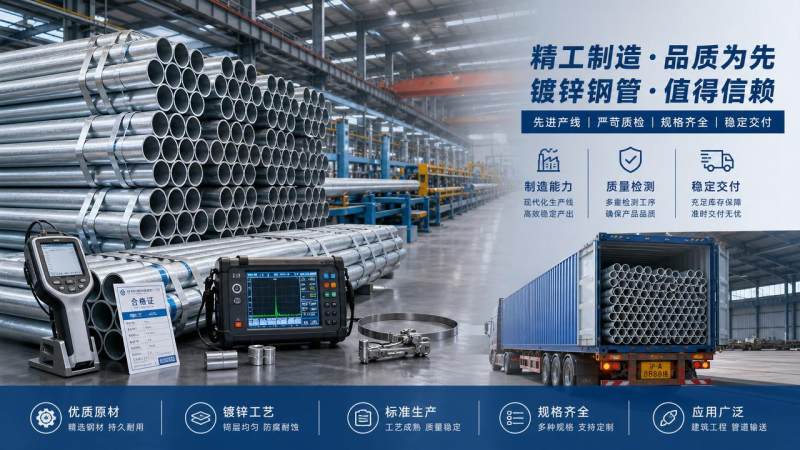
The core search intent behind galvanized steel pipe manufacturers is not simply finding a low-price source. Most buyers want a supplier that can deliver consistent quality, documentation, compliance, and dependable shipping performance.
For business decision-makers, the biggest concern is usually risk. A poor supplier can create coating failures, dimensional inconsistency, delayed delivery, claims, rework, and even project penalties that far outweigh initial price savings.
That is why the best evaluation method is practical. Instead of focusing only on quotations, buyers should assess production capability, quality systems, export experience, and how the manufacturer handles real supply-chain pressure.
Start with manufacturing capability, not sales promises
A reliable manufacturer should be able to explain its production process clearly, from raw material sourcing to forming, welding, galvanizing, inspection, packing, and shipment. Vague answers are often an early warning sign.
Ask whether the supplier operates its own manufacturing lines or depends heavily on subcontractors. Direct manufacturing control usually leads to better consistency, faster communication, and more stable delivery schedules for international orders.
Capacity also matters. A supplier may provide excellent samples, yet struggle with large-volume execution. Buyers should verify monthly output, lead-time stability, and whether peak-season orders can be supported without compromising quality.
For global projects, it is also useful to review whether the manufacturer already serves markets with demanding specifications, such as North America, Europe, the Middle East, or Southeast Asia.
Check whether the quality system is real and repeatable
Many galvanized steel pipe manufacturers mention quality control, but decision-makers should verify how that system actually works. Reliable suppliers can show inspection procedures, batch traceability, and records tied to each shipment.
Important checkpoints include steel grade verification, wall thickness tolerance, outside diameter consistency, zinc coating thickness, adhesion performance, and surface condition. These details directly affect service life and installation efficiency.
Ask for mill test certificates, coating reports, and standard compliance documents. If the supplier exports regularly, it should be familiar with ASTM, EN, JIS, or GB requirements depending on destination market needs.
A strong sign of reliability is process discipline. When inspection standards are integrated into production rather than applied only before shipment, the risk of hidden defects falls significantly.
Look beyond compliance labels and confirm standard matching
One common sourcing mistake is assuming all compliant products are equivalent. In reality, buyers need to confirm that pipe specifications match the actual project application, local regulation, and end-user expectations.
Reliable manufacturers will ask detailed technical questions before quoting. They should confirm size range, wall thickness, zinc coating method, intended environment, pressure or structural use, and the exact standard required for the project.
If a supplier offers a price without clarifying these items, that may indicate a transactional approach rather than a manufacturing partnership. Good manufacturers reduce ambiguity before production begins, not after goods arrive.
This approach matters especially for long-term sourcing programs, where repeatability across multiple shipments is more valuable than an isolated low-cost order.
Evaluate export experience and communication quality
For overseas buyers, communication quality is often as important as product quality. Delays in technical clarification, documentation errors, and weak shipment coordination can disrupt procurement timelines and increase internal management costs.
Experienced exporters usually respond with structured quotations, clear lead times, packing details, testing options, and realistic production schedules. Their teams understand customs documents, labeling requirements, and common cross-border risks.
Decision-makers should pay attention to how the supplier handles questions. Are answers specific? Are drawings reviewed carefully? Are exceptions identified early? Reliable communication is usually a sign of reliable execution.
It can also be useful to assess whether the manufacturer supports customized steel products beyond one category. Companies with broader structural steel expertise often understand project coordination better and can support integrated sourcing.
For example, some industrial buyers sourcing galvanized products also review related materials such as 304 Stainless Square steel rod for applications in manufacturing, decoration engineering, automotive parts, shipbuilding, and heavy equipment. Products in this category may be available in customized lengths, multiple surface finishes, and standards such as ASTM, AISI, JIS, GB, DIN, and EN. A supplier familiar with cross-category industrial requirements is often better prepared to support complex procurement needs.
Ask how the manufacturer manages raw materials and coating consistency
Galvanized steel pipe performance depends heavily on stable raw material quality and controlled galvanizing practice. Buyers should ask how steel coils or billets are sourced and whether incoming materials are tested before production.
Coating consistency is critical in corrosive or outdoor environments. Uneven zinc layers, poor adhesion, or surface contamination can shorten service life and trigger warranty disputes. These are not minor cosmetic issues.
Reliable manufacturers should be able to explain whether they use hot-dip galvanizing or another process, what coating thickness range is controlled, and how they verify corrosion protection performance for each batch.
If the supplier cannot clearly describe process control points, buyers should assume quality variation is likely, especially on larger or repeated orders.
Review delivery performance, not just quoted lead time
Many suppliers can promise fast delivery. Fewer can maintain dependable delivery when raw material markets fluctuate, peak season demand rises, or export logistics become unstable. Reliability means performance under pressure, not under ideal conditions.
Ask for recent examples of order sizes, production cycles, and export destinations. A reliable manufacturer should explain what lead times are normal, what variables may affect them, and how schedule risks are managed.
Packing also deserves attention. Poor export packing can damage pipe coatings during inland transportation or loading. Buyers should confirm bundle methods, end protection, marking, waterproof measures, and container loading practices.
For business leaders, predictable delivery often brings more value than the lowest initial price because it supports inventory planning, project scheduling, and customer commitments.
Use samples and audits to test supplier credibility
Before entering a large contract, buyers should validate supplier claims through samples, third-party inspection, or factory audits. This step helps confirm whether product quality and operational capability match what was presented during negotiation.
Samples should be reviewed for dimensions, finish, coating quality, and documentation accuracy. If the order is technically sensitive, involving a third-party inspection agency can provide additional confidence before mass production begins.
A factory audit does not need to be overly complicated. Even a focused review of equipment, process flow, inspection areas, and warehouse organization can reveal whether the manufacturer operates in a controlled and professional manner.
For strategic sourcing, this verification process often pays for itself by preventing costly procurement mistakes later.
Compare total sourcing value instead of unit price alone
Low quotations can be attractive, but experienced buyers know that total sourcing cost includes much more than the pipe price. Quality claims, schedule disruption, extra inspections, and replacement orders can quickly erode any apparent savings.
When comparing galvanized steel pipe manufacturers, decision-makers should evaluate total value: technical reliability, compliance support, lead-time stability, communication efficiency, and long-term cooperation potential.
A slightly higher-priced supplier may deliver stronger value if it reduces internal follow-up work, lowers claim risk, and supports smoother project execution. In B2B procurement, operational certainty is often a strategic advantage.
This is especially true for construction, industrial, and manufacturing projects where steel products are connected to larger timelines, safety expectations, and contractual obligations.
Signs that a manufacturer is worth shortlisting
In practical terms, dependable suppliers usually share several traits. They ask technical questions early, quote clearly, provide complete documents, and avoid unrealistic promises designed only to win the order quickly.
They also show stable production capability, familiarity with international standards, and willingness to support inspections or customized requirements. Their communication is consistent before and after payment, not only during initial sales contact.
Manufacturers with broader structural steel experience can be especially valuable. Companies serving global construction and industrial buyers often understand how product consistency, standard compliance, and delivery discipline affect downstream project performance.
For buyers seeking stable export supply from China, working with a professional structural steel manufacturer and exporter with modern facilities, strict quality control, and experience across international markets can significantly reduce sourcing risk.
Final decision: choose the supplier that lowers risk over time
The best way to spot reliable galvanized steel pipe manufacturers is to evaluate them through a business lens, not just a purchasing lens. Product quality matters, but so do process control, communication, compliance, and delivery reliability.
For enterprise decision-makers, the right manufacturer is one that helps protect project schedules, reduce operational uncertainty, and support long-term cost control. That is the real definition of sourcing value.
In short, shortlist suppliers that can prove manufacturing capability, demonstrate repeatable quality systems, match international standards accurately, and communicate with transparency. Those are the partners most likely to support sustainable procurement success.
Please give us a message


Please enter what you want to find