Reducing prefab structural steel lead time is critical for procurement teams balancing project schedules, cost control, and supplier reliability. By optimizing design coordination, material planning, fabrication workflows, and supplier communication, buyers can shorten delivery cycles without compromising quality. This guide explains practical ways to improve sourcing efficiency and secure dependable prefab structural steel supply for demanding construction and industrial projects.
What procurement teams really need to shorten prefab structural steel lead time
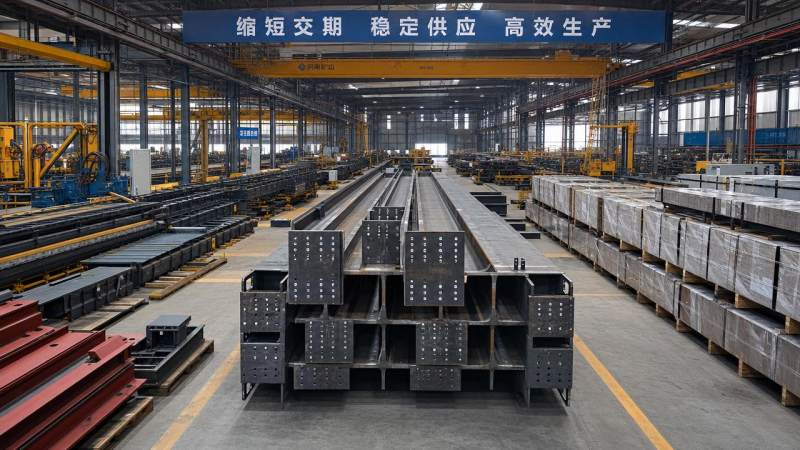
When buyers search for ways to reduce prefab structural steel lead time, they usually want practical actions, not theory. Their goal is to receive compliant steel faster while keeping project risk controlled.
For procurement professionals, the biggest delays rarely come from one single issue. Lead time is often extended by drawing revisions, unclear specifications, raw material gaps, production bottlenecks, inspection holds, and shipping uncertainty.
The most effective approach is to treat lead time as a supply chain process, not just a factory promise. Faster delivery depends on earlier coordination, cleaner documents, realistic fabrication planning, and reliable supplier execution.
If your project involves complex assemblies, customized profiles, or export shipping, cutting lead time requires procurement to act earlier in the project cycle. Waiting until final approval often means losing the best production window.
Where prefab structural steel lead time is usually lost
Before improving timelines, buyers need to understand where time is actually consumed. In many projects, the quoted production period is only part of the total delivery cycle.
Typical time loss begins during technical clarification. If section sizes, tolerances, material grades, coating requirements, welding standards, or packing instructions are incomplete, the supplier must stop and request confirmation.
Another common delay comes from design changes after production planning starts. Even minor adjustments to hole locations, cut lengths, or connection details can disrupt nesting plans, machine scheduling, and quality documentation.
Material availability also matters. Standard grades may be easy to source, but nonstandard dimensions or mixed specifications can increase waiting time, especially when mills require minimum order quantities or rolling schedules.
Export orders add another layer. Even if fabrication is finished on time, delays can happen during third-party inspection, container booking, port handling, customs documentation, or inland transportation to the loading terminal.
How to improve lead time before placing the purchase order
The fastest orders usually begin with the best preparation. Procurement can reduce prefab structural steel lead time significantly by improving RFQ quality before sending inquiries to suppliers.
Start by issuing a complete and coordinated technical package. Include drawings, bill of materials, material grades, tolerances, welding requirements, surface treatment, testing standards, packing expectations, and destination port details.
It also helps to distinguish what is fixed and what is flexible. If alternative grades, lengths, or packing methods are acceptable, state that clearly so the supplier can propose a faster manufacturing route.
Ask suppliers to break down lead time into stages instead of giving one total number. A stage-based quotation should cover material procurement, detailing confirmation, fabrication, inspection, packing, and shipment readiness.
This breakdown makes supplier comparison more meaningful. A low price with vague timing can create more project risk than a slightly higher offer with a clear and credible production schedule.
Why design coordination has a direct impact on delivery speed
In prefab structural steel projects, procurement and engineering cannot work in isolation. Every unresolved drawing issue creates uncertainty that can slow approval, purchasing, manufacturing, or inspection.
One of the best ways to shorten lead time is to freeze key fabrication details earlier. Buyers should push for early confirmation on member sizes, connection methods, hole patterns, weld categories, and finishing requirements.
If the project allows phased release, use it. Critical items can enter production first while lower-priority components remain under review. This helps protect the overall schedule without waiting for every drawing to be finalized.
Shop drawing approval discipline is equally important. Long response cycles from consultants or project teams can consume more time than fabrication itself. Clear turnaround responsibilities should be agreed before order release.
For international sourcing, use consistent standards across all documents. Mismatches between ASTM, EN, JIS, and GB references can create unnecessary review loops and delays during both production and inspection.
How supplier selection affects prefab structural steel lead time
Not every steel supplier is built to deliver prefab orders quickly. Buyers should assess lead time capability based on manufacturing reality, not only sales commitments.
First, confirm whether the supplier has in-house processing for cutting, punching, welding, forming, and finishing. The more operations completed internally, the lower the risk of delays caused by outsourced steps.
Second, review production capacity and scheduling discipline. A factory with stable output and organized planning is usually better positioned to absorb urgent orders than a supplier already overloaded with inconsistent workflows.
Third, evaluate export experience. A manufacturer may be strong in production but weak in documentation, packing, or shipment coordination. For overseas buyers, export execution is part of lead time performance.
Hongteng Fengda, as a structural steel manufacturer and exporter from China, supports global buyers with standardized production, customized processing, and compliance with major standards including ASTM, EN, JIS, and GB.
That matters because reliable lead times depend on both factory capability and cross-border order management. Procurement teams benefit when one supplier can align material control, fabrication quality, and shipping preparation.
Material planning strategies that help buyers move faster
Material planning is one of the most underestimated drivers of lead time. Even efficient factories can lose days or weeks if raw material sourcing starts too late or if the order uses difficult combinations.
Whenever possible, align design with commonly available steel grades and section ranges. Standardized material choices usually shorten procurement cycles and reduce the chance of mill-related waiting time.
Buyers handling repeated projects should also discuss rolling forecasts with key suppliers. Early volume visibility helps manufacturers reserve raw material, machine time, and labor capacity before the formal purchase order arrives.
Another smart strategy is to prioritize long-lead or custom items first. Special dimensions, heavy sections, or complex fabricated members should be identified at the beginning rather than discovered halfway through production planning.
For some industrial structure projects, using standardized beam products can support faster processing. For example, Structural Steel I Beam options are available in grades such as Q195-Q235, Q345, SS400, A36, and St52, with thicknesses from 4.5mm to 15.8mm and delivery time within 20 days.
When products are manufactured with stable tolerances, broad size ranges, and processing support such as cutting, punching, welding, and bending, procurement teams gain more flexibility to match speed with project requirements.
What to ask suppliers if you need a shorter delivery schedule
Many buyers ask for the shortest possible lead time, but not the right supporting details. To get a credible fast-delivery plan, procurement should ask more specific operational questions.
Start with raw material readiness. Ask whether the required grade and section are in stock, booked from a mill, or dependent on a new rolling schedule. The answer changes the timeline immediately.
Then ask about production constraints. Which operations are on the critical path? Is welding, drilling, galvanizing, painting, or inspection likely to become the bottleneck? Understanding this helps buyers prioritize decisions.
Request a realistic weekly schedule, not just a shipment promise. Milestones should include drawing confirmation, raw material arrival, first article fabrication, inspection date, packing completion, and cargo readiness.
Also ask what conditions must be met by your side to protect the schedule. Fast delivery often depends on timely approvals, deposit payment, document confirmation, and rapid response to technical questions.
How to reduce delays during fabrication and quality control
Quality issues are a major hidden cause of extended lead time. Rework, hold points, and repeated inspections can erase any speed advantage created during planning or production startup.
Procurement should confirm quality expectations in detail before fabrication begins. This includes dimensional tolerance, welding acceptance criteria, material traceability, coating thickness, marking rules, and required test records.
It is better to agree on an inspection and test plan early. If third-party inspection is required, booking should be arranged in advance rather than after production is already complete.
For urgent projects, consider progressive inspection instead of end-only inspection. Reviewing key stages during fabrication helps identify issues earlier and reduces the risk of a large batch being rejected late.
Clear communication channels are equally important. When NCRs, deviation requests, or clarification points arise, slow internal decision-making from the buyer side can become a direct source of factory delay.
Shipping and packaging decisions that influence total lead time
Many procurement teams focus heavily on fabrication days but underestimate logistics. In export projects, the final delivery schedule depends on what happens after steel leaves the workshop.
Packing method affects loading speed, damage risk, and customs handling. If members are bundled, marked, and documented properly, loading becomes more efficient and destination-site receiving also improves.
Container availability and vessel booking should be checked early, especially during busy seasons. A finished order can still miss the project schedule if shipping space is not reserved in time.
For oversized or mixed-component shipments, confirm cargo planning before production ends. Changes to packing sequence or loading layout at the last moment often create avoidable port-side delays.
Documentation should be treated as part of lead time management. Mill certificates, packing lists, inspection reports, invoices, and origin documents must be prepared accurately so customs clearance does not become the next bottleneck.
How buyers can balance faster lead time with cost and risk
Reducing prefab structural steel lead time does not always mean choosing the fastest quoted supplier. The real objective is achieving the best schedule outcome with acceptable cost, quality, and delivery reliability.
Expedited production may involve premium pricing, split shipments, alternate materials, or overtime processing. Buyers should evaluate whether these options create true project savings or only shift cost elsewhere.
Sometimes the best decision is not full acceleration but smarter sequencing. Receiving critical members first can protect construction progress while less urgent items follow in a second batch.
Risk evaluation should also include supplier consistency. A manufacturer that routinely delivers within a controlled timeframe may be more valuable than one that promises an extremely short lead time but lacks execution discipline.
For procurement teams, the right question is not only “How fast?” but “How reliably fast under actual project conditions?” That distinction is what separates a realistic sourcing strategy from a risky one.
A practical checklist to reduce prefab structural steel lead time
Buyers can improve results quickly by applying a structured process. First, prepare complete RFQ documents and eliminate specification gaps before requesting quotations.
Second, identify long-lead items, custom components, and approval-sensitive details early. These are usually the parts that control the schedule more than standard items do.
Third, select suppliers with proven fabrication capacity, export experience, and transparent scheduling. Ask for milestone-based timelines instead of broad delivery promises.
Fourth, align engineering, procurement, quality, and logistics from the start. Lead time shrinks when decisions move smoothly across departments instead of stopping at each handover.
Fifth, monitor progress actively after order release. Regular updates on material readiness, production status, inspection planning, and shipment booking help prevent surprises late in the cycle.
Conclusion
The most effective way to reduce prefab structural steel lead time is to improve control before, during, and after production. Procurement has a major influence through document quality, supplier selection, material planning, and approval speed.
For buyers sourcing globally, dependable lead time comes from a combination of manufacturing capability, quality consistency, and export coordination. Faster delivery is possible, but only when the full process is managed carefully.
If you treat prefab structural steel as a coordinated supply chain rather than a simple commodity purchase, you can shorten schedules, reduce sourcing risk, and support better project outcomes with more confidence.
Please give us a message


Please enter what you want to find