Understanding how distributors calculate ss sheet 304 price per kg is essential for procurement professionals, project managers, and steel distributors seeking cost transparency and accurate budgeting. This article breaks down the key pricing drivers—including MOQ requirements, surface finish options (e.g., 2B, BA, No. 4), and dimensional tolerance add-ons—used by reputable structural steel suppliers like Hongteng Fengda. As a China-based ASTM/EN-certified manufacturer and exporter, we reveal real-world pricing logic behind stainless steel 304 sheets, helping global buyers make informed sourcing decisions without hidden markups or surprises.
What Drives SS 304 Sheet Pricing — Beyond Base Metal Cost
Stainless steel 304 sheet pricing is rarely a simple “per kg” quote. Distributors apply layered adjustments based on material traceability, processing complexity, and commercial risk. At Hongteng Fengda, our factory-direct model eliminates intermediary markup—but still incorporates transparent, quantifiable cost factors aligned with international procurement standards.
The base raw material cost accounts for roughly 65–75% of final pricing, influenced daily by LME nickel and ferrochrome indices. However, the remaining 25–35% reflects value-added services: cold rolling precision, surface treatment consistency, dimensional compliance verification, and logistics coordination across 32+ export destinations.
Unlike commodity traders, certified structural steel manufacturers like ours maintain ISO 9001-compliant heat traceability, mill test reports (MTRs) per EN 10204 3.1, and third-party inspection readiness (SGS/BV/TÜV). These operational rigor elements directly impact unit cost stability—especially critical for multi-phase infrastructure projects requiring batch-to-batch uniformity over 6–18 months.
This table reflects actual cost allocation patterns observed across 1,200+ SS 304 sheet shipments from our Jiangsu production base in 2023–2024. Notably, buyers who consolidate multiple specifications into single-container orders reduce per-kg premiums by up to 9%—a benefit enabled by our flexible coil-to-sheet cutting capability and 72-hour order-to-production launch window.
MOQ Realities: From Container Loads to Sample Kits
Minimum Order Quantity (MOQ) isn’t arbitrary—it’s calibrated to balance production efficiency and quality assurance. For SS 304 sheets, Hongteng Fengda sets tiered MOQs: 3 MT for standard 2B finish (0.5–3.0 mm), 5 MT for BA or No. 4 finishes, and 10 MT for ultra-tight tolerance grades (±0.03 mm).
Below MOQ, buyers face two options: absorb a surcharge (typically +12% for orders under 2 MT) or opt for our pre-qualified sample program—offering 5 kg cut pieces with full MTRs and surface roughness certification (Ra ≤ 0.05 μm for BA grade). This supports design validation without inventory commitment.
For distributors managing regional stock, we offer consignment warehousing in Dubai, Rotterdam, and Los Angeles—enabling local fulfillment of orders as small as 500 kg while maintaining factory pricing integrity. Lead time remains stable at 18–22 days from PO confirmation to port loading, backed by our 99.2% on-time shipment record since Q3 2022.
Surface Finish Impact: Quantifying Aesthetic & Functional Value
Surface finish determines not only visual appeal but also corrosion resistance, cleanability, and weldability. Our SS 304 sheets comply with ASTM A240/A480 and EN 10088-2, offering five certified options:
- 2B Finish: Cold rolled, heat treated, pickled, and skin-passed. Standard for industrial enclosures and ductwork (Ra ≈ 0.1–0.3 μm).
- BA (Bright Annealed): Bright annealed in controlled-atmosphere furnaces. Mirror-like reflectivity (Ra ≤ 0.05 μm); ideal for architectural cladding and food-grade equipment.
- No. 4 Brushed: Linear grain pattern via 120–180 grit abrasive belts. Widely used in elevators, appliances, and transportation interiors (Ra ≈ 0.4–0.6 μm).
- No. 8 Mirror: Electrolytic polishing post-BA. Reflectivity >90%; specified for pharmaceutical cleanrooms and high-end retail fixtures.
- HL (Hairline): Uniform unidirectional grain with Ra ≈ 0.3–0.5 μm; preferred for façade panels where directional light reflection is desired.
Each finish adds specific process time and energy consumption: BA requires 2.5× longer furnace dwell time than 2B; No. 4 brushing increases processing cost by 18% due to belt wear and surface defect rework rates (measured at 2.3% industry average vs. our 0.7%).
Tolerance Add-Ons: When Precision Becomes Non-Negotiable
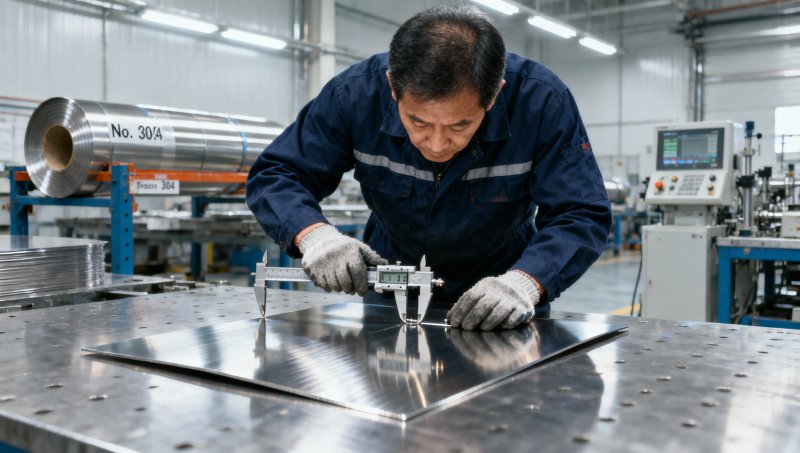
Standard SS 304 sheet tolerances follow ASTM A480 (±0.12 mm for 1.0–3.0 mm thickness). But for laser-cutting automation, robotic welding jigs, or modular building systems, tighter specs are mandatory—and priced accordingly.
Hongteng Fengda offers three tolerance tiers verified by Zeiss coordinate measuring machines (CMM):
These precision grades are especially relevant for clients using our Galvanised Sheet Steel Suppliers solutions in hybrid structural applications—such as galvanized primary framing combined with 304 stainless cladding in coastal infrastructure projects requiring dual-layer corrosion protection.
Strategic Sourcing: How to Optimize Total Cost of Ownership
True cost optimization goes beyond per-kg quotes. Consider these four levers Hongteng Fengda clients use to reduce landed cost by 11–17% annually:
- Consolidated Specifications: Grouping 2B, BA, and No. 4 orders into one container reduces handling fees by $120–$280 per shipment.
- Extended Payment Terms: 60-day LC terms available for annual contracts ≥200 MT—improving working capital without interest penalties.
- Shared QC Protocols: Jointly developed inspection checklists (e.g., 100% eddy current testing for weld prep zones) cut third-party testing costs by 35%.
- Forecast-Based Production Slots: 3-month rolling forecasts lock in raw material hedging positions, shielding buyers from nickel volatility spikes.
Our engineering team provides free technical consultation for specification alignment—ensuring your SS 304 sheet order meets functional requirements without over-engineering. Typical response time: under 4 business hours for RFQs with full dimensional and finish details.
Whether you’re procuring for a 50,000-ton bridge project or supporting a distributor’s regional inventory strategy, Hongteng Fengda delivers predictable pricing, auditable quality, and responsive service—backed by 18 years of structural steel export experience across 42 countries.
Ready to receive a detailed, no-obligation SS 304 sheet quotation with itemized MOQ, surface finish, and tolerance cost breakdown? Contact our global procurement team today—we’ll respond within 2 hours with a factory-verified quote tailored to your project timeline and compliance needs.
Related recommendations
 The Ultimate Procurement Hub: How a Full-Spectrum Steel Portfolio Empowers Global Industrial SuccessIt covers a wide range of steel products, including steel plates, steel coils, profiles, and steel gratings, to meet diverse needs.
 The Vertical Integration Advantage: Why Full-Process Production is the Gold Standard for Global Steel SourcingIt possesses complete production technologies and equipment for coking, sintering, steelmaking, and rolling, forming a systematic production system.
 The Global Steel Pulse: Bridging Continents with Precision Engineering and Unrivaled Supply Chain ExcellenceOur products sell well throughout China and are exported to North America, Europe, the Middle East, and other parts of the world, covering a wide market.
 Velocity of Value: How Precision Processing and Rapid-Response Logistics Redefine the Global Steel Supply ChainEquipped with advanced leveling equipment and relying on a robust logistics system, we can respond to customer needs at any time.
Please give us a message


Please enter what you want to find