Why lead time risk matters in steel sourcing scenarios
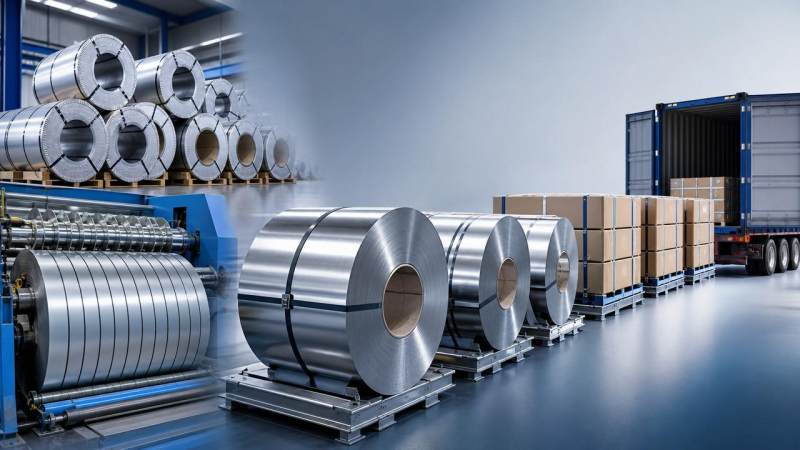
For procurement and evaluation teams, lead time risk can directly affect project budgets, delivery schedules, and supplier confidence.
A reliable stainless steel coil manufacturer reduces that risk through stable production planning, raw material control, quality consistency, and export experience.
Understanding how manufacturers manage lead times helps buyers make better sourcing decisions, avoid costly delays, and build a more resilient steel supply chain.
In steel projects, timing is rarely a simple calendar issue.
It shapes installation sequences, labor allocation, vessel booking, and cash flow release.
A qualified stainless steel coil manufacturer understands that different applications carry different timing pressures.
That is why lead time control must be scenario-based, not only production-based.
How project scenarios change lead time expectations
Lead time risk looks different across construction, fabrication, equipment production, and export replenishment.
The same stainless steel coil manufacturer may face very different service expectations in each case.
Scenario 1: Fixed-deadline construction schedules
Construction projects often work backward from site milestones.
If coil arrival slips, cutting, forming, and installation can all move off plan.
A dependable stainless steel coil manufacturer protects this scenario with realistic production slots and shipment coordination.
It also confirms grades, thicknesses, and surface requirements early to avoid engineering changes later.
Scenario 2: Continuous manufacturing supply
Factories need regular inbound steel to keep lines running.
Here, one late lot can stop output and increase urgent purchasing costs.
An experienced stainless steel coil manufacturer reduces this risk with rolling forecasts, safety stock planning, and repeat-spec production control.
Stable process discipline matters more than promising the shortest possible lead time.
Scenario 3: Export orders with complex documentation
Cross-border steel supply adds paperwork, inspection, packaging, and port scheduling pressure.
In this case, a stainless steel coil manufacturer must manage more than mill output.
It needs document accuracy, customs familiarity, and booking flexibility.
This is especially important when delivery windows are tied to project mobilization overseas.
What a stainless steel coil manufacturer does to control lead time risk
Lead time control begins long before the order reaches the production line.
The strongest suppliers build risk resistance into sourcing, planning, processing, and shipping.
Raw material planning and mill coordination
A capable stainless steel coil manufacturer does not wait for shortages to appear.
It tracks upstream availability, books material windows, and balances standard versus custom orders.
When grades or finishes are less common, early reservation becomes critical.
This reduces sudden schedule extensions caused by raw material gaps.
Production scheduling with realistic capacity
Overpromising creates more risk than conservative planning.
A responsible stainless steel coil manufacturer aligns order intake with line capacity, maintenance time, and process complexity.
This matters when slitting, recoiling, polishing, or protective packaging are included.
Clear scheduling improves delivery reliability and communication credibility.
Quality stability that prevents hidden delays
Rejected material creates the worst kind of delay because it happens after planned production time.
A strong stainless steel coil manufacturer controls chemistry, dimensions, surface condition, and traceability from the start.
Consistent quality reduces rework, dispute time, and emergency replacement shipments.
That makes the original lead time more dependable in practice.
Mid-project supply decisions often depend on compatible steel solutions
Many buyers source more than coils during the same project cycle.
Structural items may need synchronized planning to avoid staggered site arrivals.
For example, Structural Steel Channel may be required alongside other steel materials.
It is widely used in building structure, curtain wall engineering, mechanical equipment, vehicle manufacturing, room beam, ship beam, and industrial furnace projects.
Common models include 5-40# and 6.5-30#, with lengths of 6m, 9m, 12m, or custom requirements.
Available materials include A36, Q235B, Q345B, S235JR, S355JR, A572 GR50, and other international grades.
Its tensile strength can reach ≥520MPa, and finishing options include galvanized and paint.
With ISO, SGS, BV, ASTM, AISI, JIS, GB, DIN, and EN references, coordinated sourcing can reduce schedule fragmentation.
How lead time needs differ across steel purchasing scenarios
Practical ways to evaluate a stainless steel coil manufacturer before ordering
Lead time promises should always be tested against process evidence.
The following checks are useful before committing volume.
- Ask for standard lead times by grade, thickness, width, and finish.
- Confirm whether raw material is stocked or purchased after order release.
- Review export experience, packaging method, and port booking process.
- Check how quality issues are handled without extending delivery unnecessarily.
- Request recent examples of on-time shipments for similar steel orders.
A trustworthy stainless steel coil manufacturer can explain these points clearly.
Vague answers usually signal weak internal control.
Common mistakes that increase lead time risk
Some delays are caused by market conditions.
Others come from preventable misunderstandings during supplier selection.
- Choosing only by quoted price while ignoring schedule discipline.
- Assuming standard lead times apply to customized processing.
- Approving technical details too late in the order cycle.
- Ignoring holiday periods, vessel congestion, or documentation lead time.
- Treating quality claims and delivery claims as separate issues.
A professional stainless steel coil manufacturer helps prevent these mistakes through early clarification and disciplined follow-up.
What reliable steel partners do differently
Reliable steel exporters combine production capability with communication discipline.
That combination matters when schedules are tight and specifications are detailed.
Hongteng Fengda, as a structural steel manufacturer and exporter from China, supports global projects with stable production capacity and strict quality control.
With experience across North America, Europe, the Middle East, and Southeast Asia, the company understands timing, standards, and export coordination.
That broader supply experience is valuable when buyers compare any stainless steel coil manufacturer for long-term sourcing reliability.
Next-step guidance for lower-risk steel sourcing
The best sourcing decision is not the shortest quoted lead time.
It is the most controllable and verifiable one.
When evaluating a stainless steel coil manufacturer, compare planning methods, raw material strategy, quality consistency, and export execution.
Then match those strengths to the actual project scenario.
If the order involves multiple steel categories, align delivery timing early to reduce overall project risk.
A structured review today can prevent delays, disputes, and cost pressure later.
Please give us a message


Please enter what you want to find