For reliable stainless steel sourcing, choosing a qualified 316 stainless steel pipe manufacturer is never only about unit price.
Quality control affects compliance, service life, corrosion resistance, project safety, and delivery confidence.
From raw material verification to final inspection, every step must be measurable, documented, and repeatable.
This guide explains how a professional 316 stainless steel pipe manufacturer controls quality for demanding industrial and construction applications.
How does a 316 stainless steel pipe manufacturer define quality?
A reliable 316 stainless steel pipe manufacturer defines quality before production begins.
Quality is not a final inspection activity only.
It is a complete control system covering materials, process, dimensions, surface condition, testing, packing, and traceability.
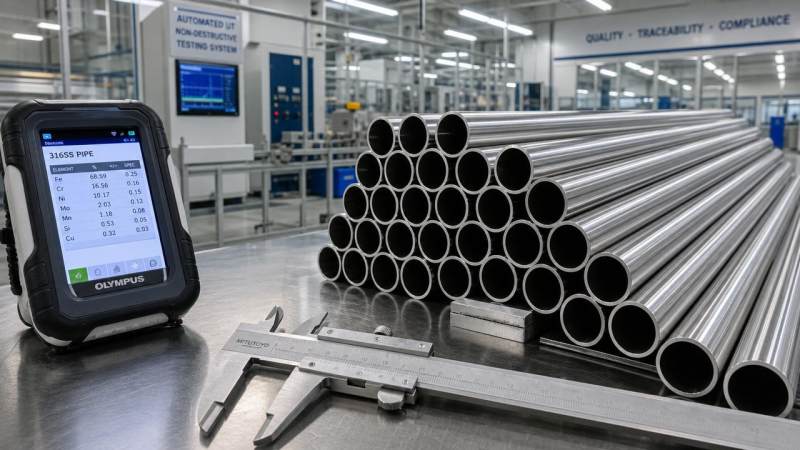
316 stainless steel contains molybdenum, which improves resistance to chloride corrosion.
Because of this, it is widely used in chemical plants, marine structures, food equipment, and outdoor piping systems.
If composition, heat treatment, or surface control is weak, the expected corrosion resistance may decline.
A qualified 316 stainless steel pipe manufacturer normally builds control points around international standards.
- Material grade verification before production.
- Dimensional control during forming or welding.
- Mechanical testing based on order requirements.
- Surface inspection for defects and contamination.
- Final documentation for traceability.
Hongteng Fengda applies this quality thinking across structural steel and customized steel supply.
Its experience with ASTM, EN, JIS, and GB standards helps reduce sourcing uncertainty.
What raw material checks should a 316 stainless steel pipe manufacturer perform?
Raw material is the first risk point.
A serious 316 stainless steel pipe manufacturer confirms chemical composition before releasing material to production.
The key elements include chromium, nickel, molybdenum, carbon, manganese, phosphorus, and sulfur.
The molybdenum level is especially important for 316 stainless pipe performance.
Material test certificates should match the heat number, grade, size, and applicable standard.
When certificates are incomplete, the 316 stainless steel pipe manufacturer should arrange spectrometer testing or third-party verification.
Why is traceability important?
Traceability links each pipe to its heat number, production batch, inspection record, and packing list.
This prevents material mixing and supports later quality claims or project audits.
A dependable 316 stainless steel pipe manufacturer keeps records clear from incoming material to shipment.
For broader steel programs, similar discipline also applies to other products.
For example, High Carbon Steel Plate requires controlled chemistry, tensile strength, hardness, and surface consistency.
Its specifications may cover Width100mm-3000mm, Length1m-12m, and Thickness0.1mm-400mm.
This shows how documented control supports both stainless pipe and carbon steel supply.
How is production controlled during pipe manufacturing?
Production control depends on whether the pipe is seamless or welded.
A capable 316 stainless steel pipe manufacturer defines procedures for each route.
For welded pipe, edge preparation, forming accuracy, welding parameters, and weld bead treatment are essential.
For seamless pipe, billet quality, piercing, rolling, sizing, and heat treatment must be closely controlled.
Process records should include machine settings, operator checks, inspection frequency, and corrective actions.
A stable 316 stainless steel pipe manufacturer does not rely on experience alone.
It uses standard operating procedures and measurable tolerances.
Which production defects need attention?
- Wall thickness deviation beyond tolerance.
- Ovality affecting installation fit.
- Weld undercut, porosity, or lack of fusion.
- Surface scratches, dents, or embedded iron particles.
- Improper pickling, passivation, or polishing.
Each defect may create leakage, corrosion, assembly delay, or rejection at site.
That is why an experienced 316 stainless steel pipe manufacturer inspects during production, not only after completion.
What tests confirm stainless steel pipe quality?
Testing confirms whether the pipe meets the order standard and application requirement.
A professional 316 stainless steel pipe manufacturer selects tests based on grade, process, size, and end use.
Common tests include dimensional inspection, chemical analysis, tensile testing, flattening testing, and hardness checks.
For pressure or critical applications, hydrostatic testing or eddy current testing may be required.
Ultrasonic testing can help identify internal discontinuities in suitable pipe types.
Visual inspection remains important because surface defects may influence corrosion resistance.
A trusted 316 stainless steel pipe manufacturer provides test reports with clear batch references.
Reports should be easy to compare with the purchase order and standard requirements.
How should standards and tolerances be evaluated?
Standards define the acceptance baseline.
A 316 stainless steel pipe manufacturer may produce according to ASTM, ASME, EN, DIN, JIS, or GB requirements.
The correct standard depends on destination market, engineering design, pressure rating, and inspection expectations.
Tolerance details should be confirmed before production.
These include outside diameter, wall thickness, length, straightness, end finish, and surface finish.
Misunderstood tolerances often cause disputes even when the pipe grade is correct.
What documents should be requested?
- Material test certificate with heat number.
- Dimensional inspection report.
- Mechanical test report when required.
- Nondestructive testing report when specified.
- Packing list and traceability labels.
A transparent 316 stainless steel pipe manufacturer will not avoid documentation questions.
Instead, it explains available records and any testing limits before order confirmation.
What quality risks appear during packing and delivery?
Quality can be damaged after inspection if packing is weak.
A careful 316 stainless steel pipe manufacturer protects pipes from scratches, moisture, deformation, and mixed batches.
Stainless steel should be separated from carbon steel contamination where necessary.
Pipe ends may need caps, bundling, waterproof wrapping, or wooden cases.
Labels should show grade, size, heat number, quantity, standard, and destination details.
Delivery reliability also reflects quality management.
Late shipments can disrupt construction, fabrication, and equipment installation schedules.
Hongteng Fengda supports global steel buyers with stable production capacity and dependable lead times.
Its structural steel export experience helps coordinate packing, documentation, and logistics for international projects.
How can a supplier be judged before ordering?
A 316 stainless steel pipe manufacturer should be assessed through evidence, not promises.
Factory capability, inspection equipment, standard knowledge, and export experience all matter.
Sample inspection can confirm surface finish, tolerance control, marking, and documentation style.
For larger projects, pre-shipment inspection or third-party inspection may be useful.
Price should be reviewed together with inspection scope, tolerance level, packing method, and after-sales response.
The lowest quote may become costly if rejection, delay, or replacement occurs.
FAQ: common questions about 316 stainless steel pipe quality
Is 316 always better than 304?
316 offers better chloride resistance because it contains molybdenum.
However, the best grade depends on environment, temperature, fluid, pressure, and cost target.
Can visual inspection replace testing?
No.
Visual inspection finds surface problems, but it cannot confirm full chemistry, strength, or internal defects.
Why do two suppliers quote different prices?
Differences may come from raw material source, wall tolerance, testing level, surface finish, order quantity, and delivery terms.
When is third-party inspection useful?
It is useful for critical projects, new supplier approval, large orders, or strict compliance requirements.
What is the most common mistake when sourcing?
The common mistake is confirming price before confirming standard, tolerance, testing, packing, and documentation.
Conclusion: build quality into every sourcing step
A dependable 316 stainless steel pipe manufacturer controls quality through the whole supply chain.
The strongest results come from verified materials, controlled production, accurate testing, complete documents, and safe delivery.
Before placing an order, confirm grade, standard, dimensions, tolerance, inspection scope, surface finish, and packing details.
Hongteng Fengda provides reliable steel products and customized solutions for global construction, industrial, and manufacturing projects.
For stainless pipe or structural steel sourcing, share drawings, standards, and application conditions to receive a practical supply proposal.
Please give us a message


Please enter what you want to find