Sourcing galvanized steel sheet China requires more than just comparing prices—it means understanding realistic lead times, MOQ terms, and supplier reliability. For distributors, agents, and trading partners, this guide explains what affects delivery schedules, order flexibility, and export performance, helping you choose a dependable Chinese steel supplier and reduce purchasing risk.
What buyers really want to know before ordering from China
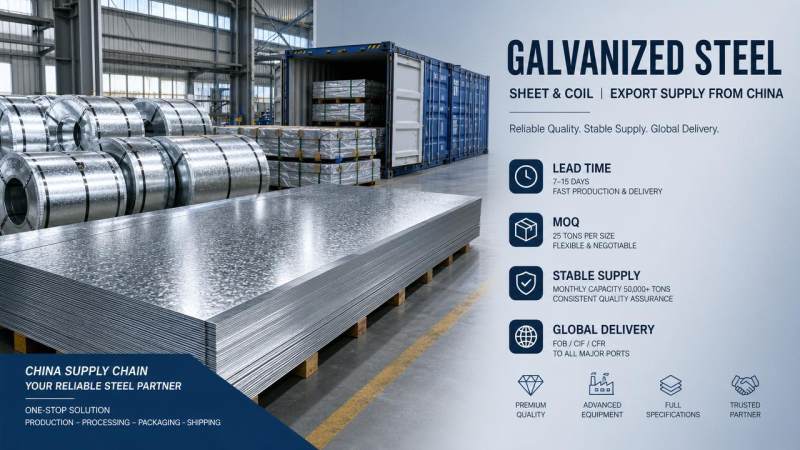
For most distributors and trading companies, the real question is not whether China can supply galvanized steel sheet, but how predictably it can supply it.
When buyers search for galvanized steel sheet China, they usually want practical answers on delivery time, minimum order quantity, export handling, and supplier consistency.
Price matters, but for channel partners, missed delivery windows, unstable quality, and inflexible order terms can create bigger costs than a slightly higher unit rate.
The overall market reality is simple: Chinese suppliers can offer strong value, but lead time and MOQ vary widely by mill type, coating requirement, thickness range, and order customization.
If you are buying for resale or project supply, the best decision comes from balancing factory capability, stock position, processing flexibility, and shipping readiness.
What is a realistic lead time for galvanized steel sheet China orders?
Lead time depends first on whether the material is ex-stock, made from standard rolling plans, or produced against a custom order.
For stock-based galvanized steel sheet China purchases, lead time can be as short as a few days to one week before inland transport and port booking.
For standard production orders, many exporters quote roughly two to five weeks, depending on zinc coating, dimensions, and current production schedules.
For customized orders, especially with special widths, strict tolerance, slitting, cutting, or branded packaging, lead time often extends to four to eight weeks.
Export timing also includes document preparation, trucking, customs coordination, and vessel space. Buyers who ignore these steps often underestimate total fulfillment time.
During peak steel demand cycles or before long holidays, such as Lunar New Year, delivery can stretch noticeably even when the supplier itself is responsive.
A practical buyer should therefore ask for two timelines: production lead time and total ex-works-to-on-board shipping time.
What factors most often delay delivery?
The first major factor is raw material and mill scheduling. If the supplier relies on upstream coils from partner mills, availability directly affects production start dates.
The second factor is specification complexity. Uncommon thicknesses, nonstandard widths, high coating requirements, or special surface treatment usually reduce scheduling flexibility.
Third is order size. Very small orders may wait longer because factories try to combine them with similar production runs for better efficiency.
Fourth is finishing and packaging. Cut-to-length sheets, palletized export packing, waterproof protection, and customer-specific marks all add processing time.
Fifth is logistics. Port congestion, vessel rollovers, container shortages, and customs inspection can affect even well-produced orders.
Finally, communication itself can cause delays. If the buyer confirms specifications slowly or changes details after production planning, the original lead time may no longer apply.
How MOQ works in the Chinese steel supply chain
MOQ does not always mean one fixed number. In China’s steel trade, MOQ usually reflects production economics, stock handling efficiency, and export cost structure.
For stock material, some suppliers can support lower MOQs because the goods already exist and only need packing and shipment coordination.
For mill-based or customized production, MOQ is often tied to each thickness, width, coating class, or color requirement, especially when coils must be produced specifically.
Distributors should distinguish between minimum trial order quantity, minimum quantity per specification, and minimum container loading requirement.
A supplier may accept a small total order, but only if each item meets practical batching rules or if the buyer accepts mixed stock specifications.
This is why some quotations look flexible at first, but become restrictive once exact dimensions and coating details are finalized.
What MOQ range should distributors expect?
There is no universal MOQ for galvanized steel sheet China sourcing, but trading companies should expect clear differences between stock business and production business.
For standard items available in inventory, MOQ may be relatively low, especially if the supplier regularly exports mixed loads for overseas distributors.
For custom sheet production, MOQ often increases because setup cost, coating line efficiency, and packing cost must be spread across enough tonnage.
In export practice, many suppliers also prefer orders that support efficient container utilization, since freight economics matter to both sides.
If your business model relies on testing new markets, ask whether the supplier supports mixed specifications in one container or phased repeat orders after a trial shipment.
That conversation often reveals whether the supplier truly understands distributor needs or only wants large one-off factory orders.
How to reduce MOQ pressure without increasing risk
Buyers who do not want to commit to large volume too early have several negotiation options that are more realistic than simply asking for a lower MOQ.
First, choose standard grades and dimensions that match the supplier’s regular production or stock program. This makes smaller orders easier to accept.
Second, combine multiple compatible items in one shipment, especially if the supplier can consolidate related steel products for export.
Third, simplify packaging and avoid unnecessary customization in the trial order phase. Special labels and branded wrapping can raise minimum requirements.
Fourth, build a repeat-order plan. Many factories become more flexible if they see a realistic quarterly or annual purchasing path instead of a one-time inquiry.
Fifth, ask whether substitute specifications can meet your market needs. A slightly adjusted width or coating option may unlock better availability and lower MOQ.
How reliable suppliers present lead time and MOQ information
Dependable suppliers usually explain lead time and MOQ with conditions, not just with attractive headline numbers.
They clarify whether timing starts from deposit receipt, technical confirmation, or raw material allocation. They also define whether the quote is ex-works, FOB, or CIF based.
For MOQ, a reliable exporter explains what applies per item, per thickness, per color, or per container, so the buyer can plan commercial decisions accurately.
Good suppliers also mention what could change the schedule, such as zinc layer requirements, holiday closure, or testing and inspection requests.
If a factory promises extremely fast delivery and unusually low MOQ for every specification, experienced buyers should verify whether this reflects actual capacity or only sales language.
Why product range matters when evaluating a Chinese supplier
Distributors often focus on one item, but supplier breadth can reduce sourcing risk and improve shipment efficiency over time.
For example, some buyers of galvanized sheet also need coated sheet products for roofing, cladding, appliances, or fabricated applications in their local markets.
In such cases, sourcing from a supplier with compatible product capability can simplify communication and mixed-container planning.
One example is Color Coated Galvalume Steel Coil PPGL, which is used in construction panels, transport components, appliances, furniture, shutters, and signage.
Its thickness range of 0.13mm to 0.8mm and width range of 600mm to 1250mm support varied downstream requirements, while custom length options improve order flexibility.
With finishes based on the RAL color card and paint systems such as PE, SMP, HDP, and PVDF, it fits markets that need both corrosion resistance and visual appeal.
For distributors, access to adjacent coated steel products can improve container utilization and create cross-selling opportunities without adding new supplier management complexity.
What distributors and agents should ask before placing an order
Before confirming any galvanized steel sheet China purchase, buyers should ask for a specification-based lead time, not a generic company lead time.
Request the exact production standard, thickness tolerance, zinc coating level, surface condition, packing method, and shipping term in writing.
Ask whether the quoted MOQ is based on tons, pieces, container quantity, or per-specification batching.
Confirm whether the supplier can provide mill test certificates, export packing photos, pre-shipment inspection support, and loading updates.
It is also useful to ask what percentage of their business is export, which markets they serve, and whether they routinely work with distributors rather than only end users.
Experienced exporters usually answer these questions clearly because they understand the commercial pressure faced by overseas intermediaries.
How to judge supplier reliability beyond price
For channel buyers, supplier reliability is a combination of manufacturing discipline, export process control, and communication quality.
Look for evidence of stable production capacity, standard compliance, and familiarity with ASTM, EN, JIS, or GB requirements where relevant to your market.
A trustworthy supplier should also show consistent document handling, practical packaging standards, and realistic responses about production scheduling.
Another strong signal is whether the supplier helps you reduce risk by proposing workable alternatives when a requested specification causes delay or excessive MOQ.
Factories with long-term export experience generally focus on repeatability, because they know distributors value continuity more than one unusually cheap shipment.
For this reason, assessing service responsiveness is just as important as checking the product itself.
How Hongteng Fengda fits practical sourcing needs
For buyers looking for a structural steel manufacturer and exporter from China, Hongteng Fengda positions itself around reliability, customization, and export consistency.
Its business covers angle steel, channel steel, steel beams, cold formed steel profiles, and customized structural steel components for global projects.
For distributors and agents, this matters because sourcing stability often improves when a supplier has modern facilities, strict quality control, and experience with international standards.
Serving North America, Europe, the Middle East, and Southeast Asia also suggests familiarity with export expectations, documentation needs, and schedule discipline.
Most importantly, the company’s value proposition aligns with what trading partners actually need: stable capacity, dependable lead times, and lower sourcing risk.
Final takeaway for buyers of galvanized steel sheet China
If you are sourcing galvanized steel sheet China, the smartest approach is to evaluate total supply performance rather than headline price alone.
Realistic lead time depends on stock position, specification complexity, production scheduling, and shipping coordination. MOQ depends on whether the order is standard, mixed, or customized.
For distributors, agents, and resellers, the best supplier is usually the one that communicates clearly, offers workable flexibility, and performs consistently over repeat orders.
By asking the right questions early and comparing suppliers on delivery reliability as well as cost, you can reduce purchasing risk and improve market responsiveness.
In short, good sourcing decisions come from clear specifications, practical MOQ planning, and partnership with an exporter that understands global trade realities.
Please give us a message


Please enter what you want to find