When sourcing A36 Carbon Steel Round Bar for heavy duty use, distributors must rigorously verify mill test reports (MTRs) and full material traceability—especially for structural applications, industrial use, and mission-critical projects. This distributor checklist ensures compliance with ASTM A36 specifications while mitigating supply chain risk. As a trusted structural steel manufacturer and exporter from China, Hongteng Fengda provides fully traceable, certified A36 Carbon Steel Round Bar—backed by rigorous QC, international standards (ASTM/EN/GB), and real-time batch documentation. Whether you're a procurement officer, project manager, or global distributor, accurate verification starts here.
Why Mill Test Reports Are Non-Negotiable for A36 Carbon Steel Round Bar for Structural Applications
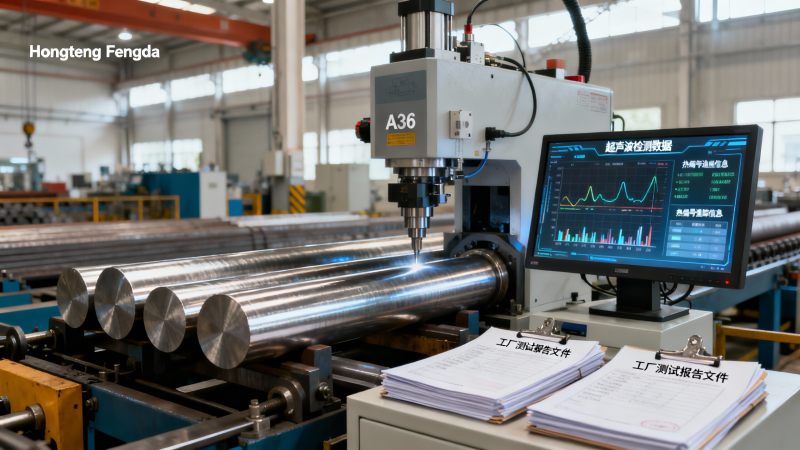
Mill Test Reports are not administrative formalities—they are the foundational evidence of metallurgical integrity, dimensional conformity, and process accountability. For A36 Carbon Steel Round Bar for structural applications, where load-bearing performance directly impacts life safety and long-term asset durability, an incomplete or unverifiable MTR introduces unacceptable liability. ASTM A36 mandates specific mechanical properties: minimum yield strength of 36 ksi (250 MPa), tensile strength between 58–80 ksi (400–550 MPa), and elongation of at least 20% in 8 inches. But these values mean little without traceable correlation to heat number, rolling batch, chemical analysis (C ≤ 0.26%, Mn ≤ 1.05%, P ≤ 0.04%, S ≤ 0.05%), and post-rolling condition (as-rolled or stress-relieved). At Hongteng Fengda, every coil and bar is assigned a unique heat ID linked to real-time furnace logs, spectrographic scans, and ultrasonic testing records. Distributors should insist on MTRs that include third-party witnessed testing—not just internal lab stamps—and confirm that the report references actual test specimens cut from the same heat and lot supplied. Missing heat numbers, mismatched batch IDs, or generic “typical values” instead of measured data are red flags demanding immediate escalation. In North American bridge rehabilitation projects or Middle Eastern refinery expansions, regulatory auditors routinely reject shipments lacking MTRs with full ASTM E29 compliance notation and certified signatory authority.
Traceability Beyond the Certificate: From Furnace to Final Inspection
True traceability extends far beyond a stamped MTR—it requires end-to-end digital and physical linkage across the production chain. For A36 Carbon Steel Round Bar for industrial use, especially in sectors like power transmission towers or offshore platform foundations, material pedigree must survive transport, cutting, threading, and welding. Hongteng Fengda embeds traceability into every operational layer: raw material certificates from iron ore and scrap suppliers are cross-referenced with ladle analyses; continuous casting logs record temperature gradients and withdrawal speeds; hot rolling schedules specify reduction ratios per pass; and final cold-drawing or straightening parameters are logged against individual bar IDs. Each shipment includes a QR-coded label linking to an encrypted portal where distributors can view live updates: ultrasonic flaw detection maps, surface roughness scans, dimensional verification reports (including out-of-roundness ≤½ diameter tolerance), and antimixing spectrotest results confirming alloy consistency. This level of granularity prevents substitution risks—such as inadvertent blending of A36 with lower-grade A283 or non-compliant domestic heats—and supports ISO 9001:2015 Clause 8.5.2 on identification and traceability. When a European wind farm contractor requested revalidation of 120 tons of 120mm-diameter A36 round bar after site delivery, our system retrieved original heat analytics, thermal history curves, and even operator shift logs—enabling rapid resolution without costly retesting or project delay.
The Critical Role of Dimensional & Surface Verification in Heavy-Duty Performance
While chemistry and strength define specification compliance, dimensional accuracy and surface integrity determine real-world service life—particularly for A36 Carbon Steel Round Bar for heavy duty use. Deviations exceeding ASTM A29/A29M tolerances (e.g., ±0.15mm for 25–50mm diameters) compromise fit in high-strength bolted connections or hydraulic cylinder rods. Surface defects—including seams, laps, or grinding burns—act as stress concentrators under cyclic loading, accelerating fatigue failure in crane booms or mining equipment axles. At Hongteng Fengda, every bar undergoes automated optical surface inspection using Circoflux technology, detecting subsurface discontinuities down to 0.05mm depth. Straightness is verified on precision roller beds with laser alignment (≤1.5mm deviation per meter), and diameter uniformity is confirmed via dual-point micrometry across three axial positions. For clients requiring tighter control—such as OEMs machining precision shafts—we offer ISO h8/h9 ground finishes, peeling treatments, and chamfered ends to prevent thread damage during assembly. Notably, our galvanizing line integrates seamlessly with this workflow: Galvanized Round Steel produced from A36 base material benefits from hot-dip zinc coatings meeting ASTM A123, with adhesion tested per ASTM B571 and coating thickness validated by magnetic induction gauges. This synergy ensures corrosion resistance without compromising core mechanical reliability—a critical balance for highway guardrail posts or substation grounding rods exposed to salt-laden coastal air.
Standard Alignment, Certification Gaps, and Global Market Realities
Distributors sourcing A36 Carbon Steel Round Bar specifications across multiple jurisdictions face complex harmonization challenges. While ASTM A36 remains dominant in North America, EN 10025-2 S235JR or GB/T 700 Q235B are often accepted substitutes—but only when accompanied by equivalent test evidence and dimensional validation. Misalignment occurs most frequently in heat treatment declarations: ASTM A36 permits as-rolled condition only, yet some suppliers falsely claim “normalized” or “annealed” processing to justify premium pricing. Hongteng Fengda’s certification framework resolves ambiguity through dual-standard reporting: each MTR displays parallel columns comparing ASTM A36, EN 10025-2, and GB/T 700 requirements alongside measured results. We also maintain active accreditation from SGS, TÜV Rheinland, and China Classification Society—ensuring third-party audit trails for every export consignment. For Southeast Asian infrastructure projects, we pre-validate documentation against local customs tariff codes (HS 7210.70 for hot-rolled, 7214.20 for forged/forged bars) and provide bilingual MTRs with notarized translations. This proactive standard bridging reduces clearance delays by up to 68% compared to generic exporters relying solely on self-declared conformity.
Actionable Verification Checklist for Distributors & Procurement Teams
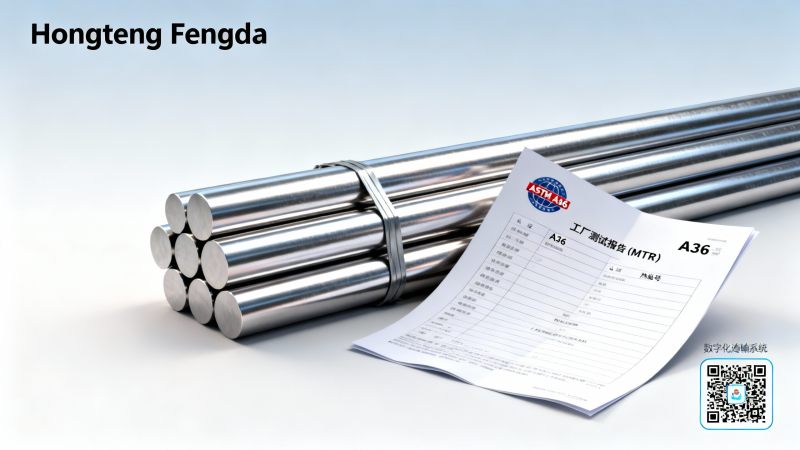
To operationalize traceability assurance, adopt this field-tested verification protocol before releasing payment or authorizing shipment:
1. Heat Number Cross-Check: Match the MTR heat ID with mill roll tags, shipping documents, and warehouse receiving logs.
2. Test Specimen Origin: Confirm tensile/impact specimens were taken from the same heat and location (end vs. mid-length) as supplied bars.
3. Dimensional Audit Trail: Request calibration certificates for measuring instruments used during final inspection—especially for diameter, roundness, and straightness.
4. Surface Defect Mapping: Ask for Circoflux or ultrasonic scan summaries showing absence of laminations or inclusions above ASTM E112 Grade 2.5.
5. Galvanizing Integration: If specifying coated products, verify zinc bath chemistry logs (Al ≤ 0.005%, Pb ≤ 0.003%) and intermetallic layer thickness per ASTM B6 and ISO 1461.
This checklist transforms passive acceptance into active quality governance—reducing rejection rates, avoiding costly rework, and strengthening contractual enforceability.
Partner with Confidence: Why Hongteng Fengda Delivers End-to-End Assurance
Sourcing A36 Carbon Steel Round Bar for heavy duty use demands more than competitive pricing—it requires embedded engineering discipline, documented process control, and responsive partnership. Hongteng Fengda delivers all three: modern electric arc furnaces with oxygen lance optimization ensure consistent carbon control; automated rolling mills with real-time tension monitoring guarantee dimensional repeatability; and a dedicated traceability team maintains 100% MTR issuance within 24 hours of final inspection. Our customers—from Tier-1 construction contractors in Dubai to Tier-2 machinery fabricators in Ohio—report 99.4% on-time documentation accuracy and zero non-conformance incidents related to material certification over the past 36 months. With ISO 9001, ISO 14001, and OHSAS 18001 certifications, plus direct access to ASTM, EN, and GB standard libraries, we don’t just meet specs—we anticipate verification pain points before they arise. Ready to eliminate supply chain uncertainty? Contact Hongteng Fengda today for customized MTR templates, real-time traceability portal access, and technical support tailored to your project’s compliance framework.
Related recommendations
 The Ultimate Procurement Hub: How a Full-Spectrum Steel Portfolio Empowers Global Industrial SuccessIt covers a wide range of steel products, including steel plates, steel coils, profiles, and steel gratings, to meet diverse needs.
 The Vertical Integration Advantage: Why Full-Process Production is the Gold Standard for Global Steel SourcingIt possesses complete production technologies and equipment for coking, sintering, steelmaking, and rolling, forming a systematic production system.
 The Global Steel Pulse: Bridging Continents with Precision Engineering and Unrivaled Supply Chain ExcellenceOur products sell well throughout China and are exported to North America, Europe, the Middle East, and other parts of the world, covering a wide market.
 Velocity of Value: How Precision Processing and Rapid-Response Logistics Redefine the Global Steel Supply ChainEquipped with advanced leveling equipment and relying on a robust logistics system, we can respond to customer needs at any time.
Please give us a message


Please enter what you want to find