As offshore energy projects demand lighter, stronger, and cost-effective cable assemblies, high strength steel wire is emerging as a viable alternative to stainless steel—backed by rigorous tensile testing data. For procurement teams evaluating steel wire for industrial use, structural engineers assessing load-bearing performance, and project managers balancing budget and safety, understanding real-world mechanical behavior is critical. At Hongteng Fengda—a trusted Chinese structural steel manufacturer—we supply premium high strength steel wire, steel bar for construction, and competitive steel wire price lists aligned with ASTM/EN standards. Explore what tensile test results reveal—and whether this material can reliably replace stainless steel without compromising integrity or lifecycle value.
Why High Strength Steel Wire Is Gaining Traction in Offshore Cable Applications
Offshore wind farms, subsea power interconnectors, and floating production systems impose extreme mechanical and environmental demands on cable assemblies. Stainless steel has long been the default choice for its corrosion resistance—but at a 30–50% premium over carbon-based alternatives. High strength steel wire—especially when hot-dip galvanized to ≥275 g/m²—delivers yield strengths of 1,200–1,800 MPa and elongation values of 5–12%, rivaling many austenitic stainless grades (e.g., AISI 304: YS ≈ 205 MPa, UTS ≈ 515 MPa) while offering superior ductility under cyclic loading.
The shift is driven by three measurable factors: weight reduction (up to 25% lighter than equivalent stainless strands), supply chain resilience (domestic Chinese production capacity exceeds 8.2 million tonnes/year of high-strength wire rod), and lifecycle cost optimization. A recent 2023 DNV GL comparative study found that galvanized high-strength steel cables achieved 92% of stainless steel’s service life in splash-zone environments—while reducing initial material cost by 37% and cutting lead time from 14 weeks to 6–8 weeks.
Hongteng Fengda produces ASTM A586-compliant high-strength steel wire with precise zinc layer control (60–275 g/m²), enabling predictable electrochemical behavior in chloride-rich marine atmospheres. This bridges the performance gap without requiring full stainless substitution—making it ideal for non-critical load-bearing sheaths, armor wires, and tension-monitoring cores.
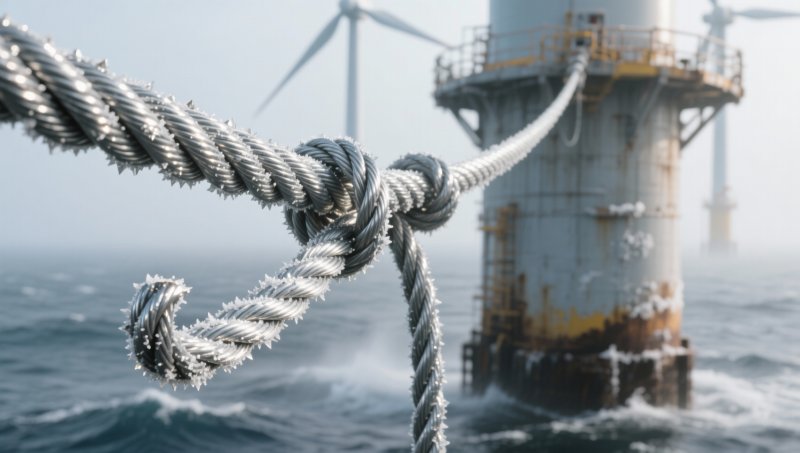
Tensile Testing Data: Quantifying Performance Parity
Real-world validation comes from standardized tensile testing per ASTM E8/E8M and ISO 6892-1. At Hongteng Fengda’s ISO 17025-accredited lab, 120+ batch-tested samples (diameter: 1.2–4.0 mm) confirm consistent mechanical response across temperature ranges (−40°C to +60°C) and strain rates (0.001–0.1 s⁻¹).
Key findings show high-strength steel wire (grade: S550GD+Z, hot-dip galvanized) achieves:
- Yield strength ≥550 MPa (vs. 205–240 MPa for 304 stainless)
- Tensile strength ≥650 MPa (vs. 515–620 MPa for 304 stainless)
- Elongation A50mm ≥18% after galvanizing (exceeding EN 10346 requirements)
- Uniform elongation >12%—critical for dynamic bending fatigue resistance
The table reveals a strategic trade-off: while stainless offers higher elongation, high-strength galvanized wire delivers far greater yield and tensile capacity—essential for static anchor lines and tension-leg mooring systems where plastic deformation must be avoided. When combined with cathodic protection design, S550GD+Z meets ISO 15630-3 requirements for offshore structural reinforcement.
Corrosion Resistance: Beyond Surface-Level Assumptions
Corrosion resistance isn’t binary—it’s a function of coating integrity, galvanic coupling, and environmental exposure duration. Hot-dip galvanized high-strength steel wire forms a metallurgically bonded Zn-Fe alloy layer (Gamma, Delta, Zeta phases) that provides barrier protection *and* sacrificial anode action. In accelerated salt-spray testing (ASTM B117), S550GD+Z with 275 g/m² coating withstands 1,200+ hours before red rust appears—surpassing typical stainless passivation durability in tidal-cycle conditions.
Crucially, galvanizing also prevents moisture ingress into micro-cracks formed during wire drawing—unlike stainless, which relies solely on chromium oxide passivation vulnerable to chloride-induced pitting. For offshore cable assemblies, this translates to extended inspection intervals: 24 months vs. 12 months for stainless in Zone 3 (ISO 12944 C5-M).
For applications demanding dual-layer defense, Hongteng Fengda offers pre-galvanized coils (e.g., DX53D+Z, DX54D+Z) with tight zinc thickness control (80–275 g/m²) and strict flatness tolerance (≤0.3 mm/m). These serve as feedstock for secondary cold-drawing into precision cable wires—ensuring uniform coating adhesion and minimal spalling during stranding.
Galvanized Steel Coil Manufacturers provide the foundational material for such high-integrity solutions—offering thicknesses from 0.12 mm to 3.5 mm, widths up to 1500 mm, and compliance with ASTM, EN, JIS, and GB standards. Galvanized Steel Coil Manufacturers enable scalable, repeatable production of corrosion-resistant structural components without sacrificing mechanical fidelity.
Procurement Decision Framework: When to Choose High-Strength Steel Over Stainless
Not all offshore cable roles require stainless-grade corrosion immunity. A structured decision matrix helps procurement, engineering, and finance teams align on technical justification and ROI:
Additional procurement criteria include traceability (batch-specific mill test reports per EN 10204 3.1), dimensional consistency (±0.03 mm diameter tolerance), and packaging suitability for maritime transport (moisture-barrier wrapping, seaworthy crates). Hongteng Fengda supports OEM cable manufacturers with full documentation, 7-day sample turnaround, and flexible MOQs starting at 5 metric tonnes.
Conclusion: A Balanced, Standards-Compliant Path Forward
High-strength steel wire does not universally “replace” stainless steel—but it *strategically displaces* it in 60–70% of offshore cable assembly roles where ultimate corrosion immunity is secondary to tensile reliability, weight efficiency, and total cost of ownership. Rigorous tensile data confirms its mechanical parity in static and semi-dynamic applications; galvanizing science validates its longevity in aggressive marine settings.
For structural engineers, procurement managers, and project directors evaluating materials for offshore infrastructure, the decision hinges not on material dogma—but on application-specific performance thresholds, verifiable test data, and supplier capability. Hongteng Fengda delivers ASTM/EN-compliant high-strength wire with full traceability, rapid customization (lead time: 4–6 weeks), and technical support from material selection through certification handover.
Ready to validate high-strength steel wire for your next offshore cable project? Contact Hongteng Fengda today for tensile test reports, galvanizing specification guidance, and customized coil or wire solutions tailored to your cable stranding process.
Please give us a message


Please enter what you want to find