Yes — our 201 stainless steel pipe ODM services for pharmaceutical cleanrooms include full traceability documentation, from raw material mill test reports (MTRs) and heat numbers to surface finish verification and cleanroom-compatible packaging records. As a China-based structural steel manufacturer serving global project managers, Hongteng Fengda ensures every ODM batch meets ISO 14644-1 compliance requirements while maintaining full audit-ready documentation. We integrate traceability into every stage — from 201 stainless steel pipe odm design and cold-drawn processing to final inspection — enabling seamless validation for FDA, EU GMP, or ASME BPE projects.
Project managers overseeing cleanroom infrastructure in pharmaceutical manufacturing often face tight deadlines, strict regulatory audits, and zero tolerance for undocumented material origins. A missing heat number on a pipe shipment, inconsistent surface roughness readings, or unverified passivation logs can trigger full-batch quarantine, delay commissioning, and require costly third-party retesting. These aren’t hypothetical risks — they’re recurring friction points when sourcing stainless components from suppliers without embedded traceability systems. The question isn’t whether traceability is needed; it’s whether your ODM partner builds it into the process — not as an add-on report, but as an inseparable part of production execution.
How Traceability Is Embedded in Our 201 Stainless Steel Pipe ODM Workflow
Unlike transactional suppliers who generate documentation post-production, our traceability framework begins at raw material intake and flows continuously through each value-add step:
- Material Inbound Control: Every coil of 201 stainless steel is logged with supplier MTR, heat number, chemical composition (verified against ASTM A240), and mechanical property data. Heat numbers are physically marked on coil tags and entered into our internal ERP system before uncoiling.
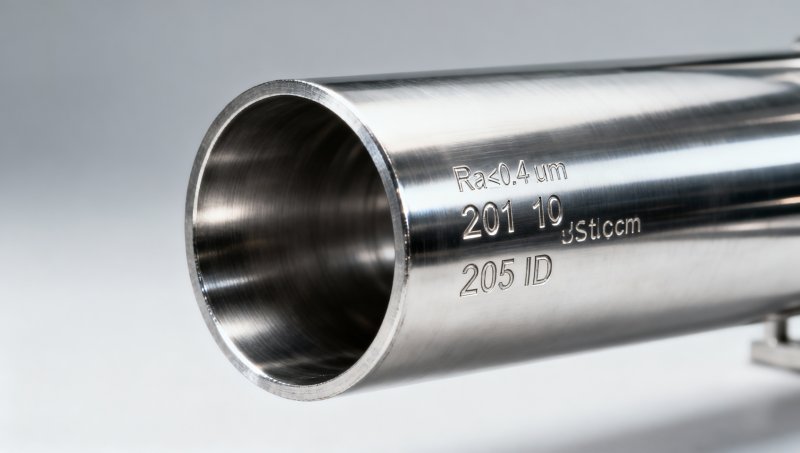
- Tube Forming & Cold Drawing: Each tube run is assigned a unique batch ID linked to the parent heat number. Process parameters — drawing speed, reduction ratio, annealing temperature/time — are recorded digitally. Surface finish (Ra ≤ 0.4 µm for cleanroom-grade tubing) is measured per ASTM E1157 using calibrated profilometers, with results tied to the batch ID.
- Cleaning & Passivation: Electrolytic cleaning and citric acid passivation cycles are validated per ASTM A967. Bath concentration, temperature, immersion time, and post-treatment rinse conductivity (≤ 1.0 µS/cm) are logged for every load. No batch proceeds without signed operator verification and QA release.
- Packaging & Final Inspection: Tubes are sealed in double-layer, low-particulate polyethylene bags inside rigid cardboard boxes lined with VCI paper. Each box carries a label listing heat number, batch ID, dimensions, surface finish result, and passivation date. Final dimensional checks (OD, wall thickness, straightness) follow ISO 11960 sampling plans.
This end-to-end linkage means you receive more than a stack of PDFs. You receive a coherent, auditable chain: heat number → batch ID → process logs → inspection records → packaging verification. That coherence matters during FDA pre-approval inspections or EU Annex 1 gap assessments — where reviewers don’t just ask “Do you have MTRs?” but “Can you prove this exact tube came from that exact heat, processed under those exact conditions?”
Why 201 Stainless Steel Requires Extra Traceability Discipline
While 316L remains the default for high-purity applications, 201 stainless steel is increasingly specified for non-product-contact cleanroom support systems — utility piping, structural framing, ductwork supports — where cost efficiency, strength-to-weight ratio, and adequate corrosion resistance are prioritized. But 201’s lower nickel content and higher manganese make its performance more sensitive to variations in raw material chemistry and thermal history. A slight deviation in carbon or nitrogen content can affect weldability, surface oxide stability, and long-term passive layer integrity. Without full heat-level traceability, there’s no way to correlate field performance issues — like localized pitting in humid environments or inconsistent electropolishing results — back to root cause.
That’s why we don’t treat 201 stainless steel pipe odm as a commodity specification. We treat it as a controlled process requiring tighter input verification and more granular output documentation than standard structural grades. It’s not about adding paperwork — it’s about preserving the information needed to validate performance in context.
Documentation You Receive — And What It Enables
For every ODM order, you’ll receive a structured digital package containing:
- Mill Test Report (MTR) with full chemical analysis and tensile/yield data per heat;
- Batch-specific process log summary (cold draw parameters, annealing cycle charts);
- Surface finish verification report (Ra measurements across three axial positions per tube length);
- Passivation validation record (bath analytics, exposure logs, post-rinse conductivity);
- Cleanroom packaging certificate (material safety data, particulate shedding test reference, seal integrity statement);
- Dimensional inspection report (sample size per ISO 2859-1 Level II, AQL 1.0).
This isn’t generic boilerplate. Each document references the same batch ID and heat number, allowing cross-verification in seconds. If your QA team needs to confirm whether a specific tube segment was included in the passivation load, they can trace it directly — no email chains, no manual spreadsheet lookups.
Integration With Broader Material Sourcing Strategy
Pharmaceutical cleanroom projects rarely rely on stainless tubing alone. Structural framing, duct supports, and ancillary enclosures often use galvanized steel components where atmospheric corrosion resistance and fabrication flexibility are critical. For such applications, our Galvanised Steel Sheet Metal offers consistent zinc coating adherence (per ASTM A653), predictable formability across DX51D–DX57D and SGCC–SGC510 grades, and documented yield/tensile ranges that align with structural design assumptions. Its traceability framework — while less granular than pharmaceutical-grade stainless — still includes mill certifications, coating weight verification, and bend test reports. This consistency across material families simplifies procurement oversight and reduces qualification overhead when managing mixed-material packages.
What to Verify Before Placing Your ODM Order
Not all “traceable” claims hold up under audit scrutiny. Before finalizing your 201 stainless steel pipe odm agreement, confirm these four points directly with your supplier:
- Whether heat numbers are physically marked on raw material coils *and* carried forward to final tube labels (not just listed in MTRs);
- If surface finish measurements are performed per tube lot — not just per machine shift or weekly calibration;
- Whether passivation validation includes bath chemistry testing *and* post-rinse water conductivity — not just timer-based cycle logs;
- If packaging records specify the exact polyethylene grade used, its particulate generation rating, and seal method (heat-sealed vs. tape-sealed).
If any answer is “no,” “only upon request,” or “we provide summaries,” that signals documentation is being generated reactively — not built into the process. Reactive documentation creates gaps. Built-in traceability closes them.
For project managers balancing budget constraints with regulatory accountability, choosing a 201 stainless steel pipe odm partner isn’t about finding the lowest quote — it’s about identifying the supplier whose documentation workflow mirrors your validation requirements. At Hongteng Fengda, traceability isn’t a deliverable. It’s the operating system.
Please give us a message


Please enter what you want to find