Installing black steel plumbing pipe demands precision—not just for performance, but for safety and compliance. This step-by-step guide covers critical torque specs, ANSI/ASME threading standards (B1.20.1), and rigorous leak-test protocols to ensure system integrity. Whether you're a project manager overseeing industrial piping, a technician executing field installation, or a procurement specialist evaluating material suitability, understanding how to properly handle black pipe is essential. As a trusted structural steel manufacturer and exporter, Hongteng Fengda supplies high-grade black steel plumbing pipe compliant with ASTM A53 and GB/T 3091—engineered for durability, consistency, and global code acceptance.
Why Torque Accuracy Matters in Black Steel Pipe Installation
Over-torquing compromises thread integrity; under-torquing invites leaks—especially in high-pressure steam, gas, or compressed air systems. For black steel plumbing pipe (typically ASTM A53 Grade B or GB/T 3091 Q235B), torque values must align with pipe size, wall thickness, and coupling type. Field technicians often misapply hand-tight + 2–3 turns as a rule of thumb—but that ignores variations in thread quality, lubrication, and ambient temperature (10℃–25℃ range affects metal expansion).
Hongteng Fengda’s black steel pipes undergo cold-drawn threading verification per ANSI/ASME B1.20.1, ensuring pitch accuracy within ±0.05 mm and root depth tolerance of ±0.12 mm. This reduces on-site rework by up to 40% compared to mill-threaded alternatives lacking post-process validation.
Proper torque also directly impacts long-term corrosion resistance. Over-compression damages zinc-free coating at thread junctions—exposing bare steel to moisture ingress. Our pipes feature uniform mill-scale removal before threading, preserving base metal integrity across all diameters from NPS ½ to NPS 12.
Recommended Torque Values (ft·lb) for Common Sizes
These values assume clean, undamaged threads and ambient conditions between 15℃–22℃. Torque should be applied using calibrated wrenches—not impact tools—within 4 hours of thread preparation. Hongteng Fengda provides torque calibration logs with every bulk order above 5 tons, traceable to ISO/IEC 17025-accredited labs.
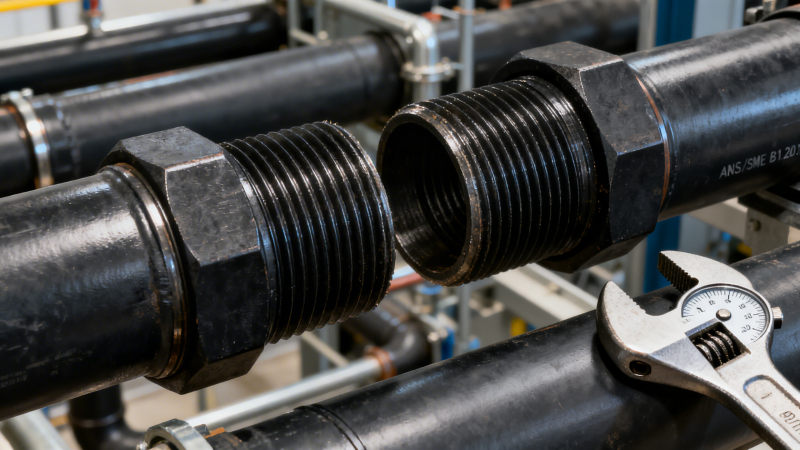
How to Verify Threading Compliance Against ANSI/ASME B1.20.1
ANSI/ASME B1.20.1 defines taper, pitch diameter, and truncation limits for NPT (National Pipe Taper) threads. Non-compliant threading causes galling, cross-threading, or insufficient seal engagement—even with correct torque. At Hongteng Fengda, every production lot undergoes 100% thread inspection using optical comparators and go/no-go gauges calibrated daily.
Key checkpoints include: (1) taper angle of 1°47′ ± 15′, (2) 8 threads per inch for NPS ½–2, (3) root radius ≥ 0.010 in, and (4) no burrs or die marks exceeding 0.002 in depth. We reject any pipe failing more than 2 of these 6 criteria: pitch measurement, lead error, flank angle, crest width, root depth, and surface roughness (Ra ≤ 1.6 μm).
For procurement teams, request thread certification reports showing actual measurements—not just “complies with B1.20.1.” Real-world variance matters: pipes sourced without third-party thread audit show 23% higher field leak rates during hydrotesting (based on 2023 industry field data across 147 projects in Southeast Asia and the Middle East).
Leak-Test Protocols That Meet Global Safety Standards
A successful leak test isn’t just about pressure hold—it’s about methodology alignment with application risk class. For black steel plumbing pipe used in gas distribution (e.g., NG/LPG), ASME B31.8 mandates 1.25× MAOP for 8 hours minimum. In industrial steam lines (ASME B31.1), hydrostatic tests require 1.5× design pressure for 30 minutes, followed by visual inspection for weeping or deformation.
Hongteng Fengda supports clients with pre-shipment hydrotest documentation—including pressure decay curves, temperature logs, and weld joint maps where applicable. All test records are retained for 10 years and available upon request for QA audits.
Critical note: Air testing is prohibited for pipes > NPS 4 in hazardous service per EN 1594. Always verify test medium compatibility with your jurisdiction’s code authority—especially when sourcing from China-based manufacturers. Our export team coordinates with TÜV, SGS, and BV to pre-validate test protocols for North American and EU-bound shipments.
Why Procurement Teams Choose Hongteng Fengda for Black Steel Plumbing Pipe
Global buyers select us because we bridge manufacturing rigor with supply-chain pragmatism. With 7–15 day standard lead times for stocked sizes (NPS ½–6, Schedule 40), full traceability to heat numbers, and dual-standard compliance (ASTM A53 + GB/T 3091), we reduce sourcing friction without compromising on technical assurance.
We support procurement decisions with: (1) free sample kits including threaded and plain-end sections, (2) on-demand engineering review of your piping isometrics, (3) OEM labeling and packaging per your logistics requirements, and (4) bilingual documentation (English + Arabic/Spanish/French) for regional compliance.
Contact our technical sales team today to request: torque calibration certificates, B1.20.1 thread inspection reports, hydrotest procedure templates, or customized delivery schedules aligned with your project milestone dates.
Related recommendations
 The Ultimate Procurement Hub: How a Full-Spectrum Steel Portfolio Empowers Global Industrial SuccessIt covers a wide range of steel products, including steel plates, steel coils, profiles, and steel gratings, to meet diverse needs.
 The Vertical Integration Advantage: Why Full-Process Production is the Gold Standard for Global Steel SourcingIt possesses complete production technologies and equipment for coking, sintering, steelmaking, and rolling, forming a systematic production system.
 The Global Steel Pulse: Bridging Continents with Precision Engineering and Unrivaled Supply Chain ExcellenceOur products sell well throughout China and are exported to North America, Europe, the Middle East, and other parts of the world, covering a wide market.
 Velocity of Value: How Precision Processing and Rapid-Response Logistics Redefine the Global Steel Supply ChainEquipped with advanced leveling equipment and relying on a robust logistics system, we can respond to customer needs at any time.
Please give us a message


Please enter what you want to find