Why ASTM A36 Round Bar Quality Checks Matter
Selecting an astm a36 round bar OEM manufacturer is not only a sourcing decision.
It is a decision about material consistency, shipment reliability, traceability, and long-term safety in structural and industrial use.
ASTM A36 round bar is widely used where strength, weldability, machinability, and predictable behavior are required.
Typical uses include fabrication parts, support members, shafts, base components, anchors, and general structural connections.
A simple visual check is never enough for such applications.
The material must match the standard, the purchase order, and the actual conditions of the project.
The following scene reflects common inspection priorities before round bars move into fabrication or installation.
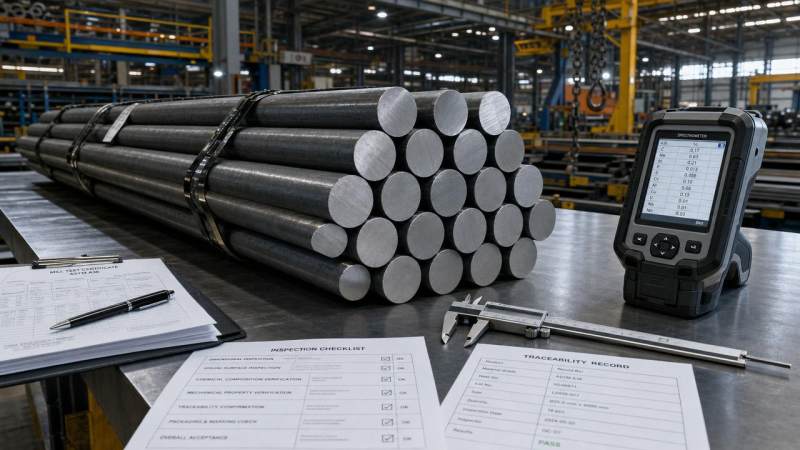
Hongteng Fengda supports this process as a China-based structural steel manufacturer and exporter.
The company supplies standard steel products and OEM structural steel components for global construction and manufacturing projects.
Understanding ASTM A36 Round Bar in Practical Terms
ASTM A36 is a carbon structural steel specification known for balanced strength and workability.
For round bar products, the focus is not limited to grade name.
The actual check covers chemical composition, tensile performance, yield strength, elongation, dimensional accuracy, and surface condition.
An astm a36 round bar OEM manufacturer must also understand custom processing needs.
These may include specified diameter ranges, cut lengths, chamfering, bundled packing, marking, or project-based documentation.
In many export projects, compliance evidence is as important as the physical steel itself.
A mill test certificate, heat number, inspection record, and packing list should match each shipment clearly.
When these details are weak, the supply risk increases even if the price looks attractive.
What “OEM” usually adds to the inspection scope
OEM supply often involves more than standard stock delivery.
It may require repeated production batches, controlled tolerances, consistent markings, and packaging aligned with downstream operations.
This is why the quality system should cover the full production flow.
Checks before production, during rolling or processing, and before shipment all serve different purposes.
Core Quality Checks Before Shipment
A reliable astm a36 round bar OEM manufacturer should not depend on final inspection alone.
Quality control should begin with raw material verification and continue until goods are loaded for export.
These checks help identify problems before they become installation delays or rework costs.
For international projects, they also reduce disputes caused by unclear acceptance criteria.
Dimensional tolerance deserves close attention
Round bar dimensions influence machining, welding, drilling, and assembly.
Even small deviations may create problems when bars are used in repeated OEM components.
A consistent astm a36 round bar OEM manufacturer should define inspection frequency clearly.
Random checks, batch records, and calibrated measuring tools should all be part of the routine.
Traceability and Documentation Are Part of Product Quality
Steel quality is difficult to manage when documents cannot be connected to actual bundles.
Traceability links each round bar batch to its heat number, test data, and production record.
This link is especially important when products are used in regulated or safety-sensitive environments.
Documentation should be complete, but also practical.
A useful document package usually includes material test reports, packing details, inspection photos, and shipment references.
For export orders, standard alignment also matters.
Hongteng Fengda works with major standards including ASTM, EN, JIS, and GB for different steel product lines.
This multi-standard experience helps when projects combine different structural steel items under one supply plan.
How Round Bar Checks Connect with Broader Structural Steel Supply
Round bars are rarely purchased in isolation for large steel projects.
They may be supplied together with angles, channels, beams, cold formed profiles, or customized steel parts.
This broader supply context makes supplier control more important.
A capable astm a36 round bar OEM manufacturer should understand how each product affects project scheduling.
For example, retaining systems may require different steel products from the same supply network.
Hongteng Fengda also supplies Hot Rolled Steel Sheet Pile for retaining wall and water retaining wall applications.
U Sheet Pile options can be produced under EN10248, EN10249, JIS5528, JIS5523, and ASTM references.
Material options include S275, S355, S390, S430, SY295, SY390, and ASTM A690.
Interlock choices may include Larssen locks, cold rolled interlocks, and hot rolled interlocks.
Lengths can be customized, with single lengths reaching over 80 meters where project logistics allow.
The relevance is not that round bars and sheet piles serve the same function.
The practical point is shared supplier discipline across standards, records, tolerances, and export coordination.
Common Risks When Quality Checks Are Weak
Some steel risks are visible during receiving inspection.
Others appear later, after cutting, welding, machining, or installation.
A weak quality process may lead to wrong diameter, mixed heat numbers, unclear markings, or incomplete certificates.
Surface defects can also create downstream problems.
Cracks, deep scratches, heavy corrosion, and deformation may affect performance or processing efficiency.
The cost of these issues is not limited to replacement steel.
They can cause production stoppage, site delay, redesign discussions, and additional third-party inspection fees.
- Unclear material traceability can delay project acceptance.
- Inconsistent diameter may affect machining yield.
- Poor packing can increase rust and handling damage.
- Missing test records can create compliance uncertainty.
- Late inspection findings can disrupt shipment schedules.
These risks explain why supplier evaluation should include more than quotation comparison.
What to Review in an OEM Manufacturing Partner
A reliable astm a36 round bar OEM manufacturer should demonstrate control before order confirmation.
The review can begin with manufacturing capability, but it should not stop there.
Stable production capacity matters when repeat orders or project phases require consistent delivery.
Quality management matters when products must match standards and documents without repeated correction.
Export experience matters because packing, loading, labels, and lead times influence final project outcomes.
Useful questions before placing an order
- Which ASTM A36 properties will be tested and reported?
- How are heat numbers marked on bundles?
- What dimensional tolerances apply to diameter and length?
- Can OEM cutting, marking, and packing requirements be repeated?
- Are inspection photos and shipment documents available before loading?
- How are nonconforming products handled during production?
Clear answers help turn a purchase order into a controlled supply process.
They also reduce misunderstanding between technical requirements and commercial execution.
Hongteng Fengda’s Quality Perspective
Hongteng Fengda manufactures and exports structural steel from China for global construction and industrial markets.
Its product scope includes angle steel, channel steel, steel beams, cold formed profiles, and customized components.
For OEM structural steel supply, quality control is treated as a process rather than a final checkpoint.
That process includes order review, material verification, production monitoring, dimensional inspection, packing checks, and document preparation.
Certifications and management systems provide additional structure.
The company supports projects that require references such as ISO9001, ISO14001, ISO18001, and CE FPC where applicable.
Markets served include North America, Europe, the Middle East, and Southeast Asia.
This export background helps align production planning with shipment schedules and receiving requirements overseas.
Turning Quality Checks into a Practical Decision Framework
The best supplier decision usually combines technical review and operating reality.
A low unit price may not compensate for unclear tolerances, late documents, or inconsistent batch control.
When evaluating an astm a36 round bar OEM manufacturer, start with the application conditions.
Then define the required diameter, length, grade evidence, inspection level, packing method, and delivery window.
After that, compare suppliers by their ability to prove consistency.
Useful proof includes past export records, inspection procedures, sample documents, and responsiveness during technical clarification.
For repeat OEM orders, it is also practical to build a shared checklist.
This checklist can define accepted tolerances, marking format, document names, photo requirements, and packaging details.
Such preparation makes every shipment easier to verify and easier to receive.
Next Steps for Safer and More Consistent Sourcing
ASTM A36 round bar quality is not judged by one certificate or one inspection photo.
It depends on consistent control across material, production, measurement, documentation, and shipment.
An astm a36 round bar OEM manufacturer should make that control visible before the order moves forward.
The next practical step is to organize project requirements into a clear technical and quality checklist.
Compare available suppliers against that checklist, not only against price and delivery time.
For projects involving multiple structural steel items, review supplier capability across the full package.
This approach helps reduce sourcing risk, support compliance, and keep steel supply aligned with project safety expectations.
Please give us a message


Please enter what you want to find