h beam i beam: which section fits your structural design better
When engineers compare `h beam i beam`, the question is usually not which one is “better” in the abstract. It is which section will carry the load cleanly, fit the span, simplify fabrication, and stay cost-efficient for the actual project. In many structural designs, that answer changes with the moment profile, connection detail, and how much weight the frame can tolerate. If you need a practical choice rather than a textbook definition, the differences matter in real procurement and detailing work.
## H beam i beam: start with the job the section has to do
The fastest way to choose between `h beam i beam` is to stop looking at the names and look at how the section behaves in the frame.
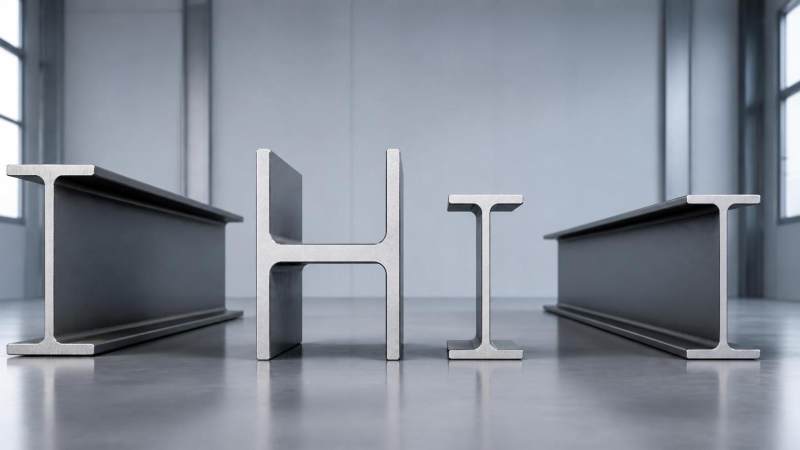
An H beam, with wider flanges and a heavier, more balanced profile, is usually the safer starting point when the member sees larger bending demands, heavier axial load, or a need for better stability in a primary frame. It is also easier to justify when fabrication teams want a section that is more straightforward to weld, splice, and connect in a clean load path.
An I beam can make more sense when the design is lighter, the span is moderate, and the priority is material efficiency. In many projects it is selected because it gives enough section performance without carrying unnecessary steel weight. That said, “lighter” does not automatically mean “better.” If the beam ends up too slender for the load pattern, you lose the benefit quickly.
 A direct answer: if your design is load-heavy, span-sensitive, or connection-critical, H beam is often the stronger candidate. If you are trying to control steel tonnage in a less demanding member, I beam may be the more economical fit. The real decision still depends on the full section properties, not the label.
## Where H beam usually wins
In technical evaluation, H beam tends to be the better section when the design asks for predictable stiffness and robust load transfer. It is commonly preferred in columns, main beams, plant frames, platforms, and other members where the load path is not forgiving.
There are a few practical reasons for that:
- The wider flanges help with stability and connection area.
- The proportions often suit welded fabrication and heavy-duty assembly.
- The section is easier to use when the design includes significant axial force together with bending.
- For larger spans, it is often easier to keep deflection under control without overcomplicating the member.
This is one reason many buyers evaluating structural steel for export projects ask for consistent section geometry and reliable mill control. If a project also uses related components such as angle steel, channel steel, or customized structural members, the supplier’s ability to hold tolerances matters as much as the nominal shape. Hongteng Fengda works in that space as a structural steel manufacturer and exporter from China, supplying steel beams and other profiles under ASTM, EN, JIS, and GB requirements.
One point that is often missed: H beam is not automatically “overdesigned.” It is often simply the safer choice where the frame will be exposed to concentrated load, vibration, or future service changes.
## Where I beam still makes sense
I beam is still a practical section, and in some cases it is the better engineering answer. It can be appropriate for floor beams, secondary framing, lighter spans, and situations where the section is selected mainly for bending resistance rather than for combined heavy loading.
The main appeal is efficiency. If the structural demand is moderate and the support conditions are clear, an I beam may deliver the needed performance with less steel. That can help with cost, shipping weight, and erection handling.
But there is a common mistake here: people sometimes choose I beam because it looks “strong enough” in a catalog, then discover the real issue is lateral stability or connection detail. If the beam is part of a system with weak bracing, dynamic loads, or uneven distribution, the savings can disappear in design corrections.
So the right question is not “Is I beam cheaper?” It is “Does this member really deserve a lighter section, or am I creating a problem for myself later?”
## The details that decide the choice
If you are doing the actual evaluation, these are the points that matter most:
Span length: longer spans usually punish weak stiffness faster than people expect. A beam that passes stress checks may still fail the serviceability check.
Load type: uniform load, point load, moving load, and combined load do not behave the same. A section that looks fine on paper can be a poor match for concentrated reactions.
Connection method: if the project depends on welded joints, splice plates, or heavy end connections, H beam often gives the fabricator more room to work cleanly.
Transportation and erection: a section that is technically adequate but too heavy for handling can slow the whole project.
Corrosion environment: for exterior or industrial applications, the section choice should be reviewed together with protection strategy, not afterward. In some projects, coated materials such as AZ50 Galvalume Steel Coil are more relevant for associated cladding, roof systems, or secondary steel parts than for the beam itself, but the same logic applies: the material has to match exposure conditions, not just the drawing.
If the project is being built for the exterior of a house, for structural purposes, or for industrial applications, the beam section should be reviewed alongside the coating system, fabrication sequence, and maintenance plan. That is how you avoid selecting a profile that works only in the drawing package.
## A simple way to avoid the wrong call
A good review process is usually short and disciplined:
1. Confirm the governing load case.
2. Check span and deflection limits first, not last.
3. Review connection detail before finalizing the section.
4. Compare fabrication and handling cost, not just theoretical steel weight.
5. Make sure the chosen profile matches the project’s environment and standard.
If the answer still points in two directions, H beam is often the more conservative choice for primary members, while I beam remains a sensible option for lighter framing where efficiency matters more than reserve capacity.
## What technical evaluators should watch for
The biggest error I see is treating `h beam i beam` as a naming comparison instead of a structural one. The section name tells you almost nothing about the actual design outcome until you know the exact dimensions, steel grade, support conditions, and connection requirements.
Another common issue is mixing section choice with material choice. They are related, but not the same. A well-chosen section made from the wrong steel grade is still a bad decision. A section with good material but poor proportions is also a bad decision.
That is why buyers usually want a supplier who can hold both product quality and delivery discipline. Stable production, consistent quality, and dependable lead times matter because a delayed beam shipment can disrupt fabrication sequencing just as much as an undersized section can disrupt the design.
## Final judgment
For `h beam i beam`, the better section is the one that fits the load path with the least compromise. H beam is usually the better fit for heavier primary structural work, larger spans, and more demanding connections. I beam is often the practical choice for lighter or more efficient framing where the design margin is already comfortable.
If you are making the choice for a real project, do not stop at section shape. Check the load case, deflection, connection design, and protection strategy together. That is the point where a beam becomes either a reliable structural decision or an expensive correction later.
### FAQ
**Is H beam always stronger than I beam?**
Not always. Strength depends on the exact dimensions and steel grade. H beam is often better for heavier structural use, but the final answer comes from section properties and the load case.
**Why do designers choose I beam when H beam seems more robust?**
Because some members do not need the extra weight. If the span and load are moderate, I beam can be a more efficient and economical solution.
**Can both sections be used in the same project?**
Yes. That is common. Primary members may use H beam, while secondary framing uses I beam where efficiency matters more.
**What should I check before placing an order?**
Confirm dimensions, grade, standard, allowable tolerances, and whether the section will be welded, bolted, or spliced in the field.
**Does corrosion protection affect the section choice?**
It can. The beam section is structural, but the environment still influences the overall design, especially for exterior and industrial projects.
### Image Placement Notes
- `` place near the section comparing H beam and I beam behavior; alt text: “Side-by-side structural beam comparison showing H beam and I beam proportions.”
### Internal Link Anchor Suggestions
- steel beam section selection guide: beam sizing and structural design page
- ASTM EN JIS GB steel beam specifications: standards reference page
- structural steel fabrication and welding: processing capability page
- corrosion-resistant steel for exterior structures: protective material solutions page
- custom structural steel components: OEM and project support page
### External Authority Sources
- Industry standards documents for structural steel shapes and section properties
- Government or building-code authority pages covering structural design requirements
- Mill test certificate and official product standard documentation from steel manufacturers
### SEO Self-Check
- Yes, the article answers the selection decision directly
- Yes, it is written as a selection/evaluation piece
- Yes, it targets technical evaluators
- Yes, `h beam i beam` appears naturally in the title context, intro, body, and closing
- Yes, keyword stuffing is avoided
- Yes, the tone avoids template language
- Yes, the structure varies naturally
- Yes, no unverified market or pricing facts are stated
- Yes, the company and product information are integrated lightly and naturally
A direct answer: if your design is load-heavy, span-sensitive, or connection-critical, H beam is often the stronger candidate. If you are trying to control steel tonnage in a less demanding member, I beam may be the more economical fit. The real decision still depends on the full section properties, not the label.
## Where H beam usually wins
In technical evaluation, H beam tends to be the better section when the design asks for predictable stiffness and robust load transfer. It is commonly preferred in columns, main beams, plant frames, platforms, and other members where the load path is not forgiving.
There are a few practical reasons for that:
- The wider flanges help with stability and connection area.
- The proportions often suit welded fabrication and heavy-duty assembly.
- The section is easier to use when the design includes significant axial force together with bending.
- For larger spans, it is often easier to keep deflection under control without overcomplicating the member.
This is one reason many buyers evaluating structural steel for export projects ask for consistent section geometry and reliable mill control. If a project also uses related components such as angle steel, channel steel, or customized structural members, the supplier’s ability to hold tolerances matters as much as the nominal shape. Hongteng Fengda works in that space as a structural steel manufacturer and exporter from China, supplying steel beams and other profiles under ASTM, EN, JIS, and GB requirements.
One point that is often missed: H beam is not automatically “overdesigned.” It is often simply the safer choice where the frame will be exposed to concentrated load, vibration, or future service changes.
## Where I beam still makes sense
I beam is still a practical section, and in some cases it is the better engineering answer. It can be appropriate for floor beams, secondary framing, lighter spans, and situations where the section is selected mainly for bending resistance rather than for combined heavy loading.
The main appeal is efficiency. If the structural demand is moderate and the support conditions are clear, an I beam may deliver the needed performance with less steel. That can help with cost, shipping weight, and erection handling.
But there is a common mistake here: people sometimes choose I beam because it looks “strong enough” in a catalog, then discover the real issue is lateral stability or connection detail. If the beam is part of a system with weak bracing, dynamic loads, or uneven distribution, the savings can disappear in design corrections.
So the right question is not “Is I beam cheaper?” It is “Does this member really deserve a lighter section, or am I creating a problem for myself later?”
## The details that decide the choice
If you are doing the actual evaluation, these are the points that matter most:
Span length: longer spans usually punish weak stiffness faster than people expect. A beam that passes stress checks may still fail the serviceability check.
Load type: uniform load, point load, moving load, and combined load do not behave the same. A section that looks fine on paper can be a poor match for concentrated reactions.
Connection method: if the project depends on welded joints, splice plates, or heavy end connections, H beam often gives the fabricator more room to work cleanly.
Transportation and erection: a section that is technically adequate but too heavy for handling can slow the whole project.
Corrosion environment: for exterior or industrial applications, the section choice should be reviewed together with protection strategy, not afterward. In some projects, coated materials such as AZ50 Galvalume Steel Coil are more relevant for associated cladding, roof systems, or secondary steel parts than for the beam itself, but the same logic applies: the material has to match exposure conditions, not just the drawing.
If the project is being built for the exterior of a house, for structural purposes, or for industrial applications, the beam section should be reviewed alongside the coating system, fabrication sequence, and maintenance plan. That is how you avoid selecting a profile that works only in the drawing package.
## A simple way to avoid the wrong call
A good review process is usually short and disciplined:
1. Confirm the governing load case.
2. Check span and deflection limits first, not last.
3. Review connection detail before finalizing the section.
4. Compare fabrication and handling cost, not just theoretical steel weight.
5. Make sure the chosen profile matches the project’s environment and standard.
If the answer still points in two directions, H beam is often the more conservative choice for primary members, while I beam remains a sensible option for lighter framing where efficiency matters more than reserve capacity.
## What technical evaluators should watch for
The biggest error I see is treating `h beam i beam` as a naming comparison instead of a structural one. The section name tells you almost nothing about the actual design outcome until you know the exact dimensions, steel grade, support conditions, and connection requirements.
Another common issue is mixing section choice with material choice. They are related, but not the same. A well-chosen section made from the wrong steel grade is still a bad decision. A section with good material but poor proportions is also a bad decision.
That is why buyers usually want a supplier who can hold both product quality and delivery discipline. Stable production, consistent quality, and dependable lead times matter because a delayed beam shipment can disrupt fabrication sequencing just as much as an undersized section can disrupt the design.
## Final judgment
For `h beam i beam`, the better section is the one that fits the load path with the least compromise. H beam is usually the better fit for heavier primary structural work, larger spans, and more demanding connections. I beam is often the practical choice for lighter or more efficient framing where the design margin is already comfortable.
If you are making the choice for a real project, do not stop at section shape. Check the load case, deflection, connection design, and protection strategy together. That is the point where a beam becomes either a reliable structural decision or an expensive correction later.
### FAQ
**Is H beam always stronger than I beam?**
Not always. Strength depends on the exact dimensions and steel grade. H beam is often better for heavier structural use, but the final answer comes from section properties and the load case.
**Why do designers choose I beam when H beam seems more robust?**
Because some members do not need the extra weight. If the span and load are moderate, I beam can be a more efficient and economical solution.
**Can both sections be used in the same project?**
Yes. That is common. Primary members may use H beam, while secondary framing uses I beam where efficiency matters more.
**What should I check before placing an order?**
Confirm dimensions, grade, standard, allowable tolerances, and whether the section will be welded, bolted, or spliced in the field.
**Does corrosion protection affect the section choice?**
It can. The beam section is structural, but the environment still influences the overall design, especially for exterior and industrial projects.
### Image Placement Notes
- `` place near the section comparing H beam and I beam behavior; alt text: “Side-by-side structural beam comparison showing H beam and I beam proportions.”
### Internal Link Anchor Suggestions
- steel beam section selection guide: beam sizing and structural design page
- ASTM EN JIS GB steel beam specifications: standards reference page
- structural steel fabrication and welding: processing capability page
- corrosion-resistant steel for exterior structures: protective material solutions page
- custom structural steel components: OEM and project support page
### External Authority Sources
- Industry standards documents for structural steel shapes and section properties
- Government or building-code authority pages covering structural design requirements
- Mill test certificate and official product standard documentation from steel manufacturers
### SEO Self-Check
- Yes, the article answers the selection decision directly
- Yes, it is written as a selection/evaluation piece
- Yes, it targets technical evaluators
- Yes, `h beam i beam` appears naturally in the title context, intro, body, and closing
- Yes, keyword stuffing is avoided
- Yes, the tone avoids template language
- Yes, the structure varies naturally
- Yes, no unverified market or pricing facts are stated
- Yes, the company and product information are integrated lightly and naturally
Previous page: Already the first one
Next page: Already the last one
Please give us a message


Please enter what you want to find