On many fabrication floors, the first trouble with h beam and i beam work does not show up in the drawing room. It shows up at the cutting table, during fit-up, or when a member refuses to land the way the crew expected. A section that looked “close enough” on paper can create extra trimming, awkward weld access, or a mismatch at splice points.
That is why the shape difference matters so much. Both sections are common in structural steel, but they behave differently in fabrication because of flange width, web depth, stability during handling, and the way attachments sit on the section. If you are sorting parts for a project and trying to avoid rework, the practical question is not which one sounds stronger, but which one fits the operation with fewer surprises.
Where the confusion usually starts
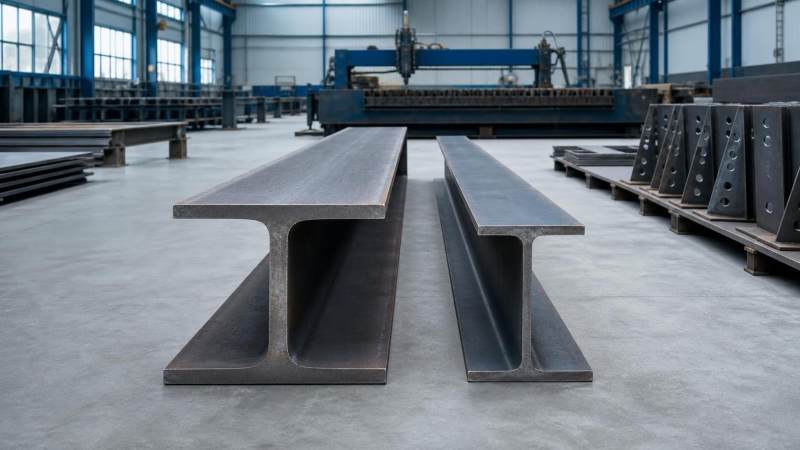
Many people use the two names loosely, then discover the section they received does not match the assumptions built into the shop drawings. An i beam typically has narrower flanges and a more tapered profile, while an h beam usually has wider flanges and a more uniform shape. That difference changes how the steel behaves during marking, clamping, drilling, and welding.
In daily fabrication, the problem is rarely the section itself. The problem is using the wrong expectations. For example, a narrow flange may be easier to pass through some jigs, but it can leave less room for weld access. A wider flange can give better bearing or connection area, but it may also increase handling weight and require more care when setting up lifting points. If the team does not check the section profile early, small errors pile up into wasted time.
Points that affect the workshop first
The most obvious difference is fit-up. Wider flanges can make layout easier when plates, stiffeners, or connection parts need a stable landing surface. Narrower flanges may demand tighter positioning because there is less tolerance before an attachment runs out of usable area. This matters when you are aligning hole lines or preparing end connections.
Next is weld access. On sections with tighter flange geometry, torch angle and gun position become more important. Crews may need to change sequence, rotate the member, or use different fixtures to keep the weld consistent. If the beam is being built into a larger assembly, the shape can also affect how much heat is trapped near the web and flange junction.
Then comes handling. A section that looks simple on paper may feel very different once it is moved around the shop. Longer lengths, wider flanges, and heavier profiles often need better support to avoid twist during lifting or rolling. That is not just a safety concern; even a small distortion can make later alignment more difficult.
Checking the section before cutting
One useful habit is to verify the actual section profile before any irreversible work begins. Start with the drawing, then compare the delivered material against the section designation, flange width, web depth, and straightness. If the project depends on tight connection fit, do not assume that one beam type can replace the other without rechecking the details.
For shop teams handling a mix of structural members and corrosion-resistant plate work, material choice can also shape the process. In areas where welded parts need extra resistance to chemical exposure or elevated temperatures, some fabricators may specify a 316L Stainless Steel Plate for related components, covers, or attachments. That does not change the beam selection itself, but it can influence how the surrounding assembly is planned and welded.
Choosing the right section for the job
A simple way to compare h beam and i beam differences is to ask what the member must do during fabrication, not only in service. If the job needs more room for connections, broader bearing, or a flatter surface for attachment work, the h-shaped section is often easier to manage. If the work is limited by space, weight, or existing connection geometry, the i-shaped section may be the more practical fit.
Do not stop at shape alone. Confirm the steel grade, available lengths, surface condition, and any cutting or drilling restrictions from the mill or stock list. A beam that seems convenient can still slow production if it arrives in the wrong stock length or needs extra prep before welding. This is where standardization helps, especially when the project includes mixed materials or components supplied for different industries such as chemical equipment, transportation, or heavy assemblies.
Small process changes that save rework
In real fabrication work, the best fix is often a better sequence. Mark the section orientation clearly before moving it to cutting. Use reference faces for layout, not just visual alignment. If the beam will be welded to plates or brackets, mock the joint before final tacking so the team can spot clearance problems early. For longer members, support them at enough points to avoid sag during drilling or fit-up.
It also helps to separate “can it be assembled” from “should it be assembled this way.” A connection that fits after force may still create distortion or poor weld access later. Operators usually notice this first when the torch path becomes awkward or the clamp has to work against the section shape. At that point, changing the order of assembly is usually easier than correcting a finished distortion.
Common mistakes to avoid
One frequent mistake is treating all beam profiles as interchangeable because the nominal size looks similar. Another is assuming the wider section is always the better one. In practice, the correct choice depends on connection layout, lifting method, and the amount of fabrication still ahead.
It is also easy to overlook downstream effects. A section that is convenient for one cut may create difficulty at the next station if its flange geometry blocks the clamp, the drill head, or the weld torch. Good fabrication work is not just about receiving the right steel; it is about matching the section to the sequence of operations.
When crews take the time to check those details early, h beam and i beam selection becomes much less of a guessing game. The result is usually smoother fit-up, fewer adjustments, and a clearer path from material receipt to final assembly.
Please give us a message


Please enter what you want to find