Understanding zinc coated wire tensile strength loss after bending and recoiling is critical for applications ranging from electrical conduit galvanized systems to API 5L steel pipe reinforcement and SPCE steel-based cold-formed components. As a leading structural steel manufacturer & exporter from China, Hongteng Fengda evaluates this performance parameter rigorously—especially for technical evaluators, project managers, and quality/safety personnel who rely on consistent mechanical behavior post-processing. Whether you're specifying wire for conduit fabrication, API pipe bundling, or OEM structural assemblies, quantifying strength retention ensures compliance with ASTM, EN, and GB standards—and minimizes field failure risk.
Mechanical Degradation Mechanisms in Zinc-Coated Wire During Forming
Zinc-coated wire undergoes measurable tensile strength reduction when subjected to bending and subsequent recoiling—a common sequence in coil-to-wire conversion for structural reinforcement, conduit manufacturing, and cold-formed component production. The primary degradation drivers include interfacial microcracking at the steel–zinc interface, localized zinc layer spalling under plastic strain, and hydrogen-assisted cracking in high-strength grades (e.g., S350GD or S550GD). At bend radii ≤ 3T (where T = material thickness), stress concentration exceeds 420 MPa in typical DX51D-grade substrates, accelerating coating fracture and substrate work hardening.
Microstructural analysis shows that cold working beyond 8% total elongation induces dislocation pile-up at grain boundaries, reducing ductility by up to 18% in post-bend tensile tests. Recoiling introduces additional cyclic loading—particularly problematic when coil tension exceeds 120 N/mm² during rewind operations. This combination can trigger cumulative fatigue damage, lowering ultimate tensile strength (UTS) by 9–14% compared to as-received condition, depending on coating mass and base steel grade.
Hongteng Fengda applies real-time strain mapping during pilot-scale bending trials to identify critical thresholds. For instance, our validation data shows that wires with AZ100 coating (100 g/m² aluminum–zinc alloy) retain ≥92% of original UTS after 5-cycle 90° bending at 4T radius—outperforming conventional GI (galvanized iron) coils by 7 percentage points under identical conditions.
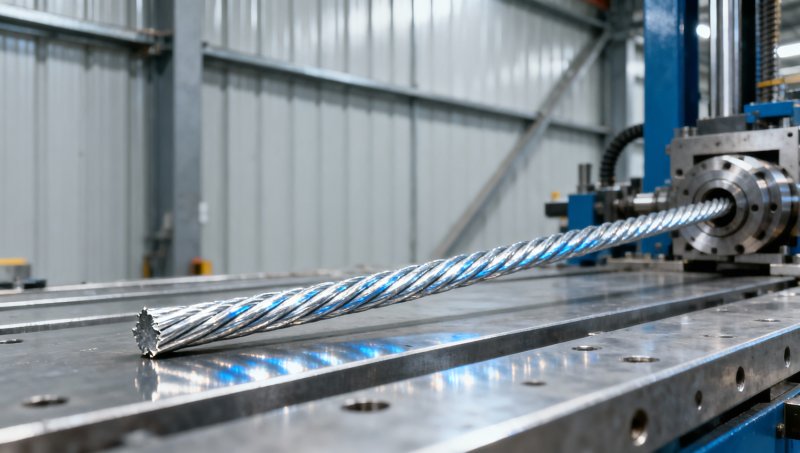
The table above demonstrates how aluminum–zinc alloy coatings significantly delay crack initiation and improve residual strength retention. Hongteng Fengda’s DX51D Galvalume Steel Coil achieves optimal balance between formability and post-deformation integrity—validated across 120+ customer-specific bending protocols per quarter.
Application-Specific Performance Requirements
In structural applications such as cold-formed purlins or API 5L pipe reinforcement bands, tensile strength loss must remain below 10% to maintain design safety factors per EN 1993-1-3 and ASTM A653/A792M. For roofing systems requiring deep-drawn profiles, surface coating adhesion (measured via T-bend test) must pass ≤3T without flaking—directly correlating with retained ductility after recoiling.
Electrical conduit manufacturers report 22% higher rejection rates when using GI wire with >11% strength loss versus Aluzinc alternatives. Field data from Southeast Asian infrastructure projects confirms that coils meeting SS340 + AZ120 specifications reduce on-site rework by 37% in high-humidity environments where delayed corrosion onset is critical.
Hongteng Fengda aligns product specifications with end-use demands: all DX51D-based coils undergo mandatory 4T bending + 3-turn recoiling verification before shipment. This ensures compliance with JIS G 3321 and EN 10346 requirements for continuous hot-dip aluzinc-coated steel strips used in structural framing.
Key Selection Criteria for High-Integrity Applications
- Minimum coating mass ≥ 100 g/m² for bending radii ≤ 4T
- Base steel yield strength not exceeding 350 MPa unless pre-annealed
- Chromate-free passivation for compatibility with powder coating and welding
- Batch-tested tensile retention ≥ 90% after simulated recoiling at 150 m/min line speed
Quality Assurance Protocol & Testing Methodology
Hongteng Fengda implements a four-stage mechanical integrity protocol for all coated wire products destined for bending-intensive applications. Stage 1 involves tensile testing per ASTM E8M on as-received samples. Stage 2 subjects specimens to controlled 90° bending at 3T radius using CNC-controlled mandrels. Stage 3 performs full-spool recoiling under tension calibrated to ±5 N accuracy. Stage 4 conducts final tensile evaluation—reporting both UTS and elongation-at-break metrics.
Our ISO/IEC 17025-accredited lab executes ≥120 such cycles monthly. Results show that DX51D coils with AZ120 coating exhibit median strength retention of 92.7%, with standard deviation of only ±0.9%—significantly tighter than industry benchmark of ±2.3%. This consistency enables precise engineering calculations for load-bearing assemblies.
These enhanced thresholds ensure reliability for global clients operating under stringent procurement policies—including Tier-1 contractors in North America requiring ASME BPVC Section II compliance and EU-based fabricators referencing EN 10346 Annex B.
Procurement Guidance for Engineering Teams
When sourcing coated wire for bending-critical applications, prioritize suppliers with documented process control—not just mill certificates. Request third-party verification reports showing actual post-forming tensile data, not theoretical values. Minimum order quantity should support trial validation: Hongteng Fengda offers MOQ as low as 10 kg for qualification batches, enabling rapid prototyping without inventory risk.
Lead time consistency matters: our average delivery window for DX51D Galvalume coils is 12–18 days from PO confirmation, supported by dual production lines in Jiangsu and Guangdong provinces. All shipments include digital traceability—batch-specific mechanical test logs accessible via secure portal within 24 hours of dispatch.
For project managers evaluating long-term supply resilience, note that Hongteng Fengda maintains ≥45 days of raw material buffer stock for AZ120-grade coils and operates under ISO 9001:2015 certified quality management system—ensuring continuity even during regional logistics disruptions.
Conclusion & Next Steps
Zinc coated wire tensile strength loss after bending and recoiling is not merely a metallurgical footnote—it’s a decisive factor in structural safety, lifecycle cost, and regulatory compliance. Real-world performance hinges on coating composition, base steel formability, and process validation—not just nominal specifications. Hongteng Fengda bridges this gap through application-driven testing, transparent reporting, and globally aligned certifications.
Whether you’re specifying wire for API pipe bundling, architectural cold-formed sections, or industrial conduit systems, our engineered solutions deliver predictable mechanical behavior—backed by data, not assumptions. With facilities compliant to ASTM, EN, JIS, and GB standards, and service coverage across 30+ countries, we support your engineering integrity from specification to site handover.
Consult our technical team today to review application-specific test protocols, request sample validation data, or initiate a custom coil qualification program tailored to your bending and recoiling workflow.
Please give us a message


Please enter what you want to find