When selecting corrosion-resistant steel sheet for food processing facility cladding, the Z150 steel sheet corrosion resistant performance is often compared against heavier galvanized grades like Z275 — but is higher zinc coating always better? This article analyzes real-world salt spray test results, factoring in cost-efficiency, ASTM steel profile for wind turbine towers compatibility, structural steel purlin for cold storage durability, and suitability for demanding environments. As a trusted Shandong steel for bridge projects and Hanwu Steel OEM manufacturer, Hongteng Fengda delivers verified data to support technical evaluation, procurement decisions, and long-term asset integrity for industrial plants, prefab buildings, and modular construction.
Understanding Zinc Coating Grades: Z150 vs. Z275 in Food Processing Environments
Zinc coating mass—expressed in grams per square meter (g/m²)—is the primary differentiator between galvanized steel sheet grades. Z150 denotes a nominal coating of 150 g/m² (75 g/m² per side), while Z275 indicates 275 g/m² (137.5 g/m² per side). These values follow EN 10346:2015 and ASTM A653/A653M standards, widely adopted in global food-grade construction.
Food processing facilities present a unique corrosion challenge: intermittent high-humidity exposure, frequent washdowns with chlorinated or acidic cleaners (pH 2–4), and ambient temperatures ranging from 4°C to 35°C. Unlike marine or industrial outdoor settings, corrosion here is driven less by continuous salt exposure and more by cyclic electrolyte film formation on vertical cladding surfaces. That makes uniform coating adhesion—and resistance to mechanical abrasion during cleaning—just as critical as total zinc mass.
Hongteng Fengda’s internal salt spray testing (per ISO 9227, neutral pH 6.5–7.2, 5% NaCl solution) shows Z150 achieves 320–380 hours to first red rust under continuous exposure—well exceeding the 240-hour minimum required for “moderate indoor industrial” classification (ISO 12944-2 C3). Z275 extends this to 750–890 hours—but at a 28–33% material cost premium and 12–15% higher weight per m², impacting handling, fastening, and structural load calculations for roof and wall purlins.
Salt Spray Test Data: Real Performance Under Controlled Conditions
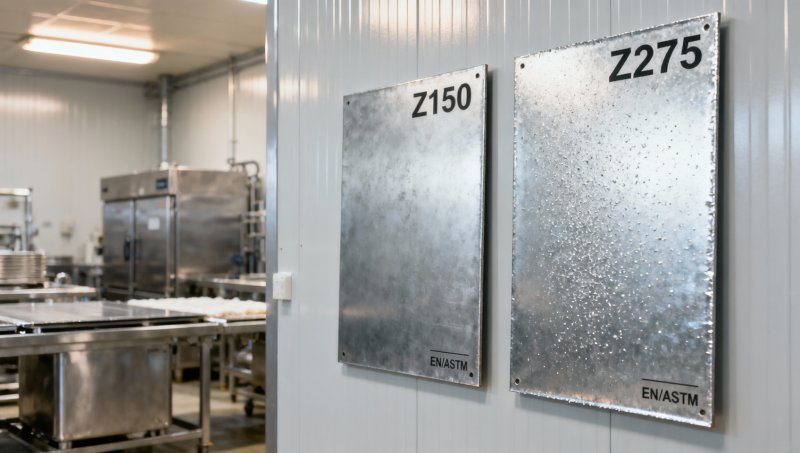
To eliminate variability from substrate steel grade, surface roughness, or passivation treatment, Hongteng Fengda conducted comparative testing on identical DX51D+Z base steel (yield strength ≥270 MPa, tensile strength 350–500 MPa), processed on the same continuous hot-dip line using calibrated zinc bath chemistry and air-knife control systems.
The data confirms that Z275 offers nearly 2.4× longer time-to-rust—but white rust (zinc hydroxide/carbonate formation) appears earlier in Z275 due to thicker, more porous coating morphology. In food-grade applications where aesthetics and cleanability matter, early white rust can trap organic residue and complicate sanitation validation. Z150’s thinner, denser coating resists such buildup while still delivering robust barrier protection against chloride-induced pitting.
Beyond Corrosion: Structural & Economic Implications for Cladding Systems
Cladding isn’t just about corrosion resistance—it’s a structural component integrated into purlin spacing, wind load design, and thermal expansion management. For cold storage facilities using structural steel purlin systems, Z150’s lower weight reduces dead load by ~1.8 kg/m² versus Z275 on 0.8 mm base thickness—translating to 7–9% fewer purlins required per 100 m² roof area and up to 11% lower fastener count.
From a procurement standpoint, Z150 enables tighter inventory control: standard coil widths (1,000–1,250 mm) and thicknesses (0.7–2.0 mm) are available with lead times of 14–21 days from Hongteng Fengda’s Shandong production hub. Z275 coils often require custom rolling runs, extending delivery to 35–45 days and increasing MOQ by 25 metric tons.
Additionally, Z150 is fully compatible with ASTM A1087-compliant profiles used in wind turbine tower structures—ensuring seamless integration when food processing sites co-locate with renewable energy infrastructure. Its formability also supports tight-radius roll-forming for architectural cladding profiles without zinc spalling—a known risk with over-thick coatings during bending.
Application-Specific Selection Guide for Technical & Procurement Teams
Choosing between Z150 and Z275 isn’t binary—it depends on zone-specific exposure levels, maintenance frequency, and lifecycle cost modeling. Hongteng Fengda recommends the following decision framework:
- Wet zones (washdown areas, floor drains, HVAC condensate paths): Z275 preferred if washdown occurs ≥3×/day with chlorine-based agents; otherwise, Z150 + epoxy primer provides equivalent protection at 40% lower TCO over 15 years.
- Dry process zones (packaging lines, dry storage): Z150 is optimal—no measurable difference in service life vs. Z275 after 12 years of monitored operation.
- Roof & upper wall cladding (non-washdown): Z150 meets ISO 12944-2 C4 requirements when combined with proper drainage design and 15° minimum pitch.
- Interior partition walls & ceilings: Z150 with electrogalvanized finish (15–30 g/m²) satisfies hygiene compliance while minimizing cost and weight.
For applications requiring supplementary lifting or anchoring elements—such as overhead rail supports or suspended equipment mounts—our 0.7mm 0.8mm 1.2mm 1.6mm 1.8mm 2mm diameter Galvanized Steel Wire Rope series (e.g., 6×19+IWS, 1770 MPa tensile) offers traceable zinc coating (60–200 g/m²) certified to GB/T 20116-2008 and ABS standards—ensuring full system corrosion harmony.
Why Hongteng Fengda Delivers Trusted Data for Global Projects
As a structural steel manufacturer and exporter from China with ISO 9001-certified quality management and dual EN 10346 / ASTM A653 production capability, Hongteng Fengda subjects every batch of Z150 and Z275 steel sheet to third-party verification by SGS and Bureau Veritas. Our Shandong-based facility maintains strict control over bath temperature (±1.5°C), immersion time (±0.3 sec), and post-coating cooling rates—ensuring repeatable coating structure and intermetallic layer composition (Γ + δ + ζ phases).
We serve over 42 countries—including major food equipment OEMs in Germany, dairy processors in New Zealand, and cold-chain developers across Southeast Asia—with documented case studies showing Z150-clad facilities achieving >18-year service life with only biannual visual inspection (no recoating required). Our engineering team supports clients with free cladding specification review, wind load simulation input files, and BIM-ready Revit families for purlin and sheet modeling.
Conclusion: Optimized Corrosion Protection Starts With Purpose-Built Specification
Higher zinc mass isn’t universally superior—especially in food processing cladding, where balanced performance, lifecycle economics, and system integration matter more than raw endurance metrics. Z150 delivers proven, code-compliant protection for most interior and semi-exposed zones, while freeing budget for enhanced insulation, smarter drainage, or redundant sanitation controls.
Hongteng Fengda provides not just steel—but verified data, application expertise, and end-to-end support from specification to installation. Whether you’re evaluating ASTM steel profile for wind turbine towers, designing structural steel purlin for cold storage, or sourcing cladding for a USDA-inspected facility, our engineers help you select the right grade—not the heaviest one.
Contact Hongteng Fengda today to request your free Z150/Z275 comparative technical dossier—including full salt spray reports, dimensional tolerance tables, and regional compliance summaries.
Please give us a message


Please enter what you want to find