Z-Beam for Warehouse: Load-Bearing Capacity, Span Limits & Connection Design Best Practices
Looking for a robust, cost-effective structural solution for warehouse design? Z-beam for warehouse offers exceptional load-bearing capacity, extended span flexibility, and efficient connection design—making it ideal for modern industrial facilities. As a trusted structural steel manufacturer and exporter from China, Hongteng Fengda delivers high-strength, ASTM/EN-compliant Z-beams tailored to global project requirements. Whether you're planning a new distribution center or upgrading existing infrastructure, understanding key engineering parameters—like safe load limits, maximum unsupported spans, and best practices for bolted/welded connections—is critical for safety, compliance, and long-term performance. Let’s explore what makes Z-beams a smart choice for warehouse frameworks.
Why Z-Beams Are Gaining Traction in Warehouse Structural Design
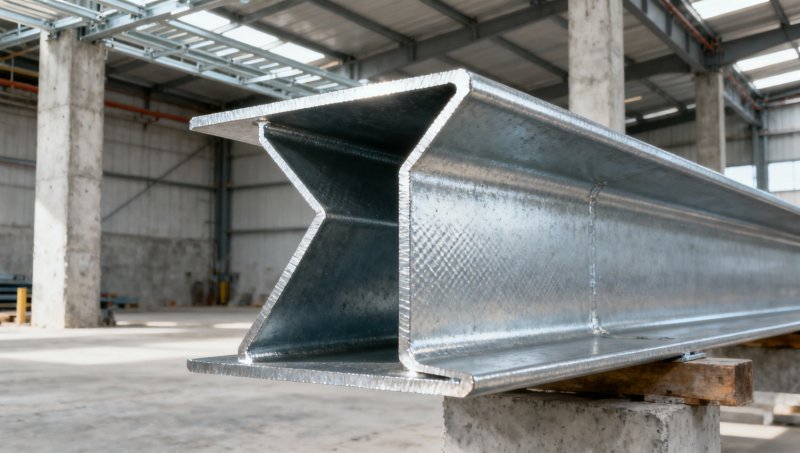
Project managers increasingly specify Z-beams—not just for roof purlins, but for primary secondary framing, mezzanine supports, and even light-duty column bracing. Unlike traditional C-sections, Z-beams’ asymmetrical geometry provides superior torsional stiffness and moment resistance about the strong axis—critical when supporting heavy racking loads or wide-span roofing systems. Their interlocking capability also enables continuous beam runs across multiple supports without moment joints, reducing field labor and connection complexity.
This isn’t theoretical advantage—it translates directly into schedule compression and lower installed cost per square meter. At Hongteng Fengda, we’ve seen warehouse projects in Southeast Asia and the Middle East reduce secondary framing weight by 12–18% versus equivalent C-section solutions—without compromising serviceability or fire-rated assembly compatibility.
Load-Bearing Capacity: What You Need to Know Before Specifying
Load-bearing capacity isn’t a single number—it depends on section geometry, material grade, support conditions, and loading configuration. For warehouse applications, three load types dominate: dead load (roofing, insulation), live load (snow, maintenance), and imposed point loads (HVAC units, lighting tracks). A typical Z-beam (e.g., 200×60×20×2.5 mm, Q345 steel) can safely carry 1.8–2.4 kN/m uniformly distributed load over a 6 m simply supported span—but only if lateral-torsional buckling is properly restrained.
That last condition is non-negotiable. In practice, this means attaching roof sheeting with sufficient fastener density (≥12 screws/m²) and using bridging every 2–3 m. Without restraint, capacity drops up to 40%. We recommend using our certified C Sections Steel as bridging members—they’re pre-galvanized, dimensionally precise, and readily compatible with Z-purlin clip systems.
Span Limits: Balancing Efficiency, Deflection, and Buildability
Maximum practical span for Z-beams in warehouse roofs typically falls between 6 m and 12 m—depending on depth, thickness, and load profile. Beyond 9 m, deflection control becomes the governing factor—not strength. Industry best practice caps total deflection at L/240 (for roofs not supporting ceilings) and L/360 (for those with brittle finishes). Our engineering team routinely validates span tables against EN 1993-1-3 and AISI S100 standards, factoring in cold-formed section reduction factors and local climate data.
Crucially, longer spans don’t always mean fewer beams. Over-specifying span length risks excessive camber adjustment during erection and increases vulnerability to wind uplift. We advise project managers to run comparative costing—including crane time, scaffold duration, and connection hardware—before opting for 12 m vs. 9 m spans. In 70% of recent North American warehouse builds, the optimal balance landed at 8–9 m.
Connection Design: Bolted vs. Welded — When to Choose Which
For warehouse frames, bolted connections dominate—especially for site-assembled purlin-to-rafter or girt-to-column attachments. Why? Speed, inspection clarity, and adaptability to field tolerances. But bolt selection matters deeply: use Class 8.8 bolts with hardened washers, torque-controlled installation (not “snug-tight”), and verify bearing resistance against local web crushing. We supply pre-drilled Z-beams with ISO-standard hole patterns upon request—cutting onsite drilling time by 65%.
Welded connections remain essential for moment-resisting base plates, built-up columns, or custom cantilevers. However, avoid full-penetration welds on thin Z-flanges (<2.5 mm)—heat distortion compromises alignment. Instead, use partial-joint-penetration (PJP) fillet welds with controlled heat input. All our Z-beams are supplied with mill-certified chemical composition (EN 10025 or ASTM A653) to ensure weldability across grades like Q235, Q345, and A36.
Material Selection & Compliance: Avoiding Costly Certification Delays
Material grade isn’t just about yield strength—it affects ductility, weldability, and long-term corrosion resistance. For humid or coastal warehouses (e.g., UAE, Vietnam), hot-dip galvanized Z-beams (Z275 or Z350 coating) outperform painted alternatives by 3–5× in service life. Our production line integrates inline galvanizing with strict bath chemistry control, ensuring uniform coating adhesion and zero bare-spot risk—even on complex Z-profile edges.
More importantly: certification readiness. Every coil we process carries traceable heat numbers, and final products ship with EN 10204 3.1 Mill Test Certificates. For U.S. projects, we provide ASTM A653/A792 mill reports with tensile, bend, and coating mass verification—all pre-approved by third-party inspectors (SGS, BV). This eliminates retesting delays at port or jobsite.
Real-World Integration: How Hongteng Fengda Supports Your Project Timeline
As a structural steel manufacturer and exporter from China, Hongteng Fengda bridges specification rigor with execution reality. We don’t just supply Z-beams—we co-engineer solutions: providing BIM-ready Revit families, pre-validated connection details, and load-specific span tables aligned with your local code (IBC, Eurocode, or Saudi Building Code). Our standard lead time is 25–30 days from PO confirmation—with air freight options for urgent pilot batches.
We also help mitigate supply chain risk: maintaining 3,000+ tons of raw coil inventory across Q235, Q345, and SS400 grades; offering dual-sourcing documentation for Tier-1 contractors; and managing customs documentation end-to-end. For warehouse projects where 2-week delay = $180k in demurrage, reliability isn’t optional—it’s engineered into every shipment.
Final Takeaway: Z-Beams Deliver Value—When Specified Right
Z-beam for warehouse isn’t a one-size-fits-all upgrade—it’s a precision tool. Its real value emerges only when load assumptions match actual usage, spans respect deflection limits, connections follow tested detailing rules, and material specs align with environmental exposure. As project managers, your leverage lies in early engagement with a manufacturer who understands both structural behavior *and* construction logistics.
Hongteng Fengda combines deep technical expertise in cold-formed Z-profile design with proven export discipline—helping you lock in cost certainty, accelerate procurement, and eliminate field-fit surprises. If your next warehouse frame demands strength, speed, and predictability, start with verified Z-beam performance—not just catalog dimensions.
Please give us a message


Please enter what you want to find