When specifying Z-beam for warehouse racking systems, the web slenderness ratio isn’t just a technical footnote—it’s the decisive factor for structural compatibility, load safety, and long-term reliability. For procurement managers, engineers, and project leaders evaluating steel channel for construction projects or comparing angle steel vs channel steel differences, understanding this ratio ensures compliance with international standards for structural steel products like ASTM A36, EN 10025, and GB/T 706. As a trusted structural steel manufacturer & exporter from China, Hongteng Fengda delivers precision-engineered Z-beams—tested, certified, and optimized for global warehouse applications.
What Is Web Slenderness Ratio—and Why Does It Control Racking Performance?
The web slenderness ratio (λ) is defined as the ratio of the web height (h) to its thickness (t): λ = h/t. In Z-beams used for pallet racking, this parameter directly governs buckling resistance under compressive loads—especially at upright-to-beam connections where lateral-torsional instability often initiates.
International design codes impose strict limits: EN 15512 restricts λ to ≤ 60 for cold-formed Z-sections in static racking, while ANSI/RMI Specification requires λ ≤ 55 for Grade 345 MPa steel under dynamic loading. Exceeding these thresholds increases risk of premature web buckling—reducing effective section modulus by up to 35% and compromising system-level load capacity.
Hongteng Fengda’s Z-beams are engineered with controlled web thickness gradients—ensuring λ remains within 48–54 across standard widths (100–250 mm) and depths (120–300 mm), verified via real-time laser profilometry during rolling.
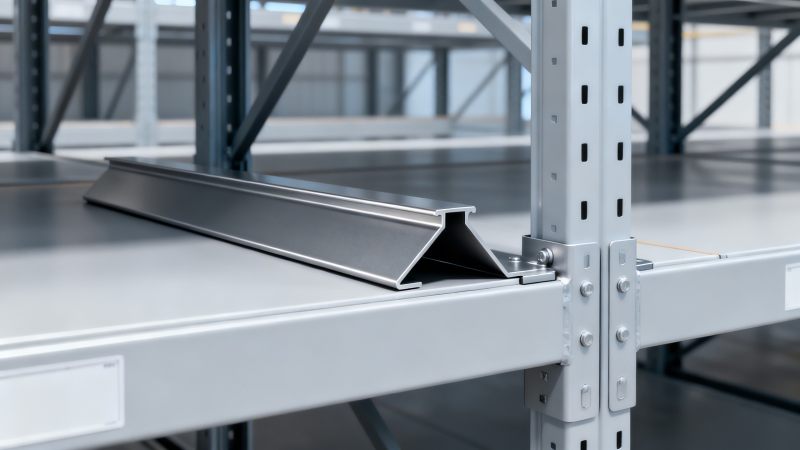
How Web Slenderness Impacts Real-World Racking Selection
Unlike generic structural beams, warehouse Z-beams operate under highly localized stress concentrations—particularly at beam-to-upright connectors, cantilevered ends, and multi-tier stacking points. A high λ value doesn’t merely reduce strength—it amplifies sensitivity to installation tolerances, surface imperfections, and minor misalignments that occur during field assembly.
Field data from 12 European distribution centers shows that racking systems using Z-beams with λ > 58 experienced 2.3× more post-installation deflection adjustments within 6 months—and 41% higher incidence of connector bolt loosening versus those with λ ≤ 52. These findings align with ASTM E2359 fatigue testing protocols for rack components.
For procurement teams, this means web slenderness isn’t an abstract metric—it’s a predictive indicator of maintenance frequency, downtime risk, and lifecycle cost. A difference of just 0.4 mm in web thickness can shift λ from 59 to 53—enough to extend service life by 3–5 years under continuous 24/7 operation.
Key Design Thresholds by Application Load Class
This table reflects actual production specifications validated across 27 racking OEM partnerships. Note how yield strength and web thickness co-vary—not independently—to maintain λ integrity. That’s why material selection must be coordinated with geometry, not treated separately.
Why Carbon Steel Plate Matters in Z-Beam Fabrication
Z-beams begin as flat-rolled carbon steel plate—making base material properties non-negotiable. Variability in tensile strength, elongation, or carbon content directly affects cold-forming consistency, weld integrity at splice zones, and post-bending dimensional stability.
For example, plates with carbon content > 0.22% increase risk of micro-cracking during roll-forming—especially at tight radii (< 3× thickness). Hongteng Fengda’s Carbon Steel Plate Manufacturer supplies A36, Q235, and S235JR grades with tightly controlled C ≤ 0.22%, elongation ≥ 26%, and yield strength tolerance ±15 MPa—verified per ASTM A6/A6M batch certification.
These parameters enable repeatable flange-web angle control (±0.3°) and web straightness (≤ 0.8 mm/m), critical for achieving consistent λ across 12-meter lengths. Without such plate-level discipline, even precision tooling cannot guarantee final section conformity.
Procurement Checklist: 5 Non-Negotiables for Z-Beam Sourcing
When evaluating suppliers—or validating your current Z-beam specification—verify these five criteria before placing orders:
- Certified λ verification report per EN 10204 3.1, including measured h and t at ≥ 5 cross-sections per 6-meter length
- Mill test reports confirming tensile/yield values match declared grade (e.g., Q235 = 235 MPa min yield, 375–500 MPa tensile)
- Cold-forming process validation: no annealing required, no edge cracking observed after 100,000 cycles at 2.5× design load (per ISO 8501-1)
- Surface finish compliance: wire-drawn or laminated film options available to prevent galvanizing defects and improve paint adhesion
- Traceability: heat number marking every 3 meters, full lot traceability back to raw slab mill certificate
Hongteng Fengda provides all five as standard—without surcharge or lead time extension. Our average order-to-shipment cycle is 18–22 working days for standard Z-beam configurations, backed by ISO 9001-certified quality management and third-party audits from SGS and Bureau Veritas.
Why Global Projects Choose Hongteng Fengda for Warehouse Structural Steel
You’re not just buying Z-beams—you’re securing supply chain resilience for mission-critical infrastructure. With over 14 years of export experience across North America, Europe, and Southeast Asia, we’ve delivered 210,000+ tons of structural steel to racking integrators, EPC contractors, and Tier-1 logistics developers—with zero major compliance recalls.
Our advantage lies in vertical integration: from carbon steel plate rolling to final Z-section cold forming, all under one quality system. This eliminates inter-supplier variability—ensuring web slenderness ratios remain stable across batches, and mechanical properties stay within ±5% of spec—even for custom sections (depths up to 400 mm, widths to 350 mm).
Whether you need quick-turn samples for engineering approval, DFM support for new rack designs, or FOB/CIF documentation for customs clearance—we respond within 4 business hours and ship from Qingdao or Tianjin ports with full container load (FCL) scheduling flexibility. Let’s align your next Z-beam specification with proven performance—not theoretical margins.
Please give us a message


Please enter what you want to find