When your steel bar supplier claims 'low carbon', don’t assume compliance — verify against EN 10025-2 S355JR’s exact chemical, mechanical, and dimensional requirements. As a trusted structural steel manufacturer & exporter from China, Hongteng Fengda ensures every steel bar, steel beam, hot dip galvanized steel pipe, and hot dip galvanized steel sheet meets international standards — not just marketing terms. Whether you’re comparing steel beams price, evaluating steel bar cost, or sourcing from an SS pipe manufacturer or steel bar supplier, technical accuracy impacts safety, procurement timelines, and project ROI. Let’s clarify what ‘low carbon’ really means — and why certification, traceability, and third-party testing matter to engineers, buyers, and quality managers alike.
What “Low Carbon” Really Means in Structural Steel
“Low carbon” is often used loosely in supplier communications — but under EN 10025-2, it’s a strictly defined term tied to precise chemical composition limits. For S355JR, the maximum allowable carbon content is 0.22% (by mass), with manganese capped at 1.60%, phosphorus ≤ 0.035%, and sulfur ≤ 0.035%. Exceeding any of these thresholds invalidates EN 10025-2 S355JR compliance — regardless of tensile strength or yield values.
Crucially, low carbon alone doesn’t guarantee weldability, impact toughness, or ductility. S355JR requires minimum Charpy V-notch impact energy of 27 J at +20°C — a non-negotiable benchmark for structural integrity in variable climates. Many suppliers omit this data unless explicitly requested, creating hidden risk for projects in Europe or North America where EN/ASTM dual compliance is standard.
Mislabeling also occurs when mills substitute equivalent grades like S235JR or Q345B without documentation. While chemically similar in some ranges, their yield strengths differ by ≥120 MPa — directly affecting load-bearing calculations and safety margins. That’s why mill test reports (MTRs) must be reviewed per heat number, not batch summary sheets.
How to Verify EN 10025-2 S355JR Compliance — 5 Non-Negotiable Checks
Procurement teams, QA managers, and project engineers need actionable verification steps — not just trust in supplier statements. Here’s what to demand before purchase or shipment:
- Full chemical analysis per EN ISO 14284 — including carbon, manganese, silicon, phosphorus, sulfur, and nitrogen — certified by an ILAC-accredited lab (e.g., SGS or BV)
- Tensile test results showing minimum yield strength ≥355 MPa, ultimate tensile strength 470–630 MPa, and elongation ≥22% (L₀ = 5.65√S₀)
- Impact test report confirming ≥27 J at +20°C per EN ISO 148-1, with specimen orientation (longitudinal/transverse) specified
- Dimensional tolerance verification per EN 10058 (for flat products) or EN 10034 (for sections) — critical for fit-up in automated fabrication lines
- Traceable heat number linkage across MTR, delivery note, and packaging labels — enabling full recall capability if non-conformance arises on-site
Without all five, “low carbon” remains an unverified claim — exposing your project to rework delays (typically 7–15 days), cost overruns (up to 18% of structural package), and liability in case of failure.
C Channel Beam: Precision-Engineered for EN-Compliant Applications
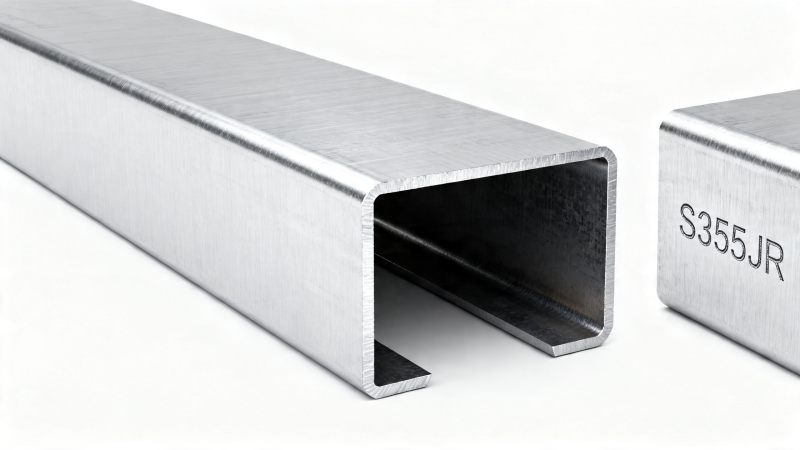
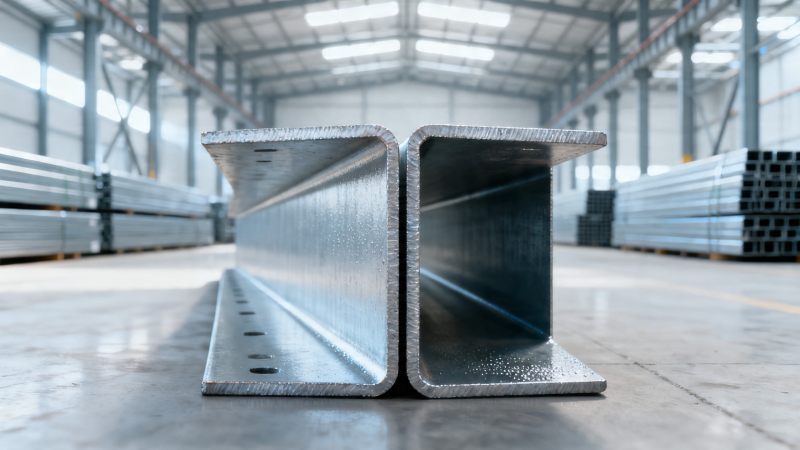
For structural frameworks requiring consistent S355JR-grade performance, our C Channel Beam delivers traceable compliance across all key parameters. Manufactured via hot-rolling with optional cold-forming for tighter tolerances (±1%), each beam undergoes 100% ultrasonic testing and receives full EN 10025-2 certification documentation.
Designed for steel structure buildings and mechanical light industry manufacturing, it supports purlins, wall beams, roof trusses, and machine support arms — with material options spanning Q235, Q345, S235JR, and ASTM A36. Surface treatments include hot-dip galvanizing (Z275 coating per EN ISO 1461), powder coating, or black varnish — all applied post-certification to preserve mechanical properties.
Standard lengths are 6m, 9m, and 12m; thickness range is 1mm–12mm. All units ship with CE, SGS, BV, and ISO 9001 certifications — backed by 15–20 day lead times and FOB/CFR/CIF trade terms.
EN 10025-2 S355JR vs. Common Alternatives: Technical Comparison
Selecting the right grade isn’t about cost alone — it’s about matching performance to application stress, environmental exposure, and regulatory jurisdiction. The table below compares S355JR against frequently substituted materials:
Note: While A572 Gr. 50 and Q345B meet strength requirements for many applications, only S355JR mandates impact testing — making it essential for seismic zones, cold-climate infrastructure, and EU public tenders. Choosing alternatives without verifying local code acceptance may trigger rejection during inspection.
Why Global Buyers Trust Hongteng Fengda for EN-Compliant Structural Steel
We eliminate sourcing uncertainty through three pillars: precision manufacturing, full documentation, and responsive partnership. Every order includes certified MTRs, dimensional inspection reports, and galvanizing thickness verification — delivered digitally within 24 hours of shipment.
Our production capacity supports stable supply across 6–12 month project cycles, with consistent quality across batches — verified by quarterly audits against ISO 9001 and EN 10025-2 internal protocols. For buyers managing multi-country projects, we pre-validate documentation for CE marking, UKCA, and GCC conformity — reducing customs clearance time by up to 40%.
Whether you need S355JR-certified C Channel Beam, custom-cut steel beams, or OEM cold-formed profiles, our engineering team provides free technical consultation — including grade selection, surface treatment recommendations, and dimensional feasibility review — before quotation.
Next Steps: Get Verified S355JR Documentation & Pricing
Don’t rely on verbal assurances. Request the following from us today:
- Sample EN 10025-2 S355JR mill test report (heat-specific, with full chemistry and mechanicals)
- Lead time confirmation for your required dimensions, quantity, and surface treatment
- Custom quote with breakdown of steel bar cost, processing fees (bending/punching), and galvanizing surcharge
- Documentation package preview: CE certificate, SGS test summary, ISO 9001 scope, and packing list template
Contact our technical sales team to discuss your next structural steel order — and receive a compliance-readiness checklist tailored to your project’s jurisdiction and application.
Please give us a message


Please enter what you want to find