Understanding relaxation loss in wire steel for prestressed concrete is critical for structural integrity—especially when choosing between cold drawn wire and as-drawn grades. As a trusted steel wire manufacturer from China, Hongteng Fengda supplies high-performance round steel wire, carbon wire, cold drawn wire, and galvanized steel wire coil—compliant with ASTM, EN, and GB standards. Whether you're a project manager specifying prestressing tendons, a procurement officer comparing cost-performance ratios, or a quality control specialist verifying HRC coil consistency, this article explains why relaxation behavior differs fundamentally—and how it impacts long-term load capacity, safety margins, and lifecycle cost. Explore the metallurgical and processing drivers behind relaxation loss, backed by real-world application insights.
What Causes Relaxation Loss — And Why It’s Not Just About Tensile Strength
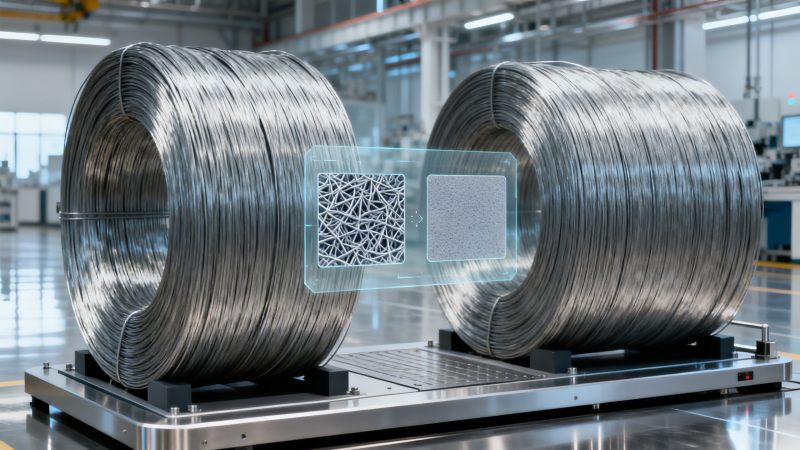
Relaxation loss refers to the time-dependent reduction in stress within a prestressing wire under constant strain. In practice, this means that even after initial tensioning, up to 3–5% of the designed prestress can dissipate within the first 1,000 hours—especially at elevated temperatures (e.g., >20°C) or sustained high stress levels (>70% of ultimate tensile strength). This phenomenon directly affects deflection control, crack resistance, and service life of post-tensioned bridges, high-rise slabs, and precast beams.
The root cause lies not in material purity alone, but in microstructural evolution during manufacturing. Cold drawn wire undergoes severe plastic deformation (reduction in area ≥25%), introducing dislocation tangles and residual stresses that gradually reorganize under load. As-drawn wire, by contrast, retains a more equiaxed ferrite-pearlite structure with lower internal energy—resulting in slower relaxation kinetics but also lower yield strength (typically 1,200–1,400 MPa vs. 1,550–1,860 MPa for cold drawn).
Hongteng Fengda’s production process includes controlled cooling and stabilizing heat treatment for both grades—ensuring ASTM A421 Class II (≤2.5% relaxation at 1,000 h, 70% UTS) compliance across batches. This eliminates guesswork for engineers validating long-term tendon performance in seismic zones or humid coastal environments.
Cold Drawn vs. As-Drawn: A Technical & Procurement Comparison
Selecting between cold drawn and as-drawn wire isn’t merely about yield strength—it’s a systems-level decision involving installation logistics, design safety factors, and lifecycle verification protocols. Below is a direct comparison based on ISO 6934-4, EN 10138-3, and GB/T 5223-2014 test requirements:
This data shows a clear trade-off: cold drawn delivers higher initial force and tighter relaxation control—but requires more precise anchorage design and stricter handling to avoid surface damage. As-drawn offers greater coil weight per shipment and lower bending fatigue risk during threading, making it preferred for curved ducts in segmental bridge construction. Both are available in our full Wire rod range—including HRB400 and HRB500 grades with Q235/Q345 base material—ready for immediate conversion into finished prestressing strands.
How Hongteng Fengda Ensures Consistency Across Production Batches
For procurement teams and quality managers, batch-to-batch variation—not just nominal grade—is the real risk. At Hongteng Fengda, every coil undergoes three mandatory checks before release: (1) tensile testing per ASTM A370, (2) relaxation verification at 20°C/40°C per ISO 15630-3, and (3) surface roughness measurement (Ra ≤ 0.8 µm) to ensure uniform grouting adhesion.
Our hot-rolled Wire rod feedstock—available in diameters from 6mm to 40mm—meets GB/T 14981 tolerance limits (±0.4mm for ≤10mm, ±0.5mm for >10mm). This tight dimensional control reduces drawing breakage rates by up to 35% compared to standard commercial rods, translating to lower scrap costs and faster turnaround for custom-diameter orders.
We support global buyers with dual-certified documentation (SGS + BV CE), 7–15 day lead times for standard sizes, and OEM labeling options—including traceable QR-coded coil tags linked to mill test reports. For projects requiring third-party witnessed testing (e.g., EN 10138-3 Annex B), we coordinate lab access at our Shandong facility or via accredited partners in Dubai and Rotterdam.
Why Choose Hongteng Fengda for Your Prestressing Wire Supply?
You need more than spec sheets—you need predictability. With over 12 years serving infrastructure contractors in North America, the Middle East, and Southeast Asia, Hongteng Fengda provides end-to-end technical partnership:
- Free engineering consultation on strand selection (e.g., matching relaxation class to local climate data or design code requirements like ACI 318-19 Chapter 20)
- Pre-shipment sample coils with full mechanical and chemical certification (C, Mn, Si, S, P, Cr, Ni per ASTM A510)
- Flexible packaging: moisture-proof wooden crates for marine export, or PVC-wrapped bundles for inland distribution
- Dedicated project coordinators for multi-container shipments—ensuring synchronized delivery across 3–4 port calls
Whether your priority is minimizing long-term creep in a 120-year dam foundation or optimizing coil handling efficiency on a fast-track rail viaduct, our team helps you select the right wire grade—not just the cheapest one. Contact us today to request a comparative quotation, review mill test report templates, or schedule a virtual factory audit.
Please give us a message


Please enter what you want to find