For technical evaluators assessing spring material performance, oil tempered carbon steel wire for valve spring is a practical choice because it combines high tensile strength, fatigue resistance, and dimensional stability under repeated stress.
In demanding engine applications, this material helps improve spring reliability, production consistency, and cost efficiency, making it essential to understand why it remains a preferred option.
In the steel industry, material selection is rarely about strength alone.
Valve spring service involves cyclic loading, heat exposure, precise forming, and stable long-term performance.
That is why oil tempered carbon steel wire for valve spring remains widely specified across automotive and industrial engine applications.
Hongteng Fengda, a structural steel manufacturer and exporter from China, supports global projects with reliable steel products, strict quality control, and standards-based supply capabilities.
Why engine spring service creates a special material selection scenario
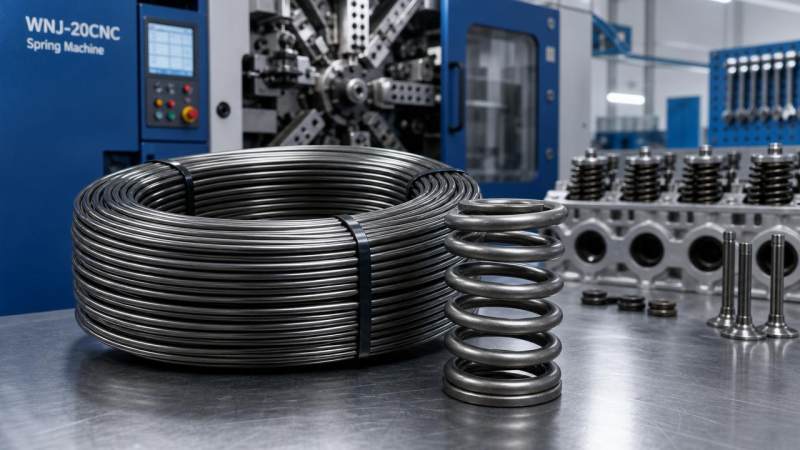
Valve springs work in a highly repetitive stress environment.
Every compression cycle pushes the wire toward fatigue limits, especially at high engine speed.
In this scenario, ordinary low-performance wire quickly shows weaknesses.
Loss of load, surface cracking, poor coiling response, and inconsistent hardness can all shorten spring life.
Oil tempered carbon steel wire for valve spring fits this scenario because it is processed for strength, resilience, and manufacturing stability.
Its heat treatment route improves microstructure uniformity and supports predictable spring forming behavior.
What makes this scenario different from general spring use
- Higher cycling frequency than many static or low-motion springs
- Greater sensitivity to surface quality and decarburization control
- Tighter demand for wire diameter consistency
- Need for stable response during coiling and heat setting
- Strong link between material quality and engine reliability
Typical application scenarios where oil tempered carbon steel wire for valve spring performs best
High-speed automotive engines
High-speed engines need valve motion control without spring surge or early fatigue failure.
In this scenario, oil tempered carbon steel wire for valve spring supports reliable load retention and repeatable dynamic behavior.
The key judgment point is fatigue resistance under millions of cycles.
Tensile properties matter, but surface integrity often matters even more.
Commercial vehicle engines with long service intervals
Long-running engines require springs that remain stable over extended operation.
Here, oil tempered carbon steel wire for valve spring is valued for durability, process consistency, and cost-effective mass production.
The core judgment point is not only peak strength.
It is also whether the wire maintains spring geometry and mechanical balance after repeated loading.
Small engines and industrial power units
This scenario often balances technical performance with budget limits.
Oil tempered carbon steel wire for valve spring offers a practical combination of strength, formability, and reasonable cost.
The best choice depends on operating speed, expected service hours, and production volume.
When the target is stable quality without excessive alloy cost, this material is often the preferred baseline.
How performance needs change across steel application scenarios
Material evaluation becomes clearer when application differences are compared directly.
In broader steel sourcing, related sheet and structural materials also matter for surrounding equipment and fabrication needs.
For corrosion-resistant fabrication in construction, industry, transportation, or home appliances, Galvanised Sheet Steel Suppliers can support projects requiring DX51D, SGCC, S250GD, and other common grades.
These galvanized sheets typically offer thickness from 0.12mm to 6.00mm and width from 600mm to 1500mm.
They are widely used where atmospheric corrosion resistance, easy processing, and standards compliance are essential.
What technical features explain the preference for oil tempered carbon steel wire for valve spring
High tensile strength with usable toughness
Valve springs need wire that can carry high stress without becoming too brittle.
Oil tempering helps create a balanced property profile.
This balance supports both spring load performance and safe forming during manufacturing.
Improved fatigue resistance under cyclic loading
Fatigue is the main failure mode in valve spring applications.
Oil tempered carbon steel wire for valve spring performs well because the process supports a refined, stable structure.
When paired with good surface quality, fatigue life improves significantly.
Dimensional consistency for spring manufacturing
Stable wire diameter and predictable mechanical response reduce variation during coiling.
That means better spring pitch control, more consistent free height, and less downstream adjustment.
This is one reason oil tempered carbon steel wire for valve spring is attractive for repeatable production.
Cost efficiency in volume applications
Not every application requires expensive alloy spring wire.
For many operating conditions, properly processed carbon steel wire delivers the needed performance at a more competitive total cost.
Practical selection advice for matching the material to the right scenario
- Check engine speed, duty cycle, and target fatigue life before comparing grades.
- Review surface condition requirements, including decarburization and defect tolerance.
- Confirm wire diameter tolerance and coilability for the planned spring geometry.
- Evaluate heat treatment consistency, not only nominal strength values.
- Use standards-based inspection for mechanical properties and dimensional stability.
A reliable supply partner should also provide traceability, testing support, and stable lead times.
This reduces sourcing risk and supports smoother qualification for engine-related steel components.
Common misjudgments when evaluating valve spring wire
Assuming higher strength always means better spring life
Excessive focus on tensile strength can hide brittleness or poor fatigue behavior.
Real performance depends on the full balance of microstructure, surface quality, and processing consistency.
Ignoring manufacturing compatibility
A wire with strong lab data may still perform poorly during coiling or heat setting.
Production stability is part of material suitability, not a separate issue.
Overlooking application-specific operating conditions
Temperature, stress range, vibration, and service intervals can change the best material choice.
Oil tempered carbon steel wire for valve spring should be judged in its real operating scenario, not in isolation.
Next-step evaluation path for better steel material decisions
If spring reliability, cost control, and process stability are all important, oil tempered carbon steel wire for valve spring deserves close evaluation.
Start with actual operating conditions, then compare fatigue requirements, forming needs, and supply consistency.
A structured review helps separate suitable wire options from materials that only look strong on paper.
With standards-aligned steel sourcing and dependable quality control, better spring performance becomes much easier to achieve.
Please give us a message


Please enter what you want to find