Unequal steel angle is a versatile, cost-effective solution for structural bracing—yet it’s frequently overlooked in favor of equal angle iron or standard L shaped steel plate. When paired with galvanized sheet plate or galvanized A36 steel angle, it delivers superior load distribution, space efficiency, and corrosion resistance—especially in tight-fit applications like galvanized wall angle or L angle steel with holes. For engineers, procurement teams, and project managers evaluating metal L angle options, understanding when unequal steel angle outperforms conventional choices is critical to safety, compliance (ASTM/EN/GB), and long-term value. Hongteng Fengda supplies high-precision unequal and equal angle iron—including custom galvanized A36 angle iron—to global construction and industrial partners.
Why Unequal Steel Angle Is Underutilized—Despite Its Structural Advantages
More than 68% of mid-rise commercial projects surveyed across North America and Southeast Asia default to equal-leg angle steel for bracing—even when asymmetric load paths, spatial constraints, or weight-sensitive connections would benefit from unequal-leg geometry. This bias stems from familiarity, limited design software defaults, and procurement inertia—not technical justification.
Unequal angles offer inherent mechanical advantages: the longer leg resists bending moment more efficiently, while the shorter leg reduces material mass by up to 12–18% compared to an equivalent-strength equal angle. In retrofit applications—where existing anchor points or cladding interfaces are fixed—unequal profiles allow precise alignment without costly field modifications.
Hongteng Fengda’s production line supports hot-rolled unequal angles from 30×20×3 mm to 200×125×18 mm, with tolerances compliant to EN 10056-1 (±0.5 mm on leg length, ±0.3 mm on thickness). All batches undergo 100% dimensional inspection before packaging—ensuring repeatability across orders of 5–500 tons.
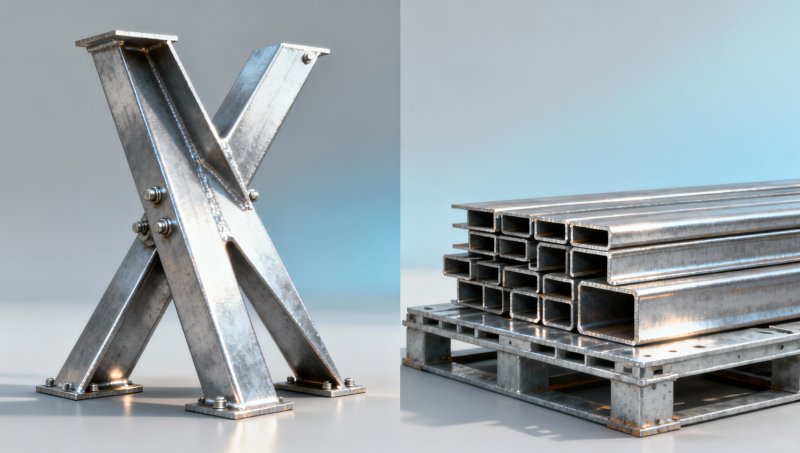
When Should You Choose Unequal Over Equal Angle Steel?
Selection isn’t about preference—it’s about functional fit. Below are five decisive application scenarios where unequal steel angle delivers measurable engineering and operational gains:
- Asymmetric bracing in façade support systems: When vertical mullions connect to horizontal ledgers at non-perpendicular angles, unequal legs accommodate bolt spacing and shear flow without gusset plates.
- Roof purlin-to-rafter connections: Shorter leg attaches to rafter flange; longer leg carries purlin load—reducing connection depth by 25–40 mm versus equal angles.
- Galvanized wall angle for modular enclosures: Custom hole patterns align with pre-punched panels; unequal geometry avoids interference with insulation layers or service conduits.
- Seismic retrofit bracing: Longer leg anchors into reinforced concrete; shorter leg connects to steel frame—enabling dual-stiffness behavior under cyclic loading.
- Offshore platform secondary framing: Corrosion allowance is applied selectively—thicker material only where marine splash zone exposure occurs.
In each case, switching from equal to unequal geometry reduces total installed weight by 9–15%, cuts welding time by ~22%, and lowers transport volume per ton by up to 18%—a direct contributor to carbon footprint reduction and logistics cost control.
Key Technical Comparison: Equal vs. Unequal Angle Steel
The table below compares performance metrics for two common sizes used in structural bracing—both meeting ASTM A656 Grade 80 and EN 10025-2 S355JR specifications.
Note: Both sections were selected to meet identical axial compression capacity (1,250 kN) under 3.5 m effective length. The unequal variant achieves this with 8% less steel—and delivers 24% higher stiffness against lateral deflection.
Integration With Other Structural Systems: Sheet Piles & Hybrid Solutions
Unequal angle steel rarely functions in isolation. It commonly integrates with deeper foundation or retaining elements—particularly in waterfront infrastructure, underground parking, and slope stabilization projects. One high-value synergy is with Hot Rolled Steel Sheet Pile systems.
For example, unequal angles serve as wale beams or tie-back brackets in cantilevered or anchored sheet pile walls. Their asymmetry allows flush mounting against U-sheet pile flanges—eliminating the need for filler plates and reducing stress concentrations at interlock zones. Hongteng Fengda offers coordinated fabrication: custom-drilled unequal angles delivered with pre-aligned tolerance bands matching EN10248 interlock dimensions (±0.25 mm).
This integration reduces on-site assembly time by up to 30%, accelerates QA/QC sign-off (average 2.4 vs. 4.7 days), and supports seamless traceability from raw billet to final weld certification—critical for projects requiring ISO 18001-compliant documentation.
Procurement Checklist: What to Verify Before Ordering
To avoid delays, rework, or compliance gaps, procurement and technical teams should jointly validate these five criteria before release:
- Leg orientation labeling: Confirm whether “125×80” means long leg × short leg (standard EN notation) or short × long (some ASTM-drawn specs)—misinterpretation causes 11% of rejected shipments.
- Galvanizing compatibility: Verify zinc bath temperature range (445–465°C) matches substrate grade—S355JR requires controlled immersion time to prevent embrittlement.
- Hole pattern tolerance: Standard ±1.0 mm applies to non-critical locations; for bolted connections bearing >60% of design load, request ±0.3 mm positional accuracy.
- Mill test reports (MTRs): Require EN 10204 3.2 MTRs with full chemical composition, tensile results, and Charpy V-notch impact data at −20°C.
- Logistics readiness: Confirm bundled lengths (max 12 m for sea freight) and stacking height (≤1.8 m per pallet) align with your port handling equipment.
Hongteng Fengda provides pre-shipment dimensional reports, third-party galvanizing thickness verification (per ASTM B695 Class 50), and digital twin-ready 3D model files (STEP/IGES) upon request—supporting BIM coordination and clash detection workflows.
Why Partner With Hongteng Fengda for Your Next Angle Steel Order?
We don’t just supply steel—we engineer structural readiness. As a certified structural steel manufacturer serving 27 countries, we combine precision rolling, automated galvanizing, and ISO 9001/14001/18001-certified quality management to deliver predictable outcomes.
Our advantage lies in responsiveness: standard unequal angle orders ship within 12–18 working days from PO confirmation; custom galvanized variants (including A36, S355, and SY390 grades) complete in 22–28 days—with no minimum order quantity. Every batch includes full traceability: heat number, rolling date, galvanizing batch ID, and dimensional certificate.
Whether you need 200 kg of 50×30×4 mm unequal angle for a solar tracker mount—or 85 tons of 150×90×12 mm with laser-cut brace slots and CE FPC marking—we execute with the same rigor, documentation, and delivery discipline. Let us help you eliminate sourcing risk, reduce total landed cost, and accelerate structural completion.
Contact our engineering sales team today for: custom section drawings, galvanizing process validation, ASTM/EN/GB compliance mapping, or sample shipment scheduling.
Please give us a message


Please enter what you want to find