Why the grade matters when specifying A572 structural steel channel
Specifying an A572 structural steel channel involves more than selecting section dimensions. The grade establishes minimum yield strength and affects design checks, fabrication decisions, and material acceptance. A channel that matches the drawing geometrically may still be unsuitable if its certified grade differs from the material assumed in the calculations.
The practical mistake is treating “ASTM A572” as a complete specification. It is not. The purchase order needs a grade, an identifiable section, and the applicable standard edition, together with any project-specific requirements. Otherwise, engineering and procurement can approve the same description while expecting different material.
“A572” names the specification; the grade sets the strength level
ASTM A572/A572M covers high-strength, low-alloy structural steel in several product forms. Its grade designations correspond to specified minimum yield strengths. They do not mean that every channel size is available in every grade, or that one grade can automatically replace another.
These are grade reference values, not a channel availability chart. ASTM A572/A572M imposes product-form and size limitations that must be checked in the specified edition. Tensile strength and elongation requirements also matter; accepting steel solely because its yield result exceeds the table value leaves part of the specification unchecked.
Grade 50 is a familiar choice in structural procurement, but familiarity is not proof of availability. A stockist may have a particular channel in another specification, while a mill may require a production order for the requested A572 grade. Resolve that distinction before approving a delivery schedule.
Higher yield strength does not improve every design check
For a member governed by yielding, a higher specified yield strength can increase calculated resistance. That makes grade selection relevant to tension members, some bending checks, and certain connection limit states. But structural performance is not a single strength calculation.
Consider a channel supporting equipment between two frames. If the problem is excessive service-load deflection, changing from Grade 42 to Grade 50 without changing the section will generally not solve it. The elastic modulus used for ordinary structural steels is essentially unchanged by this grade upgrade. Span, loading, support conditions, and section stiffness still govern elastic deflection.
Compression introduces another constraint. A slender channel can buckle before it develops its yield-based resistance. Higher strength may still affect the design result, but the benefit depends on member slenderness, restraint, and the governing design method. Local slenderness limits can also become more restrictive as yield strength increases.
Channels deserve particular attention because they are open, unsymmetrical sections. Load applied away from the shear center can produce twisting. A higher grade does not correct an unfavorable load path, insufficient lateral restraint, or a connection that permits rotation.
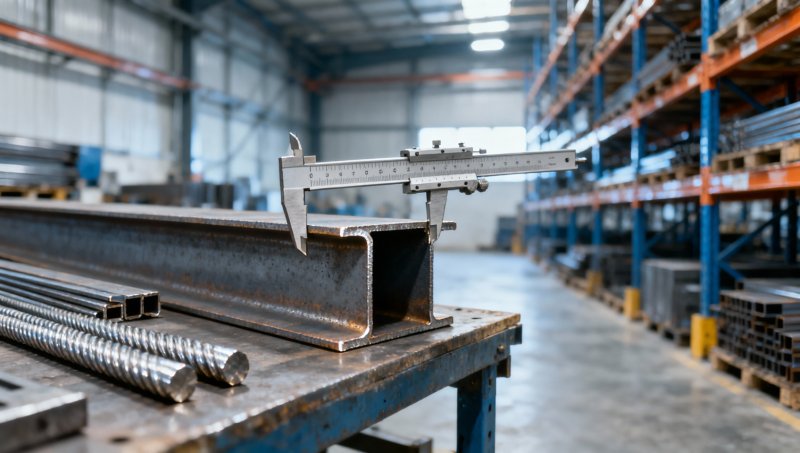
The useful question is therefore not “Which grade is strongest?” It is “Which limit state controls this channel, and does increasing yield strength address it?” Where deflection, torsion, or stability governs, changing the section or its restraint may be more effective than paying for a higher grade.
Verify the section and thickness before discussing substitution
A channel designation must identify more than overall depth. Flange width, web thickness, flange thickness, corner geometry, and mass per unit length determine section properties. Two channels sold under similar nominal dimensions can have different bending stiffness and connection geometry.
This matters in international sourcing. An American C or MC section, a European channel, and a channel produced to another national dimensional standard should not be treated as equivalent because their depths look similar. ASTM A572 specifies material requirements; it does not make different section families geometrically interchangeable.
For rolled structural shapes, ASTM A6/A6M provides relevant general requirements, including dimensional tolerances, as invoked by the material specification. The order should identify the section designation or an approved drawing, rather than relying on a catalogue photograph or nominal depth alone.
Grade applicability and dimensional conformity are separate checks. Confirm that the proposed product form and relevant thickness fall within the selected grade’s scope. Then verify the dimensions against the ordered section. A satisfactory tensile test cannot compensate for an undersized flange or an unapproved profile.
Also distinguish hot-rolled channels from cold-formed or fabricated channels. Using A572-certified feedstock does not, by itself, establish the finished member’s dimensional tolerances, forming effects, welding requirements, or design basis. The manufacturing route belongs in the technical review.
Weldability depends on more than the grade label
A572 steels are commonly used in welded structures, but “weldable” is not permission to use one procedure for every grade and thickness. Base-metal chemistry, joint restraint, thickness, hydrogen control, and heat input all influence fabrication risk.
For work governed by AWS D1.1/D1.1M, check the applicable edition’s base-metal listings and procedure requirements. Whether a welding procedure can be prequalified depends on the actual material and the other prequalification conditions. Do not extend approval from one grade to another merely because both certificates say A572.
The mill chemistry can support a carbon-equivalent assessment where the project or welding procedure requires one. State which formula is being used: different carbon-equivalent expressions are not interchangeable. Nor should a single calculated value be used as a substitute for the applicable preheat and procedure requirements.
A welded bracket on a thick channel flange illustrates the issue. The detail can combine significant restraint with rapid heat extraction. The relevant decision is whether the approved welding procedure covers that material, thickness, and joint—not whether the supplier describes the channel as easy to weld.
Low-temperature or impact-sensitive service requires another explicit check. An A572 grade designation alone does not establish a project-specific Charpy toughness guarantee. If impact testing is required, define the test temperature, acceptance criteria, specimen requirements, and applicable sampling provisions before production.
Read the mill test report against the order, not in isolation
A mill test report is useful only when it can be connected to the delivered channels. Start with the heat number and product identification, then compare the report with the purchase order and governing specification. A certificate for another heat or product is not evidence for the bundle being inspected.
- Material identity: Verify the stated specification, grade, and applicable edition where recorded. Resolve missing or ambiguous information before acceptance.
- Chemistry: Check reported elements against the applicable grade and product requirements, including required alloying provisions.
- Mechanical results: Review yield strength, tensile strength, and elongation with the relevant specimen and gauge-length information.
- Additional testing: Confirm that any ordered impact tests or supplementary requirements are documented and satisfy the project criteria.
- Traceability: Match heat identification to bundle tags or markings and preserve that link through cutting and fabrication.
One recurring acceptance error is upgrading material on the strength of a favorable test result. A lower-grade certificate showing yield strength above a higher grade’s minimum does not automatically certify the higher grade. Compliance includes chemistry, tensile properties, elongation, product scope, and the required certification.
The reverse deserves caution too: a certified higher grade is not automatically an acceptable substitute. Connections, seismic provisions, welding procedures, and project specifications may constrain substitution. Any change should pass through the responsible engineering approval process.
Keep mixed-material packages from blurring the specification
Channel orders often arrive within a package containing angles, beams, brackets, and fabricated parts. Hongteng Fengda, a China-based structural steel manufacturer and exporter, supplies these product families. For such packages, the practical safeguard is a material schedule assigning a section, grade, standard, and inspection requirement to each line item.
For example, the Angle Steel Supplier range includes angle dimensions from 20 × 20 × 3 mm to 200 × 200 × 20 mm for framing, bracing, brackets, and reinforcement applications. Those angles may accompany channels, but their listed grades must be evaluated separately. A grade offered for an angle does not establish the grade of a neighboring channel.
Likewise, ASTM, EN, JIS, and GB designations should not be mapped by yield strength alone. Their requirements can differ in chemistry, toughness, testing, and delivery condition. If an alternative is proposed, obtain the exact designation and a documented comparison. “Equivalent steel” is a starting point for review, not an acceptance decision.
Specify what must remain true at delivery
A defensible A572 structural steel channel order identifies the material specification and grade, exact section, quantity and length, dimensional requirements, certification, and any additional testing. It also states whether substitutions require written approval. Surface protection should be specified separately; A572 is not inherently weathering steel or a corrosion-protection system.
Before releasing the order, confirm three things: the design actually benefits from the selected grade, the supplier can provide that grade in the required section, and the inspection documents will demonstrate compliance. If any answer is uncertain, resolve it before cutting or welding begins. That is when a material correction remains manageable rather than becoming a fabricated-steel problem.
Please give us a message


Please enter what you want to find