Before any beam, channel, or custom component reaches the jobsite, structural steel testing plays a critical role in protecting project quality, safety, and schedule. For engineering and construction teams, early verification confirms material performance, checks compliance with ASTM, EN, JIS, and GB requirements, and reduces installation risk. Understanding why structural steel testing matters before installation supports better sourcing, fabrication, and site decisions.
Why pre-installation structural steel testing is essential
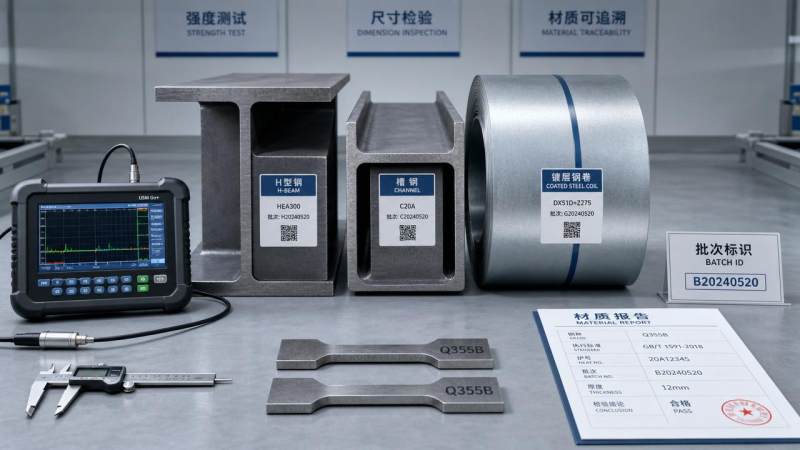
Structural steel rarely fails because of one visible defect. Problems usually start with hidden variations in chemistry, strength, weldability, coating quality, or dimensional tolerance.
If those issues appear after delivery or erection, correction becomes slow and expensive. Rework may involve cutting, replacement, re-welding, repainting, and schedule disruption.
That is why structural steel testing should happen before installation, not after. Testing creates documented proof that the supplied steel matches drawings, standards, and intended loading conditions.
For global projects, testing also reduces sourcing uncertainty. When steel comes from international supply chains, third-party verification helps confirm consistency across batches and shipments.
Use this structural steel testing checklist before installation
A checklist approach helps prevent missed steps. It also creates a repeatable process for inspections, records, and release approval.
- Verify mill certificates against the purchase order, grade, heat number, and applicable standard before unloading or releasing any structural section for fabrication or erection.
- Check chemical composition when required, especially for critical welded members, to confirm carbon equivalent, alloy balance, and expected weldability under project specifications.
- Test mechanical properties, including yield strength, tensile strength, and elongation, so the installed steel can safely resist design loads and deformation demands.
- Inspect dimensions and straightness on beams, channels, angles, and fabricated parts to avoid fit-up errors, alignment problems, and field modification during installation.
- Examine surface condition for cracks, laminations, excessive rust, edge damage, or coating defects that may reduce durability, appearance, or downstream fabrication quality.
- Review weld quality through visual inspection and, where specified, NDT methods such as ultrasonic testing or magnetic particle testing before site assembly begins.
- Confirm coating performance on galvanized, painted, or aluminium-zinc coated products to ensure corrosion resistance meets service environment and design life expectations.
- Record traceability from raw material to finished component, linking test data, production batch, and shipment documents for future audits and maintenance needs.
Key tests that add the most value
Not every project needs the same inspection depth. However, a few testing steps deliver strong value across most structural applications.
Tensile testing confirms whether steel meets specified yield and ultimate strength. This matters directly for beams, columns, trusses, platforms, and heavy industrial supports.
Impact testing becomes more important in cold climates or dynamic loading conditions. It helps verify toughness and lower brittle fracture risk.
Dimensional inspection is often underestimated. Even when steel chemistry and strength are correct, poor tolerances can stop installation progress and create field mismatch.
For coated steel products used around moisture or chemicals, coating tests matter as much as base metal tests. A useful example is DX53D Galvalume Steel Coil , widely used in roofs, walls, appliances, agricultural structures, and modular buildings. With yield strength around 270–300 MPa, tensile strength around 350–450 MPa, and strong corrosion resistance, it still benefits from pre-installation checks for coating adhesion, thickness, flatness, and formability.
How structural steel testing supports different applications
Building frames and commercial construction
In building frames, structural steel testing helps confirm load-bearing reliability before columns and beams are lifted into place. Small deviations can affect bolt alignment, plumbness, and floor elevation.
Testing also supports fireproofing and corrosion protection planning. If surface contamination or coating inconsistency is found early, corrective work stays within factory control instead of moving to the site.
Industrial plants and equipment supports
Industrial structures often face vibration, heat, chemicals, and repeated loading. In these environments, structural steel testing verifies strength while also checking toughness, weld integrity, and coating durability.
Support frames for pipelines, platforms, tanks, and machinery require precise fabrication. Testing and inspection before installation reduce shutdown risk and improve long-term maintenance planning.
Infrastructure and outdoor exposure
Bridges, sound barriers, utility structures, and outdoor steel assemblies depend heavily on weather resistance. Structural steel testing should confirm both mechanical performance and protective coating quality.
For sheet-based structural accessories or enclosure systems, coated materials such as DX53D Galvalume Steel Coil are often selected for good heat reflectivity, adhesion, and corrosion resistance. Testing ensures those properties remain consistent across delivered coils or cut lengths.
Common items that are often overlooked
Some failures happen not because testing was absent, but because the wrong details were ignored during review.
Traceability gaps
A test report has limited value if it cannot be linked to the exact heat, bundle, or fabricated member. Clear identification is essential for quality accountability.
Weld zone performance
Base metal may pass all requirements while weld areas remain vulnerable. Heat input, consumables, and joint preparation should be checked alongside material certification.
Coating damage during handling
Even compliant coated steel can lose protection through rough loading, storage, or edge abrasion. Visual inspection before installation should confirm the finish remains intact.
Tolerance accumulation
A single member can sit within tolerance, but several small deviations across a frame can create major fit-up problems. Review assemblies, not just individual pieces.
Practical steps to execute structural steel testing effectively
Good testing starts before production and continues through shipment release. The process should be simple, documented, and tied to project risk.
- Define the applicable grade, standard, and acceptance criteria in the purchase documents.
- List required tests by product type, service condition, and criticality level.
- Assign hold points for raw material approval, fabrication inspection, and pre-shipment release.
- Use qualified labs or third-party inspectors for independent confirmation when project exposure is high.
- Review reports quickly and compare values with specification limits before dispatch.
- Keep photo records, markings, and batch references with the final quality file.
Reliable suppliers support this process with stable production systems, strict quality control, and familiarity with international standards. That combination helps reduce sourcing risk and installation uncertainty.
Conclusion
Structural steel testing is not an extra step. It is a practical safeguard for safety, compliance, fabrication accuracy, and schedule control before installation begins.
By checking certificates, mechanical properties, dimensions, welds, and coatings in advance, projects avoid costly field corrections and gain stronger confidence in long-term performance.
The next step is straightforward: match test scope to project risk, require traceable documentation, and approve steel only after results confirm full compliance. That is how structural steel testing delivers real value on every stage of a steel project.
Please give us a message


Please enter what you want to find