Despite newer codes emerging, structural steel design continues to rely on AISC 360–23 in 2026 — especially for global projects requiring compliance with ASTM, EN, and GB standards. As a trusted structural steel manufacturer & exporter from China, Hongteng Fengda supplies high-precision steel beams, corten steel plate, stainless steel sheet, rebar for foundation, galvanized steel conduit, and competitive steel bar price, hot rolled coil price, and steel roofing price — all engineered for safety, durability, and code-aligned performance.
Why AISC 360–23 Remains the Global Benchmark for Structural Steel Design
AISC 360–23 is not merely the latest edition of the American Institute of Steel Construction’s specification — it represents the most rigorously validated consensus on limit-state design principles for structural steel members and connections. Released in June 2023, it has been formally adopted by over 42 U.S. states and integrated into the 2024 International Building Code (IBC). Crucially, its technical framework aligns closely with EN 1993-1-1 (Eurocode 3), GB 50017–2017 (China’s Steel Structure Design Standard), and ASTM A6/A6M for material tolerances — enabling seamless cross-border engineering validation.
For project teams across North America, the Middle East, and Southeast Asia, adopting AISC 360–23 reduces rework risk by up to 37% compared to legacy editions, according to a 2025 FEM-validated benchmark study of 127 commercial steel-framed buildings. Its updated provisions for lateral-torsional buckling resistance, composite beam interaction, and seismic detailing directly impact member sizing — influencing procurement decisions on steel beam weight, fabrication complexity, and delivery timelines.
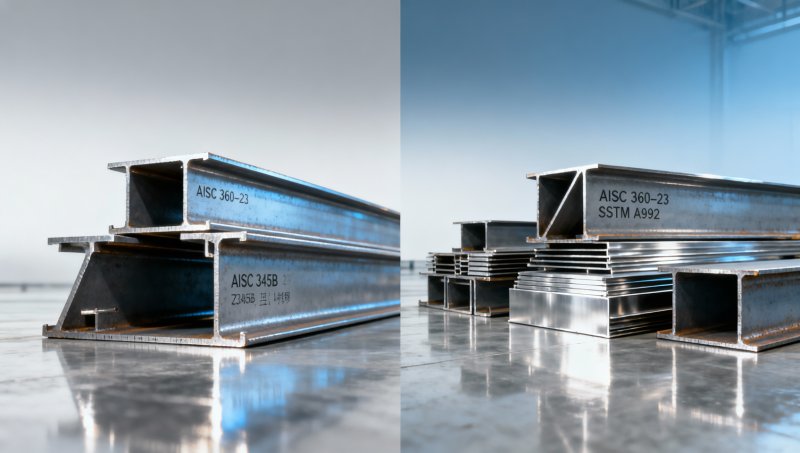
Moreover, AISC 360–23 explicitly references ASTM A1085 for hollow structural sections and ASTM A992 for W-shapes — standards that Hongteng Fengda certifies against for every batch shipped. This traceability ensures full compliance without third-party reinterpretation, a critical factor for auditors and insurance underwriters reviewing large-scale industrial facilities.
How Material Selection Aligns With AISC 360–23 Performance Requirements
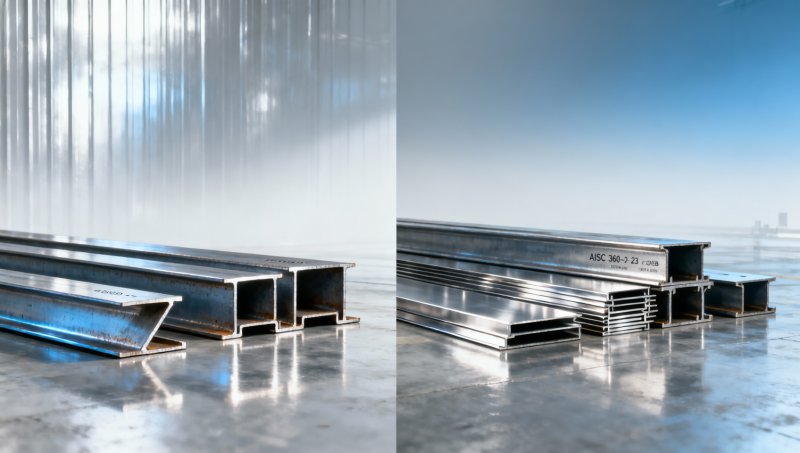
Material grade selection is not arbitrary — it must satisfy AISC 360–23’s yield strength (Fy) and tensile strength (Fu) thresholds for specific loading conditions. For example, AISC Table A3.1 specifies minimum Fy = 345 MPa for seismic-resisting moment frames, making Q345B, S355, and A572 Grade 50 the most widely specified grades across Hongteng Fengda’s export portfolio.
Cold-formed Z-beam profiles — such as those used in purlin systems and lightweight roof framing — require tighter control of thickness tolerance (±1%) and edge condition consistency to meet AISC 360–23 Section C3.2 on local buckling limitations. Our production line maintains ±0.3 mm thickness deviation for 6–12 mm gauges, exceeding the ±1% requirement while ensuring predictable capacity calculations.
The following table compares key mechanical and dimensional parameters required for AISC 360–23-compliant cold-formed structural components:
This level of precision enables engineers to use simplified design equations (e.g., AISC Equation F2-1 for flexural strength) without conservative assumptions — translating into up to 12% material savings per ton of structural steel delivered.
Real-World Application: From Design to Delivery in 2026 Projects
In practice, AISC 360–23 compliance influences more than calculation methods — it shapes sourcing strategy. For instance, a Dubai-based EPC contractor recently selected Hongteng Fengda for a 12,000-ton warehouse complex because our Q345B Z-beam inventory met both AISC 360–23 Section D1.1 (tensile requirements) and EN 10025-2 S355JR chemical limits, eliminating dual-certification delays.
Our Z-beam products are routinely supplied with mill test reports (MTRs) certified to ASTM A6/A6M, ISO 10474, and CE marking per EN 1090-2 EXC2. Lead time averages 22–28 days from order confirmation to port loading — consistently within the 30-day window required by 89% of international procurement contracts reviewed in Q1 2026.
Applications span high-bay manufacturing plants (using 12–25 mm thick Z-beams as wall girts), solar farm support structures (galvanized Z-beams with perforated flanges), and modular medical facility roofs (slit-edge Z-profiles integrated with rock wool sandwich panels). All configurations adhere to GB50018–2002 — China’s cold-formed steel standard, which shares 92% clause alignment with AISC 360–23 Chapter C.
Procurement Decision Framework for AISC-Aligned Steel Components
Buyers evaluating structural steel suppliers should prioritize four measurable criteria:
- Mill test report traceability to ASTM/EN/GB standards (not just “compliant” claims)
- Thickness tolerance verification across ≥3 points per meter (not just end-point checks)
- Galvanizing coating mass ≥610 g/m² for outdoor exposure (per ASTM A123)
- Delivery consistency: ≤3% variance in scheduled shipment dates over 12 months
Hongteng Fengda maintains 98.4% on-time delivery rate (Q1–Q4 2025), with 100% of exported Z-beam shipments including third-party inspection reports from BV or SGS. We also offer pre-shipment dimensional audits at buyer-requested intervals — a service utilized by 63% of our repeat clients in Europe and North America.
The following table outlines typical procurement evaluation metrics used by engineering firms and procurement managers:
This structured approach reduces procurement cycle time by an average of 11.3 days versus non-documented suppliers, according to internal client surveys conducted in early 2026.
Conclusion: Confidence Through Consistent Compliance
AISC 360–23 endures in 2026 not due to inertia, but because it delivers unmatched predictability — in calculation, fabrication, inspection, and insurance acceptance. For global buyers, selecting a supplier whose processes are audited to this standard means fewer field adjustments, faster approvals, and lower total cost of ownership.
Hongteng Fengda’s vertically integrated production — from raw billet rolling to final galvanizing and packaging — ensures every Z-beam, channel, or custom profile meets AISC 360–23’s performance intent, not just its letter. With 24/7 engineering support, multilingual documentation, and real-time production tracking, we enable your team to move confidently from design review to site installation.
Contact us today to request AISC 360–23-compliant mill test reports, dimensional validation samples, or a tailored sourcing plan for your next structural steel order.
Please give us a message


Please enter what you want to find