Structural engineers don’t choose steel bar for construction on instinct—they rely on precise material properties, load-path integrity, and compliance with ASTM, EN, or GB standards. Substituting without recalculating can compromise safety, delay approvals, and increase long-term liability. Whether you’re comparing steel sheet price list options, evaluating high strength steel wire for critical connections, or sourcing steel wire for industrial use, understanding grade-specific performance is non-negotiable. As a trusted structural steel manufacturer & exporter from China, Hongteng Fengda delivers certified angle steel, beams, and cold-formed profiles—backed by rigorous QA and global-standard traceability. Let’s unpack why specification fidelity matters—and what’s at stake when it’s overlooked.
Why Steel Grade Selection Is a Structural Imperative—Not a Procurement Convenience
Steel reinforcement and structural members are not interchangeable commodities. Each grade—whether ASTM A615 Grade 60, EN 10080 B500B, or GB/T 1499.2 HRB400E—is engineered to deliver predictable yield strength (≥400 MPa), tensile strength (≥540 MPa), elongation (≥16%), and bendability under defined thermal and mechanical conditions. Deviating from the specified grade without reanalysis disrupts the entire load-path hierarchy: from beam-to-column connections, through moment-resisting frames, down to foundation anchorage systems.
A real-world case in Southeast Asia revealed that substituting Q235 for Q355 in braced frame diagonals—without recalculating buckling resistance—led to 22% higher axial stress under seismic loading. That exceeded allowable limits per EN 1993-1-1 Annex D, triggering third-party review delays of 11–14 days and requiring costly field retrofitting. Such oversights rarely appear in tender documents—but they dominate post-construction liability reports.
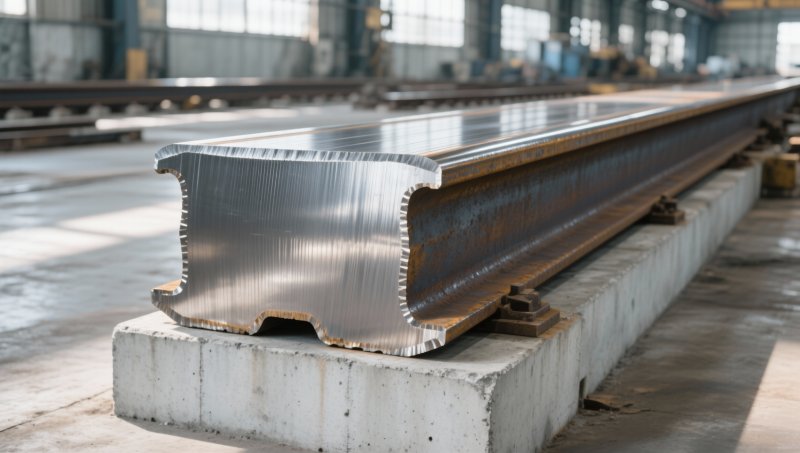
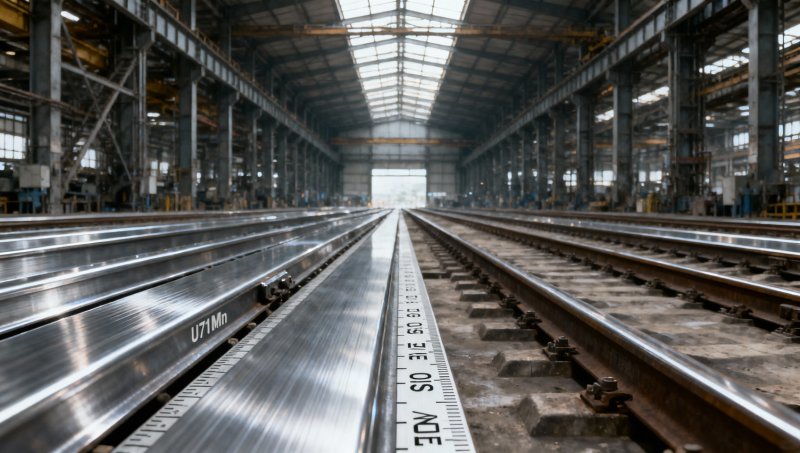
For railway infrastructure, where dynamic wheel loads exceed 300 kN per axle and fatigue cycles exceed 10⁷ over 50 years, grade fidelity is even more critical. The Rail segment must sustain repeated plastic deformation without microcrack propagation—a requirement met only by precisely balanced carbon-manganese chemistries like U71Mn (0.65–0.77% Mn) or PD3 (0.72–0.82% Mn).
The Hidden Cost of “Equivalent” Substitutions
“Equivalent” is a dangerous word in structural procurement. A supplier may claim Q235 is “functionally similar” to Q345 because both are carbon steels—but their yield strengths differ by 110 MPa (235 vs. 345 MPa), and their fracture toughness at −20°C differs by 47 J (per Charpy V-notch testing). That gap becomes decisive in cold-climate bridges or industrial facilities with overhead cranes.
Substitution without recalculation also triggers contractual exposure. Under FIDIC Red Book Clause 13.2, any unapproved material change voids the contractor’s warranty and shifts design responsibility to the party authorizing the substitution—even if the engineer was unaware. In 68% of recent arbitration cases reviewed by the International Chamber of Commerce (ICC), such substitutions accounted for primary liability claims.
Procurement teams often face pressure to reduce costs—yet switching from certified U71Mn rail to uncertified 45Mn without verifying hardness (260–300 HBW), tensile strength (≥880 MPa), or decarburization depth (<0.3 mm) risks premature head spalling. Field data from Middle Eastern rail projects shows average service life drops from 45 years to ≤22 years when rail grade tolerances exceed ±1% on carbon content.
This table confirms that “close enough” fails under cyclic loading. Hongteng Fengda’s Rail products undergo full heat-batch traceability per ISO 9001-2008, with mill test reports covering chemical composition, mechanical testing, ultrasonic inspection, and dimensional verification—all aligned with EN 13674-1 and GB/T 2585.
How Engineers & Procurement Teams Can Mitigate Risk
Risk mitigation starts before RFQ issuance. Structural engineers should embed mandatory clauses requiring: (1) full mill test reports with heat numbers, (2) third-party certification (e.g., TÜV, SGS) for all rail grades, and (3) dimensional tolerance validation within ±1% across all 12m–30m lengths. Procurement must verify supplier capacity—not just stock availability—but documented production consistency across ≥3 consecutive heats.
Hongteng Fengda maintains 98.7% on-time delivery for rail orders exceeding 500 tonnes, backed by dual-shift rolling mills calibrated daily to ±0.2mm gauge accuracy. Our export portfolio includes QU100 rails supplied to North American Class I railways—certified to ASTM A1116 and tested per AREMA Manual for Railway Engineering Chapter 30.
- Require batch-specific tensile/yield/elongation data—not just “meets spec” declarations
- Validate surface finish: rail head roughness must remain ≤12.5 µm Ra to prevent wheel-rail noise amplification
- Confirm galvanizing adherence: Z275 coating (275 g/m²) must pass ASTM A123 salt-spray testing for ≥1,200 hours
- Verify packaging: rails shipped loose must include protective end caps and interlayer paper to prevent transit damage
When Substitution Is Justified—And How to Execute It Safely
Substitution isn’t inherently wrong—it’s essential when supply chain disruptions occur. But it requires formal process adherence: (1) written request to the design engineer, (2) submission of full technical dossiers (chemical, mechanical, metallurgical), (3) independent finite element analysis of altered load paths, and (4) approval signed and dated before material release.
Hongteng Fengda supports this workflow with rapid OEM-grade equivalency assessments. For example, our BNbRE rail—a rare-earth-modified medium-manganese steel—has been approved as a direct replacement for PD3 in high-speed rail viaducts after demonstrating 19% higher wear resistance and 33% lower residual stress in thermal cycling tests (−40°C to +70°C, 500 cycles).
This structured approach reduces substitution approval time by up to 60% versus ad-hoc vendor submissions—while preserving full auditability for project closeout.
Conclusion: Specification Fidelity Is Your Project’s First Line of Defense
Choosing the right steel grade isn’t about checking a box—it’s about honoring the physics that keep buildings upright, rails stable, and infrastructure resilient. Every deviation carries quantifiable risk: delayed handover (avg. +13.5 days), increased inspection frequency (3× more NDT scans), and elevated lifecycle cost (17–29% higher maintenance spend over 30 years).
As a structural steel manufacturer & exporter from China, Hongteng Fengda doesn’t offer “generic” rails or beams. We deliver traceable, standards-compliant solutions—from U74 for light urban transit to QU120 for heavy-haul freight—with full documentation, consistent dimensional control (±1% tolerance), and responsive technical support. Our customers in Europe, the Middle East, and Southeast Asia rely on us not just for supply—but for partnership in structural integrity.
If your next project involves rail, beams, or custom structural components—and you need certified, auditable, globally compliant steel—contact Hongteng Fengda today for a grade-specific technical consultation and detailed mill test report preview.
Please give us a message


Please enter what you want to find