Outdoors, the performance of steel wire galvanized products depends heavily on coating thickness, which directly affects corrosion resistance, service life, and maintenance cost. For buyers comparing steel standards, electrical conduit galvanized options, or other Corrosion Resistant Steel solutions, understanding this detail is essential to making reliable, cost-effective decisions in construction, industrial, and infrastructure projects.
In real procurement and field use, galvanized coating thickness is not a minor specification. It influences how long steel wire can resist rain, humidity, salt exposure, and daily wear before red rust appears. For project managers, maintenance teams, distributors, and purchasing departments, this directly affects replacement cycles, labor cost, and operational risk.
For B2B buyers sourcing from China or comparing multiple suppliers, the practical question is simple: how thick should the zinc layer be for the actual outdoor environment? The answer depends on application, wire diameter, expected service life, handling conditions, and compliance with the required steel standard. A thin coating may reduce initial cost, but in many outdoor applications it increases total ownership cost over 2–5 years.
How galvanized coating thickness protects steel wire outdoors
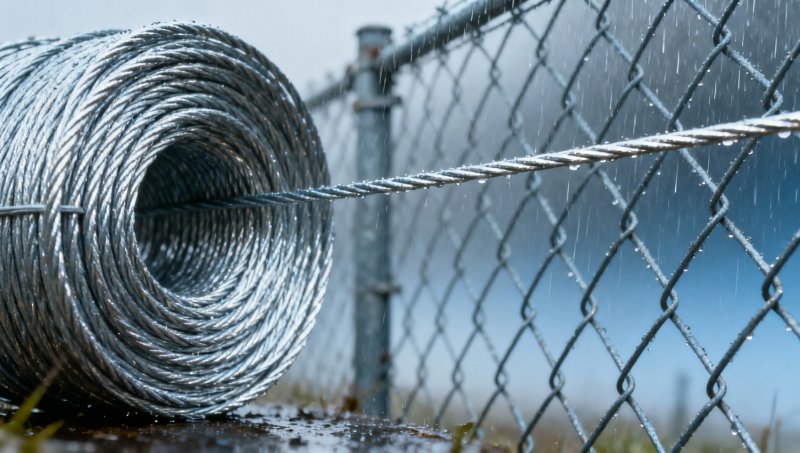
Galvanizing protects steel wire mainly in 2 ways. First, the zinc layer acts as a physical barrier between the base steel and moisture, oxygen, and contaminants. Second, zinc provides sacrificial protection, meaning it corrodes before the steel does. The thicker the coating, the more zinc is available to delay substrate corrosion in outdoor service.
This is why coating thickness matters more in outdoor fencing, mesh, packaging exposed to weather, agricultural enclosures, barrier isolation, and construction tie wire used on open sites. Under dry indoor conditions, a lighter coating may be acceptable. Outdoors, especially in coastal, industrial, or high-humidity regions, the difference between 8 g/m2 and 25 g/m2 can significantly change maintenance frequency and service life expectations.
In practical use, buyers should not evaluate galvanized wire only by appearance. A bright, smooth surface is useful, but visual finish alone does not confirm zinc mass. Technical evaluation should include coating range, base material quality, adhesion, and whether the wire can still be bent, rolled, or cold formed without damaging the coating.
Why outdoor exposure changes the requirement
Outdoor service conditions vary widely. A wire used in decorative applications under a roof may face limited moisture. A wire used in breeding, wire mesh, or construction on exposed sites may be wet for weeks during rainy seasons. In coastal areas, chloride exposure can accelerate coating consumption. In industrial zones, acidic pollutants can shorten the protection period further.
That is why technical teams often classify environments into at least 3 broad categories: mild, moderate, and severe outdoor exposure. Even without a project-specific corrosion map, this simple classification helps purchasers choose a more suitable zinc thickness instead of buying only on unit price.
The table below shows how coating thickness usually affects outdoor performance priorities in common steel wire applications.
The key conclusion is that coating thickness should match the service environment, not just the purchase budget. If the application is outdoors for 12 months a year, selecting a zinc layer by exposure level is usually more economical than replacing failed wire early.
How to evaluate the right coating thickness for different applications
The correct galvanized coating thickness depends on more than one number on a specification sheet. Buyers should review at least 4 factors together: environment, wire diameter, expected service duration, and whether the wire will be bent or formed after delivery. These points matter because even a good zinc layer can fail early if the wire is mishandled or specified for the wrong exposure class.
For example, low carbon steel wire used for tying in temporary construction may prioritize workability and cost. A breeding fence, outdoor mesh, or barrier isolation wire may need stronger corrosion resistance because replacement causes labor disruption. In these cases, coating thickness must be evaluated as part of total project cost rather than a standalone material parameter.
A common market range for galvanized steel wire includes wire diameters from 0.25 mm to 5.0 mm, zinc coating thickness from 8 g/m2 to 25 g/m2, and tensile strength from 350 MPa to 550 MPa. These figures give buyers a practical baseline for comparing offers, but the final choice should still reflect actual use conditions.
A useful selection framework
- If the wire is for temporary or short-cycle outdoor use, the lower end of the coating range may be workable when cost sensitivity is high.
- If the wire will remain outdoors for 2–5 years with repeated wetting and drying, medium coating levels are generally more dependable.
- If the wire is exposed to salt, industrial emissions, or continuous humidity, a heavier zinc layer should be prioritized over slight savings in unit price.
- If the wire will be cold stamped, rolled, or bent after delivery, coating adhesion and ductility are as important as zinc mass.
Mid-article product reference for buyers comparing options
For buyers looking for an insert-ready option in construction, wire mesh, decoration, packaging, breeding, and industrial use, Galvanized Steel Wire is commonly selected because it combines low carbon steel substrates such as Q195 and Q235 with strong flexibility, good corrosion resistance, and reliable ductility for forming operations.
Typical supply parameters include 0.25 mm–5.0 mm wire diameter, 8–25 g/m2 zinc coating thickness, and 350–550 MPa tensile strength. Common packaging formats include 50–1,000 kg coils with inner plastic film and outer woven bag, or bobbin packaging for easier handling in downstream production. For many distributors and project buyers, those ranges support both standard purchasing and OEM-oriented specification planning.
The following table helps purchasing teams match common application types with coating and performance priorities.
This comparison shows that there is no single “best” zinc thickness for every project. The right choice is the one that fits service conditions, fabrication needs, and acceptable maintenance intervals.
Common buying mistakes that increase outdoor corrosion risk
One of the most common mistakes is buying solely by price per ton or price per coil. A lower-cost wire with insufficient zinc coating may look similar at delivery, but if corrosion starts 6–12 months earlier than expected, the real cost rises through replacement, site downtime, and labor. This is especially important for distributors and contractors who need predictable after-sales performance.
Another frequent issue is confusing coating thickness with base material strength. Tensile strength in the range of 350–550 MPa is important for mechanical performance, but it does not replace corrosion protection. A wire can be mechanically adequate and still fail outdoors if the zinc layer is too light for the environment.
Quality control teams should also watch for uneven coating, poor adhesion, and damage during transport or forming. Even when zinc mass meets the target, rough handling, sharp bending radii, or poor storage conditions can shorten service life. This is why purchasing, QC, and operations should review the specification together instead of working in isolation.
Practical risk checklist before order confirmation
- Confirm whether the wire will be used in mild, moderate, or severe outdoor exposure.
- Check zinc coating range, not just product name or visual finish.
- Review wire diameter tolerance and tensile strength together with corrosion requirements.
- Ask how the wire is packed: coil size, bobbin option, and protection against moisture during shipment.
- Verify whether downstream forming, bending, or rolling could damage a brittle or weakly adhered coating.
Why supplier capability also matters
Outdoor performance is not determined by raw material alone. Manufacturing consistency, process control, and export experience all affect final quality. For global buyers, a supplier that understands ASTM, EN, JIS, and GB requirements is better positioned to support specification matching, documentation alignment, and stable batch quality across repeated orders.
As a structural steel manufacturer and exporter from China, Hongteng Fengda serves construction, industrial, and manufacturing projects in North America, Europe, the Middle East, and Southeast Asia. That broader steel supply experience is valuable for buyers who need not only material supply, but also reliable lead times, OEM support, and lower sourcing risk in multi-market procurement.
Specification, inspection, and maintenance points for long-term outdoor value
To improve outdoor performance, buyers should define inspection points before production and before shipment. At minimum, this usually includes 3 areas: base steel grade, zinc coating range, and mechanical properties. For projects where the wire will be stored on site for 2–8 weeks before use, packaging and storage instructions should also be included in the purchasing plan.
Maintenance planning matters as much as specification planning. Even good galvanized wire will perform better if it is kept off wet ground, protected from standing water, and installed without unnecessary abrasion. In high-rainfall regions, periodic visual checks every 6–12 months can help maintenance teams identify early coating wear before large sections need replacement.
For distributors and project owners, the goal is not just to buy galvanized steel wire once. The goal is to keep service life predictable. A better-matched coating thickness can reduce unplanned material replacement, lower call-back risk, and support more accurate budgeting over the full operating cycle.
Suggested inspection and maintenance matrix
The table below summarizes what technical buyers, QC personnel, and maintenance teams should focus on from order placement to outdoor use.
This process is simple, but it has clear value. When specification, inspection, packaging, and maintenance are connected, galvanized wire becomes easier to manage over the long term, especially in outdoor projects where environmental exposure is continuous.
FAQ for buyers and technical reviewers
How thick should galvanized coating be for outdoor steel wire?
There is no universal single value. For common supply ranges, 8–25 g/m2 is a practical reference, but the correct choice depends on whether the application is temporary, semi-permanent, or long-term, and whether exposure is mild, humid, coastal, or industrial.
Is a brighter surface always better?
Not necessarily. A bright and smooth appearance is useful for decoration and general quality perception, but corrosion performance should be judged by coating specification, adhesion, and consistency rather than visual finish alone.
What should procurement teams ask suppliers before ordering?
At minimum, ask for wire diameter range, zinc coating thickness, tensile strength, substrate grade such as Q195 or Q235, packaging method, and whether the product is suitable for bending, rolling, or cold forming without coating damage.
When steel wire is used outdoors, galvanized coating thickness directly influences corrosion resistance, replacement intervals, and total operating cost. For contractors, distributors, technical evaluators, and project owners, choosing the right zinc range is a more effective strategy than focusing only on the lowest purchase price.
With stable manufacturing capability, strict quality control, and experience serving international construction and industrial markets, Hongteng Fengda supports buyers who need dependable structural steel and related product solutions from China. If you are comparing outdoor wire specifications, planning a sourcing project, or evaluating customized steel supply, contact us to get product details, technical support, and a tailored solution for your application.
Please give us a message


Please enter what you want to find