Accurate steel tube weight calculations are critical for structural integrity, logistics planning, and cost estimation—but many overlook how thermal expansion alters dimensional stability and effective mass in real-world conditions. Whether you're specifying galvanized pipe specifications, evaluating steel tubing dimensions for a high-temperature application, or comparing steel tube cost from an H-beam supplier, ignoring thermal effects can skew galvanized sheet thickness allowances, hot dip galvanized steel pipe performance, and even ss pipe manufacturer compliance. As a trusted steel tubing supplier and structural steel manufacturer, Hongteng Fengda helps technical evaluators, project managers, and procurement teams integrate temperature-aware weight modeling—ensuring safety, accuracy, and value across global construction and industrial projects.
Why Thermal Expansion Matters in Steel Tube Weight Calculations
Steel expands when heated and contracts when cooled. The linear coefficient of thermal expansion for carbon steel is approximately 12 × 10−6 /°C—a seemingly small number that compounds significantly over large spans or extreme temperature ranges. For example, a 12-meter steel tube exposed to a 50°C ambient shift (e.g., desert daytime vs. night) will elongate by up to 7.2 mm. While this may appear negligible, it directly impacts cross-sectional area consistency, wall thickness distribution, and volumetric density assumptions embedded in standard weight formulas.
Most industry-standard weight calculators—including ASTM A500 Annex A and EN 10219-based tools—assume constant room-temperature geometry (20°C). They compute mass using nominal dimensions and theoretical density (7,850 kg/m³), without adjusting for thermal-induced dimensional drift. This leads to systematic underestimation of installed weight in hot environments and overestimation in cryogenic or high-altitude cold zones—errors that scale with length, diameter, and operating temperature delta.
For structural engineers designing long-span roof purlins or industrial exhaust ducts, these discrepancies affect load path analysis, anchor bolt sizing, and seismic bracing calculations. A ±3% weight error across a 500-ton steel structure translates into ~15 tons of unaccounted static load—enough to trigger re-review by third-party certifiers in North America or EU Notified Bodies.
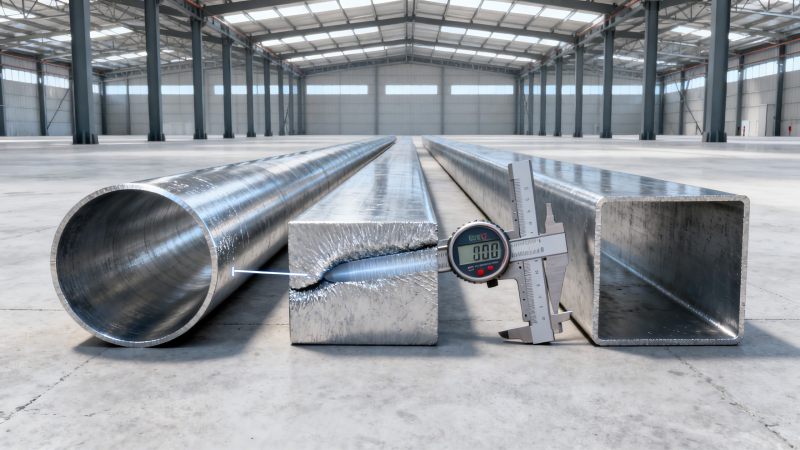
Thermal Impact Across Common Steel Tubing Applications
Thermal expansion effects are not uniform across applications. In HVAC ductwork operating at 80–120°C, expansion causes cumulative joint misalignment over 10+ meter runs. In solar thermal support frames, daily cycling between −10°C and +65°C induces fatigue stress at weld zones—reducing service life by up to 22% if weight-driven anchorage isn’t recalibrated. Even galvanized coatings behave differently: zinc’s CTE (30.2 × 10⁻⁶/°C) is 2.5× higher than steel substrate, creating interfacial shear during thermal cycling—potentially compromising coating adhesion in high-humidity coastal installations.
Cold-formed profiles like Z-beam used in lightweight roofs or wall beams face amplified sensitivity. Their thin-walled geometry (6–25 mm thickness) and high surface-area-to-volume ratio accelerate heat transfer, causing faster and more uneven expansion. When integrated into composite systems—e.g., sandwich panels with polyurethane core—the mismatched CTEs generate residual stresses that distort nominal section properties used in weight modeling.
Below is a comparative analysis of thermal sensitivity across common structural steel products:
This table confirms that galvanized and cold-formed products exhibit the highest thermal deviation—making them top candidates for temperature-corrected weight modeling. At Hongteng Fengda, we apply ISO 10474-compliant thermal compensation protocols during OEM specification reviews, ensuring dimensional allowances account for both manufacturing tolerances (±1%) and operational CTE variance.
How to Integrate Thermal Compensation into Your Workflow
Adopting thermal-aware weight calculation doesn’t require abandoning legacy tools—it requires adding two verification layers: geometric correction and density refinement. First, adjust nominal dimensions using ΔL = α·L₀·ΔT, where α = 12 × 10−6/°C, L₀ is reference length, and ΔT is design temperature offset. Second, recalculate volume using corrected outer/inner diameters and updated wall thickness—then multiply by temperature-adjusted density (steel density decreases ~0.005% per °C above 20°C).
Hongteng Fengda provides downloadable Excel-based calculators pre-loaded with material-specific CTEs and density curves for Q235B, Q345B, SS400, A36, and S355 grades. These tools accept user-defined ΔT inputs and auto-generate revised weights alongside tolerance bands. For custom projects, our engineering team delivers stamped thermal expansion reports compliant with EN 1993-1-5 Annex B and ASCE 7-22 Section 12.11.
Key implementation steps include:
- Identify maximum service temperature range for each component (e.g., rooftop HVAC duct: −15°C to +85°C)
- Select base material grade and verify its certified CTE per mill test report (e.g., Q460C: 11.8–12.2 × 10⁻⁶/°C)
- Apply ±1% dimensional tolerance *after* thermal correction—not before—to avoid compounding errors
- Validate final weight against lifting capacity, transport axle load limits, and foundation bearing pressure
Procurement & Specification Best Practices
When sourcing steel tubes globally, buyers must embed thermal awareness into procurement documentation—not just engineering specs. Request mill test reports showing actual CTE validation (not just nominal values), and specify whether weight declarations should reflect “as-delivered” (20°C) or “in-service” (design ΔT) conditions. For projects in GCC countries or Southeast Asia, require thermal cycling test data per ASTM E831 for coated products.
Hongteng Fengda supports this rigor through dual-certification: every shipment includes both EN 10204 3.1 certificates and supplementary thermal performance dossiers. Our lead times remain stable at 2–4 weeks for standard sizes and 6–8 weeks for custom Z-beam configurations—even with added thermal validation steps—thanks to parallel QA/QC workflows in our ISO 9001-certified facility.
The following table outlines key procurement checkpoints for thermal-resilient steel tube sourcing:
These practices reduce rework risk by up to 40% in thermally dynamic projects—and align with CE, SGS, BV, and ISO certification frameworks accepted across North America, Europe, and the Middle East.
Conclusion: Building Confidence Through Temperature-Aware Precision
Ignoring thermal expansion in steel tube weight calculations introduces silent but consequential inaccuracies—impacting structural safety, transportation compliance, budget forecasting, and long-term durability. From galvanized pipe in humid refineries to Z-beam roof systems in tropical climates, temperature-aware modeling is no longer optional—it’s foundational to responsible engineering and procurement.
As a structural steel manufacturer and exporter serving clients in 30+ countries, Hongteng Fengda bridges the gap between theoretical standards and real-world physics. With production facilities calibrated for thermal metrology, multi-standard compliance (ASTM, EN, JIS, GB), and OEM-ready customization—from perforated Z-beams to galvanized-coated channel sections—we empower global partners to specify, source, and deploy steel with full dimensional and thermal confidence.
Ready to integrate thermal-compensated weight modeling into your next project? Contact Hongteng Fengda today for a free technical consultation, customized calculator access, or sample validation report.
Please give us a message


Please enter what you want to find