When sourcing stainless coil pipe or steel coil pipe, procurement professionals and technical evaluators often notice significant variations in tolerance specifications—even among steel coils suppliers quoting the same grade of stainless steel pipe coil. This inconsistency impacts structural integrity, fabrication accuracy, and compliance with ASTM, EN, or GB standards. As a trusted structural steel manufacturer and exporter, Hongteng Fengda clarifies why tolerances differ across industrial stainless steel tubing—covering material behavior, rolling processes, testing protocols, and certification scope. Understanding these factors helps project managers, quality controllers, and enterprise decision-makers make informed choices on stainless steel tube coil and industrial steel coil for critical steel construction materials.
Why Tolerance Variability Is Inherent — Not a Quality Red Flag
Tolerance variation among stainless steel coil pipe suppliers is not evidence of inconsistent quality—it reflects fundamental differences in production philosophy, equipment capability, and intended application. For example, a coil destined for precision hydraulic tubing may be rolled to ±0.05 mm thickness tolerance, while one used in structural support framing may carry ±1.2% dimensional allowance per EN 10139. These are not interchangeable specs—they serve distinct engineering functions.
Material behavior during cold rolling also introduces natural variability. Stainless grades like 304 and 316 exhibit different springback characteristics under identical mill settings—requiring supplier-specific calibration. At Hongteng Fengda, we pre-test each batch’s yield response and adjust roll gap compensation algorithms accordingly, achieving ±0.3% thickness consistency across 12–30 m lengths—critical for downstream laser cutting and bending operations.
Moreover, final tolerance statements often reflect *certification scope*, not just measurement results. A supplier certified to ASTM A240 may quote tighter tolerances than one holding only GB/T 4237—because their QA system is audited against stricter verification intervals (e.g., every 500 meters vs. every 2,000 meters). This distinction directly affects traceability and audit readiness for projects in North America or the EU.
How Rolling Process & Equipment Define Real-World Tolerance Ranges
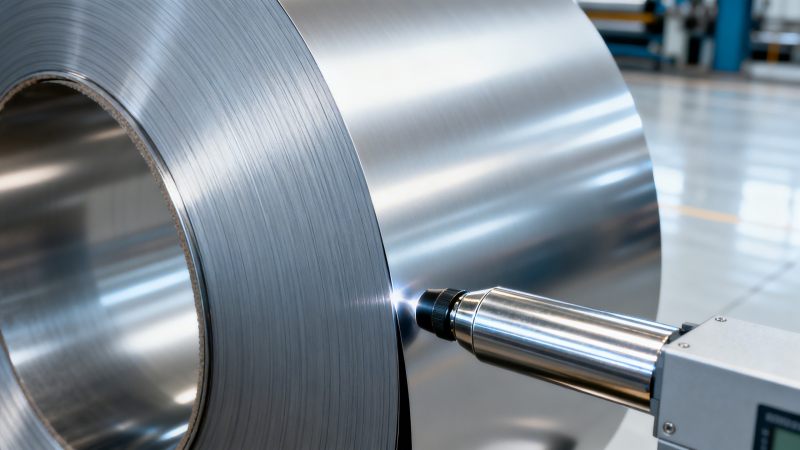
Cold-rolled stainless steel coil pipe tolerances are constrained by three physical limits: mill stand rigidity, strip tension control precision, and online gauge repeatability. Modern tandem mills with hydraulic AGC (Automatic Gauge Control) achieve ±0.08 mm thickness tolerance on 0.5–3.0 mm coils—but only if feedstock surface quality meets Ra ≤ 0.4 μm. Older single-stand mills typically deliver ±0.25 mm at best, even with skilled operators.
Hongteng Fengda operates two dedicated stainless cold-rolling lines—one equipped with laser-based thickness gauging (±0.03 mm resolution) and another optimized for high-volume structural coils. This dual-capability allows us to match tolerance delivery to your actual need: ±0.15 mm for architectural cladding applications versus ±0.8% for Rail base plates where load distribution dominates over dimensional fidelity.
Crucially, “same grade” doesn’t mean “same heat treatment history.” A 304 coil annealed in a continuous bell furnace will show lower residual stress—and thus less post-uncoiling shape deviation—than one processed in batch furnaces. That difference alone can shift flatness tolerance from 1.5 mm/m to 3.2 mm/m, impacting welding fit-up on structural assemblies.
Typical Thickness Tolerance Ranges by Production Method
This table illustrates how process selection—not just material grade—drives tolerance feasibility. Buyers specifying “304 stainless coil pipe” must also define whether they require hot-rolled or cold-rolled condition, as that decision sets the realistic tolerance floor before any supplier quotation begins.
Certification Scope vs. Measured Performance: What Your QA Team Needs to Know
A supplier quoting ±0.2 mm tolerance may hold ISO 9001:2015 but not EN 10204 3.2 mill test certification. The former confirms process control; the latter guarantees individual coil traceability to chemical composition and mechanical test reports. For rail infrastructure or pressure vessel projects, EN 10204 3.2 is non-negotiable—yet it adds 3–5 days to lead time and increases cost by 8–12%.
Hongteng Fengda maintains dual-track QA documentation: standard ISO 9001-compliant reports for general construction coils, and full EN 10204 3.2 dossiers—including tensile strength, hardness, intergranular corrosion test (ASTM A262 Practice E), and ultrasonic testing records—for critical applications. Our rail-grade carbon steel coils (U71Mn, PD3, BNbRE) all ship with 3.2 certification as standard—ensuring seamless compliance for railway authorities in Southeast Asia and the Middle East.
Also note: Tolerance statements in certificates refer to *as-rolled* dimensions—not post-processing values. If your fabrication includes leveling, slitting, or edge trimming, those operations introduce additional deviation (typically +0.1–0.4 mm in width tolerance). Always confirm whether quoted tolerances apply pre- or post-secondary processing.
Procurement Guidance: 5 Non-Negotiable Checks Before Finalizing Quotations
To avoid costly rework or rejection at site inspection, verify these five points before awarding an order for stainless steel coil pipe:
- Confirm whether tolerance values apply to thickness, width, or flatness—and request the test method (e.g., “measured per EN 10051 using laser micrometer at 3 locations per 10 m”)
- Require mill test reports showing actual measured values—not just compliance statements—for the first 3 coils of any new order
- Validate that the supplier’s declared tolerance range aligns with their certified scope (e.g., ASTM A666 Table 2 for austenitic stainless, or GB/T 706-2016 for structural rails)
- Check if tolerance allowances include “edge drop”—a common 5–10% reduction in thickness within 15 mm of coil edges that impacts laser-cut part accuracy
- Clarify sampling frequency: Is every coil tested (100% inspection), or is statistical process control applied (e.g., 1 coil per 5-ton lot)?
FAQ: Key Questions from Procurement & Technical Teams
Q: Can I specify tighter tolerances than standard EN/ASTM tables allow?
Yes—but only if your volume justifies custom mill setup. For example, tightening thickness tolerance from ±0.25 mm to ±0.10 mm requires recalibrating AGC systems and increasing inspection frequency, typically adding 15–22% to unit cost. Minimum order quantity usually starts at 50 metric tons.
Q: Does surface finish affect tolerance acceptance?
Absolutely. Bright-annealed (BA) finishes require tighter flatness control (≤2.0 mm/m) due to optical inspection requirements, whereas pickled-and-oiled (2B) coils accept up to 4.5 mm/m. Specify finish type when requesting tolerance quotes.
Q: How do I verify tolerance claims without third-party lab testing?
Request digital scan reports from the supplier’s inline thickness gauge—most modern mills provide timestamped PDFs showing real-time thickness profiles across coil width and length. Hongteng Fengda shares these automatically upon request for orders ≥20 MT.
Why Partner with Hongteng Fengda for Precision Steel Coil Supply
As a structural steel manufacturer and exporter serving global markets since 2008, Hongteng Fengda bridges the gap between theoretical tolerance standards and real-world fabrication needs. We don’t just quote numbers—we engineer solutions: offering mill-direct traceability, dual-process capability (hot-rolled and cold-rolled), and EN/ASTM/GB-compliant documentation—all backed by 100% in-house QC labs accredited to ISO/IEC 17025.
Whether you’re sourcing stainless steel coil pipe for offshore platform piping, cold-formed steel profiles for modular buildings, or certified Rail components meeting U71Mn and PD3 specifications, our team provides precise parameter alignment—not generic quotes. We support your technical evaluation with free sample coils, dimensional validation reports, and lead times as short as 7–15 days for standard grades.
Contact us today to discuss your specific tolerance requirements, review mill test report formats, or request a comparative analysis of three supplier quotations for your next steel coil pipe order.
Please give us a message


Please enter what you want to find