The stainless steel tube price can vary significantly from one grade to another, and understanding why is essential for informed sourcing.
From corrosion resistance and alloy composition to strength, processing, and application needs, each grade affects overall cost differently.
For buyers comparing options, knowing these factors helps reduce purchasing risks and achieve better value in construction, industrial, and manufacturing projects.
What does stainless steel tube price really reflect?
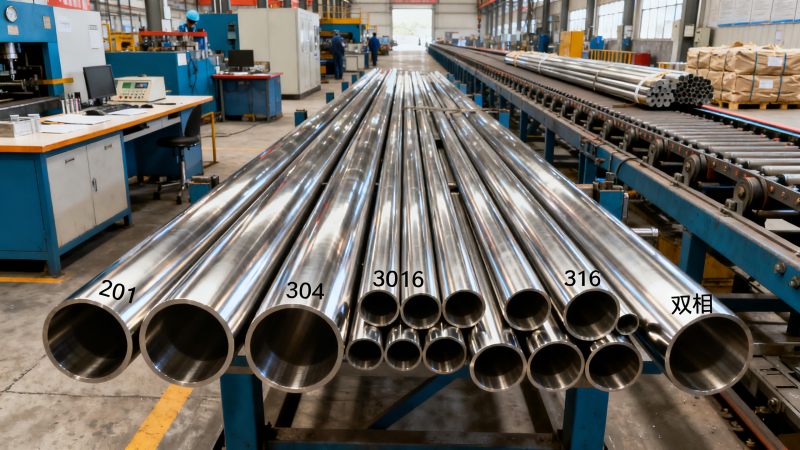
The stainless steel tube price is not based on metal weight alone.
It reflects chemistry, mechanical properties, surface finish, dimensional tolerance, and compliance with required standards.
Grades with more nickel, molybdenum, or chromium usually cost more.
These alloying elements improve corrosion resistance, heat resistance, and long-term durability.
Production route also matters.
Seamless tubes often carry a higher stainless steel tube price than welded tubes because manufacturing is more demanding.
Inspection costs can further raise pricing.
Third-party testing, PMI, hydrostatic testing, and special packaging all add measurable value and cost.
Why do different stainless steel grades change the cost so much?
The biggest reason is alloy composition.
Austenitic grades such as 304 and 316 contain higher nickel than many ferritic grades.
That difference strongly affects the stainless steel tube price.
Grade 304 is widely used because it balances corrosion resistance, formability, and cost.
Grade 316 is usually more expensive because molybdenum improves pitting resistance in chloride environments.
Grades like 201 may look attractive at first because the initial stainless steel tube price is lower.
However, lower-cost grades may not perform well in humid, chemical, or marine conditions.
Duplex stainless steels often cost more than standard austenitic options.
They offer high strength and better stress corrosion resistance, which can reduce lifecycle cost.
Heat-resistant and special alloy grades are another category.
Their higher stainless steel tube price comes from stricter melting control and specialized performance requirements.
Common grade comparison
- 201: lower initial cost, limited corrosion performance.
- 304: versatile choice for general industry and construction.
- 316: higher price, better chloride resistance.
- Duplex: higher strength, demanding applications, premium pricing.
How do size, processing, and finish affect stainless steel tube price?
Grade is only one part of the total equation.
Outer diameter, wall thickness, and tube length also influence the stainless steel tube price.
Thicker walls increase raw material usage immediately.
Large diameters may require different forming equipment, slower speeds, and more handling effort.
Surface finish can be another major cost driver.
Pickled, polished, bright annealed, or mirror finishes need different processing steps.
Each step affects labor, yield, and rejection risk.
Tighter tolerances raise the price as well.
Precision requirements increase inspection time and reduce allowable production variation.
Custom cutting, bending, drilling, or fabrication also add cost.
In broader steel sourcing, the same logic applies to reinforcing and structural products.
For example, HRB400 Rebar is valued by yield strength, standards, sizes, and project suitability.
Used in construction projects, it offers no less than 400 MPa standard yield strength.
Available sizes range from 6mm to 50mm, with compliance to ASTM, JIS, AISI, DIN, BS, EN, and GB.
That comparison shows why specification details always shape final steel cost.
Which applications justify a higher stainless steel tube price?
A higher stainless steel tube price is justified when service conditions are severe.
Marine structures, chemical processing lines, and coastal building systems need stronger corrosion protection.
In these cases, choosing only by low purchase cost can create expensive failures later.
Food processing and pharmaceutical environments often require clean surfaces and reliable hygiene performance.
That may support the use of polished or higher-grade tubes.
High-temperature systems may need grades designed for oxidation resistance and structural stability.
Pressure applications can also demand certified tubing with full traceability.
For decorative indoor use, a lower-cost grade may be acceptable if corrosion exposure is limited.
The right decision depends on matching grade to environment, not chasing the lowest stainless steel tube price.
Application-based guidance
- Indoor decorative use: appearance and basic formability may dominate.
- General industrial use: 304 often offers balanced value.
- Coastal or chemical exposure: 316 or duplex often makes more sense.
- Critical systems: certification and traceability are essential.
What risks appear when comparing stainless steel tube price only by quotation?
A low quotation may hide important differences.
The offered grade may not be identical, even when dimensions look similar.
Wall thickness tolerance can be negative and still appear competitive on paper.
Surface defects, inconsistent annealing, or weak weld quality can reduce actual value.
Missing documents are another warning sign.
Without MTCs, test reports, or clear standard references, the stainless steel tube price becomes difficult to evaluate fairly.
Logistics terms also matter.
A quote may exclude protective packing, export handling, or destination charges.
Lead time risk can be costly too.
Delayed supply may affect fabrication schedules, site work, and downstream commitments.
Comparing the stainless steel tube price without checking total delivered value often creates avoidable problems.
Quick risk checklist
- Confirm grade, standard, and chemical composition.
- Verify tolerance, finish, and tube type.
- Check testing scope and documentation.
- Review packing, Incoterms, and delivery time.
How can you judge the best value instead of the lowest stainless steel tube price?
Start with service conditions.
Define exposure to moisture, chlorides, chemicals, heat, and load before requesting offers.
Then compare equivalent specifications only.
The same stainless steel tube price means little if standards or tolerances differ.
Consider lifecycle cost, not just purchase cost.
A higher-grade tube may reduce maintenance, replacement frequency, and downtime.
Supplier capability is also part of value.
Stable production, strict quality control, and dependable lead times support better project outcomes.
For global steel sourcing, partners with experience in ASTM, EN, JIS, and GB standards offer stronger consistency.
That is especially helpful when combining stainless tubing with structural steel packages.
FAQ comparison table
The stainless steel tube price varies across grades because performance requirements vary across applications.
Alloy content, manufacturing method, finish, tolerance, testing, and delivery terms all influence final cost.
A smart comparison focuses on equivalent specifications and total project value.
When sourcing steel products for construction or industrial use, reliable standards, stable quality, and dependable supply matter as much as price.
Review service conditions carefully, compare offers line by line, and choose the option that delivers the best long-term performance.
Please give us a message


Please enter what you want to find