When trailer durability and load performance matter, material choice becomes a critical engineering decision. Carbon steel square tubing for trailer frames is widely valued for its balance of strength, weldability, and structural stability, helping reduce failure risks and improve long-term reliability.
In steel-based trailer design, frame members carry bending, torsion, impact, and fatigue loads. That is why carbon steel square tubing for trailer construction remains a common solution across transport, utility, agricultural, and industrial applications.
Structural role of square tubing in trailer frames
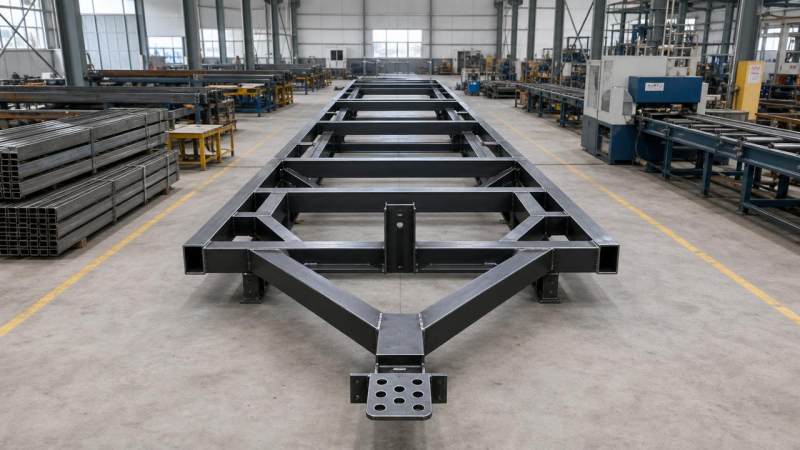
A trailer frame acts as the main load path between axle, deck, hitch, and cargo. If the frame lacks stiffness, alignment changes, welds crack, and service life drops.
Square tubing matters because its closed section resists bending and twisting more effectively than many open profiles of similar mass. This shape helps maintain geometry under repeated loading.
For carbon steel square tubing for trailer structures, the flat sides also simplify fabrication. Accurate fit-up, easier welding, and cleaner attachment points support faster production and better consistency.
Why the section shape performs well
- Closed geometry improves torsional rigidity.
- Uniform walls distribute stress more evenly.
- Flat surfaces simplify brackets, cross members, and decking support.
- Compact profile supports efficient space use below the deck.
These traits make carbon steel square tubing for trailer frames especially useful where vibration, uneven roads, and dynamic payloads are routine operating conditions.
Material behavior and strength considerations
Section shape alone does not determine performance. Steel grade, wall thickness, weld quality, and dimensional accuracy all influence the final frame strength.
Carbon steel offers a practical combination of strength, ductility, and cost control. In trailer service, that balance matters because frames must absorb impact without becoming too brittle.
Carbon steel square tubing for trailer use also supports predictable welding behavior. This is important where multiple joints, tongue assemblies, suspension mounts, and reinforcement plates are involved.
Main strength factors
In practical design, using larger tubing without checking weight can reduce payload efficiency. Strength should be matched to service conditions, not selected by size alone.
Industry concerns shaping material selection
Current trailer projects often focus on lifecycle cost rather than only initial steel price. That shifts attention toward durability, maintenance intervals, and production reliability.
- Higher road vibration exposure increases fatigue concerns.
- Outdoor storage raises corrosion risks.
- Heavier mixed loads demand better stiffness control.
- Export projects require compliance with ASTM, EN, JIS, or GB standards.
- Stable dimensions improve downstream welding accuracy.
For these reasons, carbon steel square tubing for trailer frames is often evaluated through a broader lens: section efficiency, corrosion strategy, fabrication speed, and long-term repairability.
In related infrastructure and industrial systems, corrosion control also drives material choice. For example, Galvanized Steel Electrical Conduit is widely specified where durable zinc protection and compliance with ASTM, DIN, JIS, and EN matter.
Such products show how protective coating strategy influences service life. Similar thinking applies to trailer frames exposed to water, road salt, chemicals, or agricultural environments.
Application value in trailer frame engineering
The value of carbon steel square tubing for trailer fabrication is not limited to static strength. It contributes to manufacturability, dimensional repeatability, and maintenance planning.
Key engineering benefits
- Better stiffness-to-weight performance for many common frame layouts.
- Cleaner load transfer between tongue, rails, and cross members.
- More consistent alignment during fabrication and assembly.
- Ease of reinforcing local high-stress zones.
- Wide availability in standard and custom specifications.
When frame rails remain straight and stable, axle geometry is easier to maintain. That supports safer handling, more even tire wear, and lower repair frequency.
For custom projects, carbon steel square tubing for trailer systems also supports OEM flexibility. Different wall thicknesses and lengths can be matched to deck size, load class, and route conditions.
Typical trailer scenarios and suitable tubing focus
Not every trailer uses the same frame logic. Load pattern, travel surface, and operating cycle all affect section choice and reinforcement details.
These examples show why carbon steel square tubing for trailer applications should be selected according to duty cycle, environment, and structural layout rather than appearance alone.
Practical specification and fabrication guidance
Good trailer performance starts before welding. Material sourcing, dimensional tolerances, surface condition, and mill documentation should be reviewed early.
Useful checks before production
- Confirm steel standard, grade, and mechanical properties.
- Verify tubing straightness and corner consistency.
- Match wall thickness to expected dynamic loads.
- Check weld procedure suitability for the selected carbon steel.
- Plan coating or galvanizing for outdoor service.
- Inspect high-stress locations near couplers and suspension mounts.
If corrosion resistance is critical, coated steel solutions deserve closer review. In broader steel supply chains, Galvanized Steel Electrical Conduit demonstrates how zinc-coated products can combine anti-corrosion performance, transport-ready packaging, and wide application adaptability.
For trailer frames, similar principles apply: protect cut edges, seal moisture traps, and maintain coating continuity after fabrication whenever possible.
Next-step considerations for stronger trailer frames
Choosing carbon steel square tubing for trailer frames is ultimately a structural decision with direct effects on safety, lifespan, and operating cost. The right section can improve stiffness, simplify fabrication, and reduce service issues.
A sound evaluation should compare section size, wall thickness, corrosion exposure, fabrication method, and target standards. Those details determine whether the frame performs reliably in actual transport conditions.
For projects requiring standard structural steel, custom profiles, or export-ready supply, it is useful to review technical documentation, production capability, and quality control before finalizing specifications.
Hongteng Fengda, a structural steel manufacturer and exporter from China, supplies angle steel, channel steel, steel beams, cold formed profiles, and customized structural steel components for global industrial and construction needs.
With compliance aligned to ASTM, EN, JIS, and GB standards, stable capacity, and dependable lead times, the company supports projects that require reliable steel performance and controlled sourcing risk.
Please give us a message


Please enter what you want to find