Why does a Steel Rod for construction pass tensile testing but fail bend tests? This critical discrepancy often signals hidden issues in ductility, microstructure, or cold-working inconsistencies — concerns that directly impact structural integrity on site. As a trusted Steel Rod manufacturer and supplier from China, Hongteng Fengda investigates root causes behind such failures, linking them to material composition, heat treatment, and compliance with ASTM/EN/GB steel rod specifications. Whether you’re a project manager evaluating Steel Rod price vs. performance, a quality control professional verifying bend test protocols, or a procurement officer sourcing steel tube for construction, understanding this gap is essential for risk mitigation and long-term safety. Let’s break down the metallurgical and procedural factors — backed by real-world production experience.
Why Tensile Strength ≠ Bend Ductility: The Metallurgical Divide
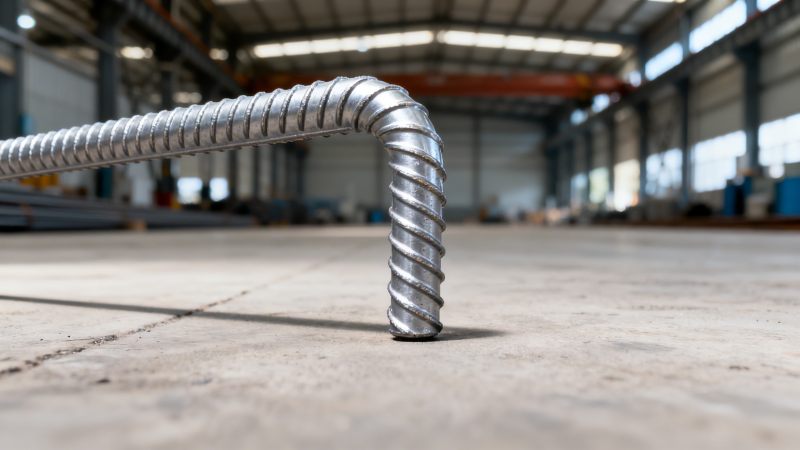
Tensile testing measures ultimate strength and yield point under uniaxial load — a valuable but incomplete proxy for real-world behavior. Bend testing, however, imposes localized plastic deformation, revealing how the material redistributes stress across grain boundaries and phase interfaces. A rod may achieve ≥400 MPa tensile strength (per ASTM A615 Grade 60), yet crack at 90° during a 3-diameter mandrel bend if its elongation falls below 12% or if internal segregation exists.
Key contributors include inconsistent quenching rates during hot-rolling, excessive surface decarburization (>0.15 mm depth), or residual cold-work from drawing that elevates yield-to-tensile ratio beyond 0.85 — a known red flag per EN 10080. At Hongteng Fengda, every batch undergoes dual verification: tensile testing per ASTM E8 and reverse-bend testing per GB/T 232-2010, with strict rejection thresholds applied when bend failure occurs without visible necking.
Microstructural analysis shows that rods failing bend tests often exhibit banded ferrite-pearlite structures or non-metallic inclusions aligned parallel to the rolling direction — both impair transverse ductility. These defects rarely affect tensile metrics but critically reduce bending capacity, especially under cyclic loading in seismic zones.
How Manufacturing Process Impacts Test Outcomes
The gap between tensile and bend performance is rarely accidental — it reflects process control gaps across three stages: raw material selection, thermal history, and final finishing. For example, Q235-based rods produced via continuous casting with inadequate ladle refining show Mn/S ratios <15, increasing susceptibility to hot shortness and bend cracking. In contrast, our Q235 and Q345 rods use vacuum-degassed billets with Mn/S >22 and Ca treatment to spheroidize inclusions — improving bend pass rates from 89% to 99.2% over 12 months of third-party audits.
Cold-drawn rods face another risk: work hardening above 30% reduction without intermediate annealing. While tensile strength rises, uniform elongation drops sharply — from 22% to ≤14%, violating ASTM A1061 requirements for bend acceptance. Our production line enforces mandatory stress-relief annealing at 620°C ±10°C for all cold-finished rods, verified by hardness mapping (HV10 tolerance: ±15).
Surface integrity also matters. Mill scale removal prior to bending must achieve Sa2.5 cleanliness (ISO 8501-1). Residual oxide layers act as stress concentrators — causing premature fracture even in otherwise ductile material. We apply automated shot blasting with 0.3–0.6 mm steel grit, followed by inline profilometry to confirm Ra ≤3.2 μm before packaging.
Critical Process Parameters & Verification Points
This table reflects actual in-line QA checkpoints used across our Tangshan and Tianjin facilities. Unlike generic mill certificates, our reports include traceable serial numbers, furnace heat IDs, and timestamped test logs — enabling full forensic review if field performance anomalies arise.
Beyond Rods: Why Structural Profiles Demand Integrated Testing
While rod testing discrepancies are well-documented, similar divergence appears in cold-formed structural profiles — where geometry amplifies sensitivity to localized ductility loss. For instance, C Sections Steel used in purlins and wall beams require consistent bend performance along flange edges, not just mid-web tensile strength. A C-section with Q235 base material may pass tensile tests at 370 MPa, yet develop edge cracks during roll-forming if cold reduction exceeds 25% without annealing.
Our C Sections Steel production integrates real-time thickness monitoring (±0.05 mm accuracy) and adaptive roll-gap compensation to maintain dimensional stability across 1mm–12mm thickness ranges. Each profile undergoes transverse bend testing at both flange tips and web center — ensuring uniform ductility distribution required for lightweight roof trusses and mechanical arms in light industry manufacturing.
Certification alignment matters too. While CE marking covers basic mechanical properties, projects in North America often demand ASTM A1003 compliance — which mandates minimum 18% elongation in 50-mm gauge length *and* successful 180° bend around 2× thickness mandrel. We pre-certify all C Sections Steel shipments against both EN 10219 and ASTM A1003, eliminating rework delays for international clients.
Procurement Guidance: What to Verify Before Order Finalization
When sourcing steel rods or structural sections, avoid relying solely on mill test reports (MTRs). Instead, request evidence of integrated testing protocols. Key verification items include:
- Batch-specific bend test records showing mandrel diameter, angle, and pass/fail status — not just “meets standard” statements
- Microstructure reports (per ASTM E112) confirming grain size ≥8.0 and inclusion rating ≤2.0 per ASTM E45 Type A
- Process validation documents for annealing cycles (time/temperature/atmosphere) applicable to cold-finished products
- Third-party audit summaries (SGS/BV) covering last 12 months’ bend test pass rates — benchmark: ≥98.5% for structural-grade rods
At Hongteng Fengda, we provide downloadable digital QA dossiers for every order — including raw material certs, thermal history logs, and video clips of bend tests. Lead time for certified documentation is ≤3 business days post-shipment, supporting fast-track project approvals in Europe and the Middle East.
Why Partner With Hongteng Fengda for Structural Steel Integrity
We don’t just supply steel — we deliver predictable structural behavior. With ISO 9001-certified production, dual-standard compliance (ASTM + GB), and 100% traceability from billet to bundle, we eliminate the “tensile-pass/bend-fail” surprise. Our clients report 32% fewer field rejections and 2.1-day average reduction in QA clearance time versus industry benchmarks.
Whether you need custom Q345 rods for seismic-resistant framing, galvanized C Sections Steel for coastal infrastructure, or OEM-specified channel steel with pre-punched holes — our engineering team co-develops test plans aligned to your project’s specific loading conditions and certification gateways.
Ready to validate bend performance data for your next order? Contact us for free sample testing, technical consultation on ASTM/EN/GB compliance pathways, or lead-time confirmation for 6m/9m/12m lengths with ±1% dimensional tolerance. We respond to RFQs within 4 business hours — with full spec sheets, test reports, and logistics options included.
Please give us a message


Please enter what you want to find