Galvannealed steel sheet is generally easier to paint because its coating surface is an iron-zinc alloy rather than the relatively zinc-rich surface found on conventional galvanized steel. During galvannealing, a freshly hot-dip galvanized strip passes through a controlled heating stage. Iron diffuses from the steel substrate into the zinc coating, creating intermetallic alloy layers at and near the surface. The resulting finish is usually matte gray, finely textured, and more chemically receptive to common pretreatment systems.
Paint adhesion is not determined by appearance alone. It depends on whether the surface can be cleaned consistently, converted into a stable pretreatment layer, wetted by the primer, and retained through forming, moisture exposure, temperature cycling, and service loading. The alloyed surface of galvannealed sheet tends to perform well in this sequence because it offers both microscopic surface texture and a different chemical response from bright zinc.
Surface chemistry changes the pretreatment response
Conventional galvanized steel normally presents a zinc-rich outer layer. Zinc provides sacrificial corrosion protection, but fresh galvanized surfaces can be difficult to paint without careful preparation. Residual rolling oils, mill-applied passivation treatments, storage stains, zinc oxidation products, or contamination introduced during handling may interfere with wetting and chemical conversion. A smooth, bright spangle-free galvanized surface can also offer limited mechanical anchoring for some paint systems.
Galvannealing changes the chemistry at the exposed coating surface. Instead of behaving primarily as metallic zinc, the surface contains iron-zinc phases with varying iron content. This composition is commonly more compatible with zinc phosphate and other conversion coatings used before liquid painting, powder coating, or electrocoating. A properly controlled conversion layer can form more uniformly, creating a stable interface between the metal coating and the organic paint film.
The practical benefit is often seen in coating continuity. Primer can spread more evenly across a matte alloy surface, especially where a paint system requires reliable coverage over pressed edges, shallow draw areas, and complex fabricated details. The better response does not remove the need for pretreatment, but it can reduce sensitivity to minor variation in surface energy when the coating line is otherwise well controlled.
Why the matte texture matters
The galvannealing reaction produces a surface that is visibly duller and microscopically rougher than typical galvanized sheet. This roughness provides additional anchoring points for pretreatment and primer. Paint does not simply sit on a flat metal plane; it follows the surface profile and locks into fine irregularities after curing. A suitable profile can improve resistance to peeling or delamination when a painted component is exposed to vibration, thermal movement, or localized impact.
That texture must remain within an appropriate range. Excessively rough coating can increase paint consumption, create an uneven visual finish, and make thin-film coverage difficult at peaks. Loose powdery deposits, heavy coating dust, or poorly controlled alloy growth are defects rather than paintability advantages. The desired condition is a coherent, uniform alloyed coating with enough texture for adhesion but without friable material that can detach beneath the paint film.
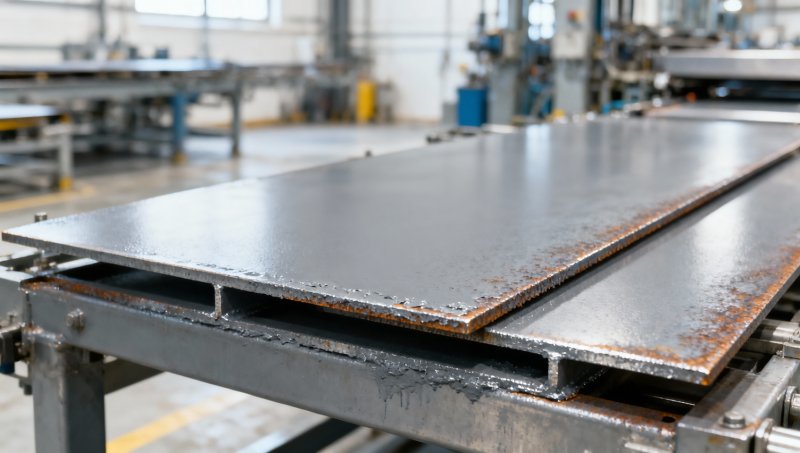
Surface roughness also affects the appearance of the finished part. On glossy topcoats, differences in substrate texture may become visible as waviness, reduced distinctness of image, or inconsistent gloss. Where decorative appearance matters, the paint specification should state the intended finish level and include representative panels after forming and curing. A galvannealed substrate can support durable paint adhesion while still requiring process trials to confirm the visual result.
The coating structure is different from ordinary galvanizing
Galvanized sheet is produced by coating steel with zinc, commonly through a continuous hot-dip process. Its coating may include alloy layers at the steel interface, but the outer surface remains predominantly zinc. Galvannealed sheet begins with a similar zinc application, then receives additional heat to promote diffusion between zinc and iron. The coating becomes an alloy system rather than a zinc-rich outer layer over an interfacial alloy.
Iron content, coating mass, heating temperature, line speed, substrate chemistry, and thermal history influence the final alloy structure. These variables affect coating hardness, powdering tendency, formability, weld behavior, and paint response. A specification that simply states “galvannealed” without defining coating designation, substrate grade, surface condition, and intended coating process can leave important performance questions unresolved.
Harder alloy phases are one reason galvannealed coatings respond differently during fabrication. They may offer a stable paint base after proper cleaning, yet they can be more susceptible than some galvanized coatings to powdering or flaking under severe deformation. The risk increases at tight bend radii, deep draws, sharp embossing, or areas with high contact pressure from tooling. Detached coating particles can contaminate dies and create defects that later appear as paint inclusions, bare spots, or poor local adhesion.
Pretreatment remains necessary
Calling galvannealed steel paintable should not be interpreted as permission to paint directly over an as-received surface in all applications. Storage conditions, transport packaging, handling methods, cutting fluids, welding residues, and fabrication dust can all change the condition of the surface. Even a coating with favorable chemistry requires a clean, conversion-ready substrate.
A typical paint preparation route may include alkaline cleaning, water rinsing, surface activation where applicable, chemical conversion treatment, rinsing or sealing, drying, primer application, and topcoat curing. The exact sequence depends on the paint technology and performance requirement. Phosphate systems are widely associated with coated sheet because they create a conversion layer that can support adhesion and corrosion resistance. Alternative non-phosphate pretreatments may also be used when qualified with the selected primer and topcoat.
Cleaning chemistry deserves particular attention. An aggressive cleaner or poorly controlled dwell time can attack a reactive metallic coating, while insufficient cleaning leaves oil or particulate contamination behind. Rinse quality is equally important. Conductivity buildup, drag-in from previous stages, or incomplete drying can leave residues that reduce adhesion even when the alloy coating itself is suitable.
Before production release, the complete substrate-to-topcoat system should be assessed rather than judging the metal alone. Useful evaluation methods may include dry and wet adhesion testing, cross-hatch testing where appropriate, bend testing, impact testing, coating thickness measurement, corrosion exposure selected for the intended environment, and examination of formed edges. The relevant acceptance method should be agreed before trial panels are prepared because test conditions can materially change the interpretation of results.
Paint coverage and electrocoating behavior
Galvannealed sheet is often selected where uniform primer deposition is important, particularly in systems using electrocoat primers. The matte alloyed surface can support consistent conversion coating formation, which in turn contributes to uniform electrical and chemical behavior during coating. Actual deposition quality still depends on bath parameters, part geometry, drainage paths, electrical contact, voltage schedule, and curing conditions.
For spray-applied liquid paint or powder coating, the advantage is more closely related to wetting and mechanical interlocking. A primer that wets the surface without beading or retreating is more likely to form a continuous barrier film. Edges, weld-adjacent areas, perforations, and formed corners remain demanding locations because film build is often lower there. Material selection cannot compensate for inadequate spray access, poor grounding, or an unsuitable cure schedule.
Film thickness should be controlled to the paint supplier's system requirements. A thin film may leave high points or edges insufficiently protected; an excessively thick film can trap solvents, reduce flexibility, or create curing defects. The interaction between coating texture and applied film build should be confirmed on production-representative material rather than on a polished laboratory coupon.
Fabrication conditions that can affect the painted result
Welding, cutting, punching, bending, and grinding can alter the surface that will eventually receive paint. Heat-affected zones from welding may carry oxides or spatter that require removal. Thermal cutting can leave rough edges, oxide scale, or localized coating damage. Abrasive cleaning may improve local cleanliness but can also remove the protective coating entirely if used aggressively.
Where galvanized or galvannealed components are joined, the paint sequence should identify which operations occur before pretreatment and which occur after coating. Weld seams fabricated before painting require cleaning compatible with the downstream conversion chemistry. Mechanical fasteners and sealed lap joints require separate consideration because trapped moisture can undermine a paint film from concealed interfaces. Sealant compatibility, cure temperature, and paint adhesion over the sealant should be verified as a system.
Forming trials are particularly relevant for parts with tight bends or drawn features. Coating powdering may not be obvious before painting. A visually acceptable formed panel can still contain fine loose particles that weaken primer anchorage. Wiping tests, tape-lift observations, die cleanliness checks, and microscopic examination of critical formed zones can reveal whether the coating and forming severity are compatible.
Specification details that avoid avoidable disputes
A useful material specification identifies the substrate steel grade, coating type, coating mass or designation, surface treatment condition, dimensional tolerances, and applicable standard. The paint specification should separately state the cleaning and pretreatment route, primer and topcoat chemistry, target dry-film thickness, curing window, required appearance, and performance tests. Combining all requirements under a broad phrase such as “paintable coated steel” creates too much room for inconsistent interpretation.
- State whether the sheet will be painted before or after forming, since severe forming can change the available coating surface.
- Define whether temporary oils, passivation, or mill-applied treatments are permitted, and confirm that they are compatible with the planned pretreatment line.
- Include representative edge, weld, and bend areas in approval samples instead of evaluating only flat panel faces.
- Set packaging and storage expectations where condensation, salt exposure, or long storage periods could create white rust or surface staining before painting.
Standards such as ASTM, EN, JIS, and GB may define relevant coating designations and test methods, but the correct document depends on the sheet product, region, coating process, and end-use requirement. Referencing a standard without selecting the applicable grade and coating designation does not establish paint performance by itself. The paint system and validation method must still be matched to the service environment.
Common comparison errors
The first error is treating galvanized and galvannealed sheet as interchangeable because both contain zinc. Their corrosion mechanisms overlap, but their surface chemistry, coating hardness, forming response, and paint preparation behavior are different. A paint process qualified on one may require adjustment before being transferred to the other.
Another error is assuming that greater coating mass automatically produces better painted durability. A heavier coating can contribute to corrosion protection, but paint adhesion depends on surface condition, conversion quality, film continuity, and damage resistance. The best coating designation is tied to the actual exposure, forming requirement, and paint process rather than coating mass alone.
A third error is evaluating adhesion immediately after curing and stopping there. Some interface problems become visible only after water exposure, thermal cycling, humidity, salt-containing environments, or mechanical deformation. The selected test sequence should reflect the anticipated service conditions, including cut edges and joints where corrosion may initiate.
Galvannealed steel sheet is easier to paint because the iron-zinc alloy surface generally accepts conversion coatings and primers more readily than a zinc-rich galvanized surface. That advantage is realized only when alloy quality, fabrication severity, cleaning, pretreatment, paint application, and curing are treated as one controlled system.
Please give us a message


Please enter what you want to find