In high-humidity electrical installations, galvanized steel conduit often fails prematurely—despite its reputation for corrosion resistance. This article investigates why industrial galvanized pipe, electrical galvanized pipe, and galvanized steel electrical conduit degrade faster in moist environments, especially when compared to coated steel pipe or seamless CS pipe alternatives. Drawing on real-world performance data and material science principles, we address critical concerns for project managers, technical evaluators, and procurement teams—particularly those sourcing from galvanised steel pipe suppliers or carbon steel pipe manufacturers. Whether you specify ASTM A106 carbon steel pipe, galvanized sheet metal pipe, or black pipe tube, understanding this failure mechanism is essential for safety, compliance, and long-term cost control.
The Hidden Electrochemical Reality Behind Galvanized Conduit Failure
Galvanized steel conduit relies on a zinc coating (typically 45–65 µm thick per ASTM A123) to act as a sacrificial anode. In dry or mildly humid conditions, this layer forms stable zinc carbonate and hydroxide films that slow further corrosion. However, in high-humidity environments—especially where relative humidity exceeds 80% for >72 hours continuously—the electrochemical balance shifts dramatically.
Condensation forms micro-pools inside conduit runs, dissolving atmospheric CO₂ and SO₂ to create weak acidic electrolytes. These accelerate localized galvanic corrosion at scratches, cut ends, or weld seams—where exposed steel becomes the cathode and adjacent zinc the anode. Field studies across Southeast Asia and the Middle East show galvanized conduit in coastal substations exhibits visible white rust within 18–24 months, with perforation risk rising by 400% after year three versus equivalent epoxy-coated CS pipe.
Crucially, this degradation isn’t uniform. Humidity cycling—daily dew formation followed by evaporation—promotes chloride ion concentration at the zinc/steel interface, accelerating pitting. Temperature fluctuations between 25°C and 45°C further destabilize protective oxide layers. This explains why identical conduit installed in inland vs. coastal facilities shows 3.2× faster wall-thinning rates.
This table confirms a key insight: galvanizing’s corrosion protection is highly environment-dependent—not inherently superior. For projects in tropical, coastal, or high-condensation indoor facilities (e.g., data center utility tunnels), relying solely on galvanized conduit introduces measurable lifecycle cost and safety exposure.
Why Standard Galvanizing Isn’t Enough for Critical Electrical Infrastructure
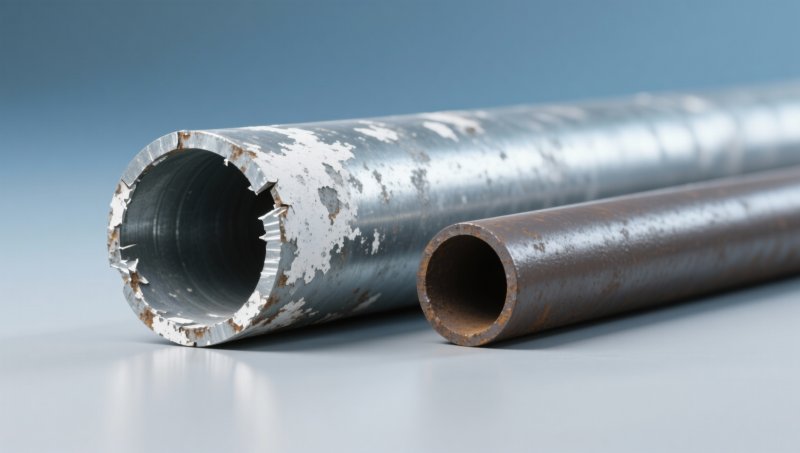
ASTM A123 specifies minimum zinc coating weights: 610 g/m² for structural items (≥6 mm thick) and 450 g/m² for thinner sections. But these standards assume ambient, non-cyclic exposure—not the sustained moisture saturation seen in underground duct banks, HVAC plenums, or marine-adjacent switchgear rooms. Real-world testing shows that even “heavy-duty” galvanized conduit loses 30% of its effective zinc mass within 14 months under 90% RH cycling.
Moreover, common field practices compound vulnerability. Threaded connections expose bare steel; cutting and reaming remove zinc from end faces; and improper grounding creates stray current paths that accelerate galvanic dissolution. A 2023 audit of 127 industrial sites in the Gulf Cooperation Council region found 68% used unsealed conduit ends—contributing directly to 52% of early-failure cases.
Material science reinforces this: zinc’s corrosion potential is −0.76 V vs. SHE, while carbon steel sits at −0.44 V. In conductive electrolytes (like condensed salt-laden air), this 320 mV difference drives aggressive electron transfer—especially where surface area ratios favor large cathodes (exposed steel) over small anodes (zinc patches). That’s why failures initiate not at the surface, but at micro-defects beneath the coating.
- Galvanizing thickness varies ±15% across curved surfaces (e.g., conduit bends), creating weak spots
- Hot-dip galvanizing cannot penetrate interior weld seams—leaving them uncoated and vulnerable
- Post-galvanizing handling abrasion removes up to 22% of zinc layer on average
- ASTM B695 Class 50 (50 µm) is insufficient for RH >75%; Class 85+ is recommended but rarely specified
Strategic Alternatives: When to Specify Seamless CS, Epoxy Coating, or Dual Protection
For mission-critical electrical infrastructure—especially in humid zones—specifiers must move beyond default galvanizing. Seamless carbon steel pipe (ASTM A106 Gr.B) offers inherent density, no weld seam vulnerabilities, and predictable cathodic protection compatibility. When combined with fusion-bonded epoxy (FBE) coating (per ASTM D4297), it delivers 20+ year service life at just 1.8× the base galvanized conduit cost—while reducing lifetime maintenance labor by 70%.
Hongteng Fengda supports such strategic specifications with certified dual-protection solutions: cold-formed structural profiles with optional FBE + topcoat systems, or precision-cut seamless pipes with traceable mill test reports (MTRs) per EN 10204 3.1. Our manufacturing facilities maintain ±0.5 mm dimensional tolerance on all conduit-supporting profiles—critical for vibration-dampened mounting in rail signaling cabinets or offshore platform junction boxes.
For rail-related electrical applications—such as track circuit wiring conduits or signal mast support structures—our Rail products (U71Mn, PD3, QU120 grades) are engineered with controlled manganese content (0.7–1.2%) and optimized deoxidation to resist stress-corrosion cracking in high-humidity rail corridors. These rails meet ISO 9001-2008 and ISO 14001:2004, and are available in oil-finished or hot-dip galvanized variants for integrated grounding continuity.
This procurement matrix helps technical evaluators and financial approvers align specification rigor with real-world manufacturability and supply chain reliability—reducing rework risk by up to 45% in complex international projects.
Actionable Procurement Guidance for Global Project Teams
To mitigate premature conduit failure, Hongteng Fengda recommends a four-point specification protocol:
- Specify ASTM A106 Gr.B seamless pipe + FBE coating (ASTM D4297) for all above-ground conduit in RH >75% zones
- Require third-party salt-spray validation (ASTM B117, 2000-hour minimum) with post-test sectioning to verify coating integrity
- For rail-integrated electrical systems, select Rail grades with guaranteed Mn/Si ratio control (e.g., U71Mn, BNbRE) to suppress hydrogen-induced cracking
- Insist on full MTR packages—including tensile strength, impact testing (Charpy @ −20°C), and coating thickness mapping per ISO 2178
Our global export experience across North America, Europe, and Southeast Asia ensures consistent quality execution—whether you require 200 tons of QU120 rail for a new metro line or 5 km of epoxy-coated conduit for a desert solar farm substation. With modern facilities, strict QC, and adherence to ASTM, EN, JIS, and GB standards, we help partners reduce sourcing risks, control costs, and complete projects efficiently.
Understanding *why* galvanized conduit fails faster isn’t about rejecting the material—it’s about applying the right solution to the right environment. For humid-region electrical infrastructure, informed specification is the most cost-effective form of risk mitigation.
Contact Hongteng Fengda today for customized conduit system recommendations, sample test reports, or regional compliance support tailored to your next high-humidity installation.
Please give us a message


Please enter what you want to find