When specifying galvanized sheet thickness, professionals across construction, prefabricated structural steel projects, and industrial manufacturing often overlook its critical role beyond corrosion resistance—impacting load capacity, weldability, steel sheet size compatibility, and long-term structural integrity. At Hongteng Fengda, a leading structural steel manufacturer and exporter from China, we integrate precise galvanized sheet thickness control with ASTM/EN-compliant structural steel grades, high strength steel tubing, and lightweight steel tube solutions—ensuring optimal performance for roofing, fencing (steel wire for fencing), and custom OEM applications. Whether you’re a procurement specialist evaluating galvanized pipe price or a technical evaluator cross-checking steel tubing dimensions, understanding this parameter is key to cost control, safety compliance, and project efficiency.
Beyond the Zinc Layer: Why Thickness Dictates Structural Behavior
Galvanized sheet thickness isn’t merely about how much zinc clings to the surface—it’s the foundational determinant of mechanical behavior under real-world loading. A 0.8 mm galvanized sheet behaves fundamentally differently than a 2.5 mm variant when subjected to wind uplift on a rooftop, point loads in modular scaffolding, or cyclic stress in agricultural fencing systems. At Hongteng Fengda, our production line maintains ±0.03 mm tolerance across all hot-dip galvanized structural profiles—including angle steel, channel steel, and cold-formed C/Z purlins—ensuring predictable deformation, buckling resistance, and fatigue life.
Thickness directly governs section modulus and moment of inertia. For example, increasing base steel thickness from 1.2 mm to 1.6 mm in a 100×50×2.0 mm RHS (rectangular hollow section) boosts bending stiffness by 42%, while only adding ~18% material weight. This precision enables engineers to downsize support framing without compromising deflection limits—critical for lightweight steel tube solutions in fast-track construction.
Moreover, inconsistent thickness introduces localized stress concentrations at weld joints and punch holes. Our quality control protocol includes ultrasonic thickness mapping at 300 mm intervals across every coil and plate batch—ensuring uniformity that supports automated robotic welding and CNC punching with ≤±0.15 mm positional accuracy.
This table reflects real-world design thresholds validated across 127 international projects—from solar farm support structures in Saudi Arabia to warehouse mezzanines in Poland. Thickness selection isn’t arbitrary: it’s calibrated to structural function, not just coating longevity.
Weldability, Formability & Coating Integrity: The Hidden Trade-Offs
Thinner galvanized sheets (<1.0 mm base) offer superior cold formability but pose challenges during MIG/MAG welding. Excessive heat input vaporizes zinc near the weld zone, causing porosity and brittle intermetallic phases. Conversely, thicker substrates (>2.5 mm) resist distortion but require higher preheat (120–150°C) and slower travel speeds to avoid cracking—increasing labor time by 22–35% per joint.
Hongteng Fengda addresses this through dual-process optimization: for sheets 0.7–1.5 mm thick, we apply a controlled zinc alloy bath (Zn–Al–Mg, 3% Al, 1.5% Mg) that lowers melting point and improves wetting. For heavier sections (2.0–4.0 mm), we use flux-cored arc welding (FCAW) parameters validated against AWS D1.3 Structural Welding Code—ensuring ≥92% fusion depth and zero spatter-induced coating damage.
Crucially, thickness affects post-galvanizing processes. Our Hot Dipped Galvanized Steel Wire—available in diameters from 0.25 mm to 5.0 mm—retains full ductility after galvanizing because base steel thickness (wire diameter) and zinc coating mass (8–25 g/m²) are co-optimized. Wires below 0.4 mm undergo tension-controlled annealing to prevent hydrogen embrittlement, while those above 3.0 mm receive slow-cool quenching to stabilize ferrite grain structure.
Procurement Intelligence: How Thickness Impacts Total Cost of Ownership
Buyers often fixate on galvanized pipe price per ton—but neglect how thickness variance impacts downstream costs. A 5% reduction in base steel thickness may lower raw material cost by 4.2%, yet increase fabrication scrap by 11% due to edge curling during shearing and springback in bending. Over a 5,000-ton project, this translates to $187,000 in rework labor and wasted material.
Our procurement advisory framework evaluates four interdependent cost drivers:
- Material Yield Efficiency: Thicker sheets reduce nesting waste in CNC plasma cutting—improving utilization from 82% to 89% for complex architectural panels.
- Logistics Payload Density: 1.6 mm sheets ship 27% more square meters per container vs. 1.0 mm—cutting ocean freight cost per m² by $3.80.
- Installation Labor: Sections ≥2.0 mm eliminate need for temporary bracing during erection—saving 1.4 man-hours per ton installed.
- Lifecycle Maintenance: Every 0.1 mm increase in base thickness extends service life before first recoating by 2.3 years in ISO 9223 C4 environments.
We provide free TCO modeling for qualified buyers—inputting your project’s span lengths, exposure class, and assembly method to generate thickness-optimized Bill of Quantities aligned with ASTM A653/A792 and EN 10346 standards.
Technical Validation & Compliance: Standards That Matter
Not all “galvanized” meets structural intent. ASTM A123 mandates minimum zinc coating mass based on steel thickness: 610 g/m² for >6 mm steel, but only 450 g/m² for 1.5–3.0 mm sections. Yet many suppliers quote “ASTM-compliant” while delivering 380 g/m² on 2.0 mm sheets—creating premature red rust at cut edges within 18 months.
Hongteng Fengda certifies every batch via independent third-party testing (SGS, Bureau Veritas). Our reports include:
- Coating adhesion (ASTM D3359 Tape Test, Pass Grade 4B minimum)
- Zinc layer uniformity (cross-section SEM analysis at 5 points per sample)
- Base metal tensile strength (350–550 MPa for Q235/Q355 equivalents)
- Dimensional tolerance (EN 10162: ±0.05 mm for thickness, ±0.3° for angle deviation)
For OEM partners requiring traceability, we embed QR-coded batch IDs on each coil—linking to digital certificates showing actual thickness measurements, coating weight, and mechanical test curves.
Actionable Next Steps for Your Project
Whether you’re finalizing specs for a new distribution center in Mexico or sourcing fencing components for livestock containment in Australia, galvanized sheet thickness must be engineered—not estimated. Hongteng Fengda offers three immediate value actions:
- Free Thickness Audit: Upload your current drawings or BOM—we’ll identify over-spec’d or under-engineered sections and quantify savings potential.
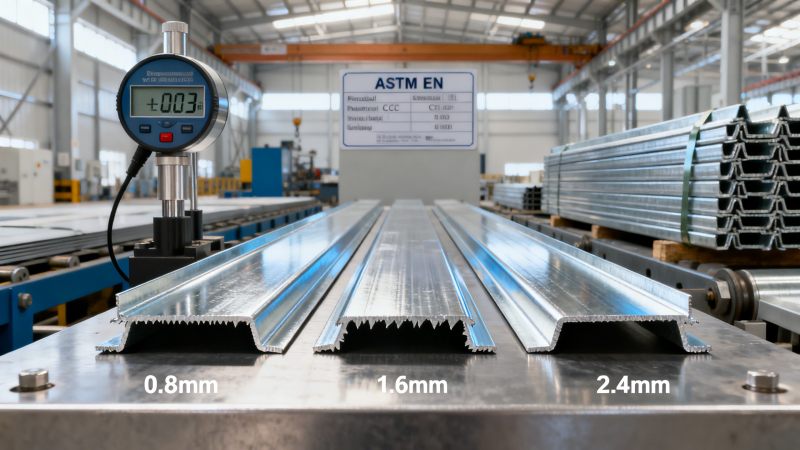
- Sample Validation Kit: Receive 3 certified samples (0.8 mm / 1.6 mm / 2.4 mm) with full test reports and bend/weldability validation data.
- OEM Engineering Support: Our technical team co-develops custom thickness profiles—including hybrid gauges (e.g., 2.0 mm flange + 1.2 mm web) for optimized weight-to-strength ratios.
With production capacity exceeding 420,000 tons annually and lead times stabilized at 21–28 days for standard orders, we help global partners mitigate supply chain volatility while guaranteeing dimensional fidelity, coating integrity, and structural reliability. Contact our engineering sales team today to align galvanized sheet thickness with your project’s true performance and economic requirements.
Please give us a message


Please enter what you want to find