Galvanized metal conduit—commonly specified as electrical galvanised conduit, galvanized electrical pipe, or conduit pipe galvanized—is widely used in industrial and construction projects. But in coastal installations, its accelerated corrosion undermines safety and lifecycle performance. Why does galvanized metal conduit fail faster near saltwater? And what alternatives—like corrosion-resistant right angle metal plate supports or premium galvanized metal tubing—offer proven reliability? For structural steel manufacturers like Hongteng Fengda, specifying the right galvanized metal pipe or galvanized industrial pipe isn’t just about compliance—it’s about risk mitigation, long-term cost control, and project integrity.
Why Coastal Environments Accelerate Galvanized Conduit Failure
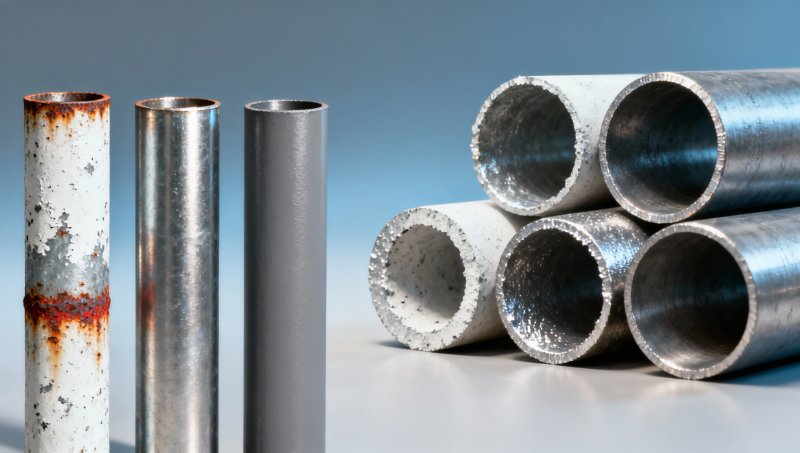
Salt-laden air, high humidity, and periodic chloride deposition create an electrochemical environment that rapidly degrades zinc coatings. In coastal zones, atmospheric chloride concentrations commonly exceed 30 mg/m²/day—well above the 5–10 mg/m²/day threshold where standard hot-dip galvanizing (HDG) begins to show visible white rust within 6–12 months.
The failure mechanism is not uniform: pitting initiates at micro-defects in the zinc layer, then propagates into the base steel through localized galvanic cells. Field studies across Southeast Asia and the Gulf Coast report average service life reductions of 40–60% compared to inland installations—dropping from 25+ years to under 10 years for standard G90 (0.90 oz/ft²) HDG conduit.
This degradation compromises both mechanical integrity and electrical continuity—critical for grounding systems. Once the zinc layer breaches, red rust forms within weeks, increasing resistance by up to 300% and triggering cascading failures in adjacent components.
Corrosion-Resistant Alternatives: Performance vs. Practicality
Not all galvanized products perform equally in aggressive environments. The key differentiator lies in coating thickness, substrate metallurgy, and post-treatment options. For example, duplex systems—zinc-aluminum alloy coatings (e.g., Zn-5%Al-Mg) with minimum 120 µm thickness—demonstrate 3–5× longer life than standard HDG in ASTM B117 salt-spray testing (≥2,000 hours vs. 400–600 hours).
Another proven solution is cold-formed structural support components made from pre-galvanized or electrogalvanized steel with supplementary passivation layers. These are especially effective for mounting brackets, cable trays, and right angle metal plate supports—where mechanical stress and crevice corrosion combine to accelerate failure.
For conduit applications demanding seamless integrity and thermal stability, A36 Steel Pipe offers a robust foundation. Its seamless cold-drawn low-carbon steel tube structure eliminates weld seams—common initiation sites for chloride-induced stress corrosion cracking—and supports custom external coating systems including epoxy-phenolic hybrids rated for continuous immersion service.
Key Selection Criteria for Coastal Applications
- Minimum zinc coating mass: ≥120 g/m² (equivalent to ASTM A123 Class 3 or ISO 1461 Grade 2)
- Base steel grade: Low-carbon, fine-grain microstructure (e.g., ASTM A500 Gr. C or EN 10219 S355JRH) for improved weldability and ductility
- Coating adhesion: Verified per ASTM D3359 cross-hatch test (Class 4B or better)
- Post-coating treatment: Chromate or silane-based passivation to inhibit wet storage stain formation
How Structural Steel Manufacturers Mitigate Coastal Risk
As a structural steel manufacturer and exporter serving North America, Europe, and the Middle East, Hongteng Fengda applies multi-layered corrosion management—not just for conduit, but across all load-bearing and exposed components. This includes strict process controls during hot-dip galvanizing (bath temperature ±2°C, immersion time 3–5 minutes), mandatory post-treatment quenching, and third-party verification of coating thickness per ISO 1460.
Our production facilities comply with ASTM A123, EN ISO 1461, and JIS H8641, enabling traceable batch certification for every order. For coastal projects, we recommend dual-certified materials—such as A36 Steel Pipe meeting both ASTM A53 and ASTM A106 requirements—to ensure compatibility with high-pressure steam, condensate return, and marine-grade fire suppression systems.
Delivery timelines remain stable: standard orders ship within 2–4 weeks; custom-coated or certified batches require 5–7 weeks—including full documentation package (MTRs, coating reports, dimensional inspection records).
Certification & Compliance Comparison
Below is how common galvanized product specifications align with coastal infrastructure requirements:
Hongteng Fengda routinely supplies Class 3 and Grade 2+ configurations—with optional third-party verification via SGS or Bureau Veritas—for clients requiring audit-ready documentation and extended warranty coverage.
Why Partner With Hongteng Fengda for Coastal-Grade Steel Solutions
We don’t just supply steel—we engineer resilience. As a China-based structural steel manufacturer exporting to 30+ countries, our strength lies in integrated control: from raw material sourcing (certified scrap and billet traceability) to final dimensional inspection (±0.2 mm tolerance on OD/ID for pipes ≤150 mm). Our cold-formed profiles undergo tensile testing per ASTM A653 and bend testing per EN 10147—ensuring formability and post-galvanizing integrity.
For procurement teams, we provide full technical support: coating thickness mapping, salt-spray validation reports, and OEM-compatible CAD models. Finance and project managers benefit from fixed-lead-time contracts (no escalation clauses) and consolidated logistics—standard container loading for 6m pipe bundles reduces handling damage by up to 22% versus loose loading.
Ready to specify corrosion-resilient conduit, support structures, or heat transfer tubing for your next coastal project? Contact us for:
- Custom coating specification review (zinc mass, alloy type, passivation)
- Dimensional validation for existing conduit layouts
- Lead time confirmation for ASTM/EN/JIS-certified batches
- Sample submission for third-party lab testing
- Multi-currency quotation with Incoterms 2020 alignment
Please give us a message


Please enter what you want to find