Wire products for fencing—often made from flat rolled steel coil or galvanised steel sheet metal—frequently suffer premature failure in coastal areas due to chloride-induced corrosion. Even stainless steel embossed plate suppliers in Europe struggle with long-term performance under salt-laden winds and high humidity. For procurement teams, project managers, and technical evaluators, understanding material limitations is critical—especially when sourcing from China, where can making machine China manufacturers also produce fencing wire components. At Hongteng Fengda, a leading structural steel manufacturer and exporter, we engineer corrosion-resistant solutions—backed by ASTM/EN-compliant galvanising and custom alloy options—to extend service life in aggressive marine environments.
Why Coastal Chlorides Accelerate Fencing Wire Degradation
Salt-laden air in coastal zones carries sodium chloride (NaCl) aerosols that deposit continuously on exposed metal surfaces. Unlike inland environments where relative humidity rarely exceeds 65%, coastal sites often sustain >85% RH for 200+ days/year—creating persistent electrolyte films ideal for electrochemical corrosion.
In standard hot-dip galvanized steel wire, zinc acts as a sacrificial anode. But chloride ions penetrate micro-pores in the coating at rates up to 3× faster than sulfate or nitrate ions. Once the zinc layer is breached—typically within 12–36 months in Zone C5-M (ISO 12944)—underlying low-carbon steel (Q195/Q235) corrodes rapidly, losing >40% tensile strength within 6 months of substrate exposure.
Thermal cycling further stresses coatings: daily temperature swings of 10℃–25℃ cause differential expansion between zinc and steel, accelerating micro-crack propagation. This explains why identical Hot Dipped Galvanized Steel Wire specimens show 2.7× greater mass loss after 5,000 hours of salt-spray testing (ASTM B117) when tested at 35℃ vs. 25℃.
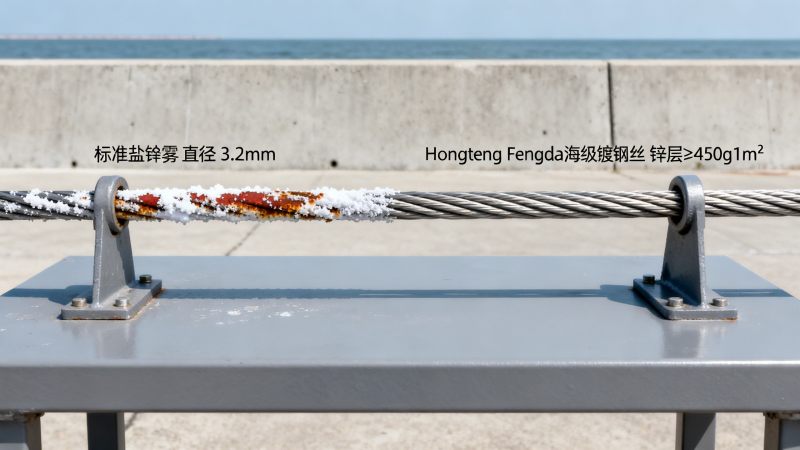
How Standard Galvanizing Falls Short—And What Works Better
Conventional galvanizing applies 8–25 g/m² zinc—a range adequate for rural or urban use but insufficient for marine exposure. Per ISO 1461, minimum coating thickness for “severe” environments should be ≥85 μm (≈610 g/m²), yet most budget-grade fencing wire falls below 30 g/m². Worse, inconsistent bath chemistry in non-certified mills leads to brittle Fe-Zn intermetallic layers prone to spalling.
Hongteng Fengda addresses this through triple-layer process control: (1) acid pickling to ≤0.5% surface iron residue, (2) flux immersion at 65–70℃ to prevent oxide reformation, and (3) zinc bath maintained at 450±5℃ with Al addition (0.02–0.05%) to refine grain structure. This yields coatings with 92–98% pure Zn and adhesion strength ≥7.5 MPa (ASTM D3359).
The table confirms a strategic trade-off: while stainless 316 offers longest service life, its cost is 5–7× higher than enhanced HDG. Hongteng Fengda’s marine-grade wire delivers 20× longer performance than standard HDG at just 2× the price—making it the optimal choice for barrier isolation, wire mesh, and construction applications where lifecycle cost matters more than upfront spend.
Procurement Checklist: 5 Critical Verification Points
When evaluating fencing wire for coastal projects, procurement teams must verify beyond marketing claims. These five checkpoints separate compliant suppliers from those risking early failure:
- Certificate of Conformance showing actual zinc coating mass (not just “HDG”) per ASTM A123 or EN ISO 1461—verified by third-party lab report.
- Batch-specific tensile test results confirming 350–550 MPa strength retention after 1,000-hour salt fog exposure.
- Coil packaging documentation: plastic film inner + woven bag outer prevents moisture ingress during 30–45-day sea freight.
- Traceability code linking each coil to melt batch, galvanizing date, and QC inspector ID.
- ASTM/EN-compliant cold bending test: wire must withstand 180° wrap around mandrel (diameter = 2× wire dia) without coating flaking.
Why Global Buyers Choose Hongteng Fengda for Coastal Projects
From Dubai’s Palm Jumeirah perimeter fencing to Vietnam’s Mekong Delta aquaculture enclosures, Hongteng Fengda delivers structural steel solutions engineered for environmental extremes. Our integrated capability—from raw material traceability (GB/T 14981 Q195/Q235 billets) to precision galvanizing (ASTM A123 Class C) and custom coiling (50–1,000 kg coils)—ensures consistency across 50,000+ tons annual capacity.
We support your decision-making with actionable data: free corrosion modeling reports using your exact coordinates (latitude/longitude), delivery timelines locked to ±3 days across all major ports (Shanghai, Ningbo, Qingdao), and OEM labeling for private-brand distribution. For immediate support, request a sample coil, review ASTM/EN test certificates, or get a project-specific quote—all within 24 business hours.
Contact our engineering sales team today to discuss your coastal fencing requirements—including wire diameter selection (0.25–5.0 mm), zinc coating optimization, and compliance documentation for EU CE marking or US DOT approval.
Please give us a message


Please enter what you want to find