When sourcing Hot diped-Galvanized Pipe for structural or industrial projects, coating quality directly affects corrosion resistance, service life, and long-term cost control. For technical evaluators, understanding coating consistency, thickness, and compliance standards is essential to reducing procurement risk and ensuring reliable project performance from every galvanized pipe order.
Why does coating quality decide the real value of Hot diped-Galvanized Pipe?
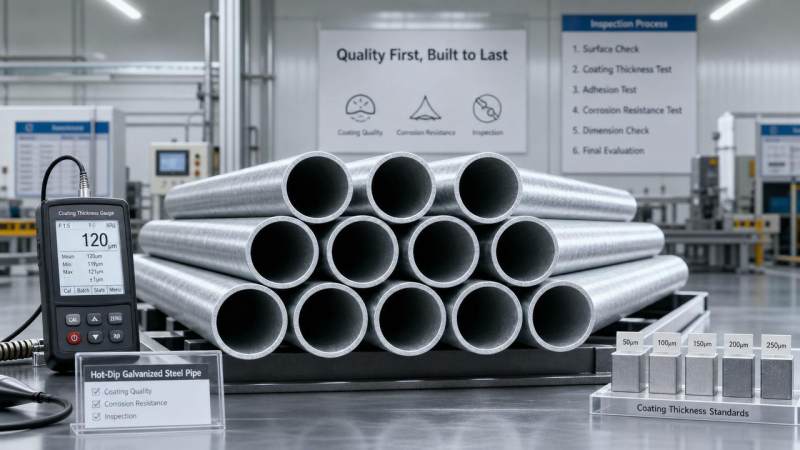
In steel procurement, price per ton is visible immediately, but coating performance reveals its value only after installation. For Hot diped-Galvanized Pipe used in outdoor structures, industrial supports, utility frames, fencing, and infrastructure, the zinc coating is the first barrier against moisture, salts, chemicals, and atmospheric attack.
A technically acceptable pipe is not defined only by base steel dimensions or mechanical properties. If the galvanized layer is uneven, too thin, poorly adhered, or contaminated during production, the pipe may fail early even when the substrate steel itself meets specification.
Technical evaluation teams often face a difficult balance: control budget, secure lead time, satisfy project standards, and avoid future maintenance claims. That is why coating quality should be reviewed as a measurable engineering factor, not as a cosmetic finish.
- It extends service life in humid, coastal, industrial, and outdoor construction environments.
- It reduces the risk of red rust appearing at welded areas, cut ends, or damaged points.
- It improves lifecycle cost performance by lowering repainting, replacement, and shutdown expenses.
- It supports compliance with common international project requirements and inspection procedures.
For buyers working with global supply chains, coating consistency also affects acceptance at destination. Poorly galvanized pipe can trigger reinspection, claims, delays in customs documentation, and site rejection, all of which cost more than the initial savings from a lower quotation.
What should technical evaluators inspect beyond basic pipe dimensions?
When comparing Hot diped-Galvanized Pipe suppliers, technical personnel should assess the full coating process, not just final appearance. A bright finish alone does not guarantee durable corrosion protection. The evaluation should connect process control, measurable coating data, and project environment.
Key coating quality checkpoints
- Surface preparation quality, including cleaning, pickling, and fluxing, because poor pretreatment weakens zinc adhesion.
- Average and local coating thickness, since insufficient zinc mass shortens corrosion protection time.
- Coating uniformity on outer surface, inner wall, ends, corners, and threaded or formed sections.
- Adhesion and surface condition, checking for peeling, blistering, ash inclusion, bare spots, excessive drips, or roughness.
- Standard compliance with ASTM, EN, JIS, or GB requirements according to the destination market and application.
This is especially important for structural steel procurement from overseas sources. Hongteng Fengda supports buyers with modern manufacturing facilities, strict quality control, and supply capability across standard and customized steel products. For technical teams, that means coating quality can be reviewed within a broader framework of dimensional control, standard compliance, and stable export execution.
The following table helps technical evaluators review the most practical coating-related factors when assessing Hot diped-Galvanized Pipe offers from different mills or traders.
A disciplined review of these items helps separate a competitive industrial product from a merely cheap one. It also gives engineering, procurement, and QA teams a shared language for acceptance criteria before production starts.
How coating defects create hidden project costs
Many procurement problems do not begin with dramatic product failure. They start with small coating irregularities that seem acceptable at shipment but become expensive on site. In Hot diped-Galvanized Pipe orders, hidden cost usually comes from delay, rework, maintenance, or shortened replacement intervals.
Common defect-to-cost chain
- Thin or bare areas accelerate rust initiation in aggressive weather exposure.
- Rough or brittle coating may crack during fabrication, transport, or site fitting.
- Excessive zinc buildup can interfere with assembly tolerances or threaded connections.
- Unclear inspection records create disputes between supplier, contractor, and project owner.
For technical evaluators, the lesson is clear: corrosion protection must be treated as part of engineering performance. The lowest offered price per pipe length can become the highest total ownership cost if coating quality causes field repair or premature replacement.
How to compare Hot diped-Galvanized Pipe offers from different suppliers
Supplier comparison works best when technical requirements are translated into a structured bid review sheet. This avoids subjective judgments and helps buyers compare mills, stockists, and exporters on the same basis.
The next table compares typical purchasing considerations for Hot diped-Galvanized Pipe in project-based steel sourcing.
This type of comparison is useful for engineering managers who must justify procurement decisions internally. It links coating quality to operational reliability, rather than treating galvanizing as a superficial add-on.
Which standards and compliance points should be reviewed?
Technical evaluation should always begin with the destination market, service environment, and contract specification. Hot diped-Galvanized Pipe may be accepted under different standards depending on the project region, industry segment, and structural function.
Practical compliance checklist
- Confirm the applicable pipe material standard and the separate galvanizing requirement, if both are specified.
- Verify whether the project calls for average coating thickness, minimum local thickness, or coating mass values.
- Check whether cut ends, threads, welded joints, or fabricated assemblies need post-treatment or repair guidance.
- Ensure mill test documentation and inspection format can satisfy owner, EPC, or third-party review.
Hongteng Fengda serves customers in North America, Europe, the Middle East, and Southeast Asia, so multi-standard coordination is a practical part of export support. That matters when technical teams need steel products aligned with ASTM, EN, JIS, or GB expectations while also maintaining lead-time discipline.
What can related steel product experience tell us about coating and specification control?
A capable structural steel exporter is usually evaluated not only by one pipe order, but by its wider ability to manage specifications, tolerances, finishing, and shipment across product categories. For example, buyers handling mixed project procurement may also source profiles, beams, or transport components together.
In some infrastructure and industrial packages, related products such as Rail may be reviewed alongside pipe, channels, or fabricated steel items. Technical teams often value suppliers that can coordinate dimensional tolerance, finish options such as oil, black, galvanized, or painted surfaces, and export documentation within one quality management approach.
For instance, rail products may involve grades such as U74, U71Mn, Q235, 55Q, 50Q, U71, or 45Mn, with common dimensions including length from 12m to 30m, thickness from 3mm to 24mm, and tolerance around ±1%. While the application differs from Hot diped-Galvanized Pipe, the procurement lesson is similar: reliable steel supply depends on process control, specification clarity, and consistent inspection discipline.
How should buyers write a better galvanized pipe procurement specification?
Many quality disputes begin with incomplete purchase documents. If the inquiry only asks for size and quantity, suppliers may quote products with very different coating levels, finish quality, and inspection scope. A better RFQ reduces ambiguity before production starts.
Recommended RFQ content for Hot diped-Galvanized Pipe
- Pipe grade, size, wall thickness, length range, and end condition.
- Applicable material and galvanizing standards for the target market.
- Required coating thickness or coating mass, including local minimum expectations.
- Inspection documents, third-party witness needs, and traceability requirements.
- Project environment details such as coastal exposure, industrial emissions, or indoor dry service.
- Packaging, marking, shipment schedule, and claim handling expectations.
This level of detail allows the supplier to quote the right process and helps the buyer compare quotations fairly. It also reduces the risk that coating quality becomes a post-order dispute instead of a pre-order decision.
FAQ: practical questions from technical evaluators
How do I know whether Hot diped-Galvanized Pipe is suitable for a coastal project?
Start by reviewing the expected corrosive environment, design life, maintenance access, and specified standard. Coastal conditions usually demand closer attention to coating thickness, surface continuity, and handling damage control. If exposure is severe, ask the supplier to clarify how the galvanizing process and inspection records support the intended service environment.
Is a thicker zinc coating always better?
Not automatically. More zinc generally improves corrosion reserve, but excessive or poorly controlled buildup can affect fit-up, thread performance, or surface condition. The right target is the coating level required by the project standard and service environment, produced with good uniformity and adhesion.
What is the most overlooked risk when buying Hot diped-Galvanized Pipe internationally?
A common risk is relying on nominal compliance without checking how inspection data is generated and linked to actual batches. Another is failing to define acceptance criteria for coating appearance, thickness, and damaged-area treatment before shipment. Both issues can lead to disputes after the cargo arrives.
Should I prioritize price, lead time, or coating quality?
For technical evaluation, coating quality should not be traded away for a small short-term price advantage. The better approach is to compare total project value: corrosion life, rework risk, standard compliance, delivery reliability, and documentation quality. A balanced supplier usually lowers risk more effectively than the cheapest offer.
Why choose us for galvanized pipe and broader structural steel sourcing?
For technical evaluators, the right supplier is one that can support both specification review and execution discipline. Hongteng Fengda is a professional structural steel manufacturer and exporter from China, serving global construction, industrial, and manufacturing projects with stable production capacity and strict quality control.
Our strength is not limited to supplying standard steel products. We also support customized solutions, OEM needs, and multi-product coordination across angle steel, channel steel, beams, cold formed profiles, and related structural components. That makes procurement easier when your project requires technical consistency across several steel categories.
- Ask us to confirm Hot diped-Galvanized Pipe parameters, coating expectations, and applicable ASTM, EN, JIS, or GB references.
- Request support for product selection based on corrosion environment, structural use, and budget target.
- Discuss lead time, mixed-product procurement planning, packaging, and export delivery requirements.
- Consult us on customized dimensions, OEM processing, documentation needs, sample support, and quotation details.
If your team is comparing suppliers for a new galvanized pipe order, a practical next step is to send the project specification, target standard, quantity, and delivery schedule for review. We can help you identify the coating-related checkpoints that matter most, reduce sourcing uncertainty, and align the offer with real project performance requirements.
Please give us a message


Please enter what you want to find