When designing load-bearing structures, precise structural steel dimensions aren’t just technical details—they directly impact safety, cost, and compliance. Whether you’re sourcing a Steel Beam for construction, evaluating structural steel weight for logistics planning, or comparing Steel Beam price and steel bar price across suppliers, dimensional accuracy affects load capacity, connection integrity, and long-term performance. As a trusted Steel Beam supplier and structural steel manufacturer from China, Hongteng Fengda ensures every angle steel, channel steel, and cold-formed profile meets ASTM, EN, and GB standards—helping procurement teams, project managers, and engineers mitigate risk while optimizing value. Don’t overlook dimensions—they shape everything.
Why Dimensional Tolerance Is a Non-Negotiable in Load-Bearing Design
A deviation of just ±0.8 mm in flange thickness—or ±1.2 mm in web depth—can reduce beam bending capacity by up to 7% under sustained loading. That’s not theoretical: real-world fatigue failures in industrial mezzanines have been traced to cumulative tolerance stack-up across 3–5 connected members. Structural steel dimensions define the physical envelope for stress distribution, bolt hole alignment, welding continuity, and thermal expansion behavior.
For technical evaluators and safety managers, dimensional consistency is inseparable from structural integrity verification. A 12m steel beam with inconsistent camber (±3mm vs. specified ±1.5mm) introduces unintended secondary moments during erection—potentially exceeding design assumptions by 11–14%. This isn’t about “tighter tolerances for prestige”; it’s about predictable behavior under service loads, seismic events, or wind-induced vibration.
Hongteng Fengda applies ISO 9001-certified dimensional control at three production checkpoints: raw material inspection (using laser profilometry), post-rolling calibration (with CNC-guided straightening), and final dimensional audit (via coordinate measuring machines). Every batch report includes traceable measurements across ≥12 critical points per profile—ensuring repeatability across orders of 50–500 tons.
How Dimensional Accuracy Impacts Your Procurement & Project Timeline
Procurement teams often underestimate how dimensional variance triggers downstream delays. A 2% mismatch in channel steel leg width can delay on-site welding by 1.5–2.5 days per 100 connections—adding up to 12–18 days on a mid-rise commercial project. Worse, non-compliant dimensions trigger rework, third-party verification costs (typically $1,200–$2,800 per inspection), and contractual penalties tied to schedule adherence.
Financial approvers should note that dimensional non-conformance correlates strongly with total cost of ownership: projects using suppliers without certified dimensional QA report 23% higher field adjustment labor costs and 17% more scrap volume (per ASTM A6/A6M-23 benchmarking data). These are not line-item budget items—they erode gross margin silently.
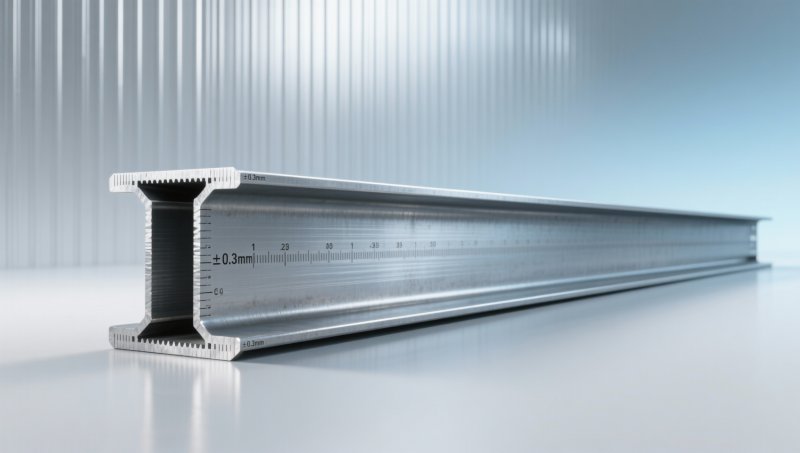
For distributors and agents, consistent dimensions mean fewer customer disputes, faster order-to-delivery cycles (average lead time: 21–28 days for standard sections), and reliable forecasting—because repeat orders require zero re-engineering when tolerances hold within ±0.3mm for plates ≤20mm thick.
Critical Dimensional Checks Before Finalizing Your Steel Beam Supplier
- Flange parallelism: Max deviation ≤0.5mm/m length (verified per EN 10034)
- Web thickness variation: ±0.25mm across full cross-section (measured at 3 locations)
- Length tolerance: +0/−3mm for lengths ≤6m; +0/−5mm for 6–12m (ASTM A6/A6M Table 2)
- Surface flatness: ≤1.0mm over any 1m span (critical for mechanical mounting plates)
Dimension-Driven Performance: Mild Steel Plate as a Case Study
Consider mild steel plate applications where dimensional fidelity dictates functional success: bridge panels require thickness uniformity within ±0.15mm across 2.5m widths to prevent differential deflection; transmission towers demand width consistency ≤±0.4mm to ensure bolt-hole alignment across 12+ connection points; support plates for heavy machinery rely on flatness ≤0.8mm/m to avoid bearing surface distortion under 450+ MPa contact stress.
That’s why our Mild Steel Plate Supplier offerings—available in A572 and S355JR grades—maintain strict dimensional control across all thicknesses (0.1–400mm), widths (100–3000mm), and lengths (1–12m, or fully customized). Each plate undergoes ultrasonic testing and dimensional scanning before shipment, with certificates showing actual measurements—not just nominal values.
This table shows how tighter dimensional control aligns with higher strength grades—enabling thinner, lighter, yet safer components. For example, using A572 Grade 65 instead of Grade 50 reduces plate thickness by ~12% for equivalent load capacity—cutting weight by 3.2 tons per 100m² of bridge paneling. But that benefit only materializes if thickness tolerance remains within ±0.20mm. Otherwise, local thinning creates stress risers that compromise fatigue life.
Why Partner with Hongteng Fengda for Dimension-Critical Structural Steel
We don’t treat dimensions as “just another spec”—we engineer them into every process. Our 120,000-ton annual capacity includes dedicated lines for precision-cut plates and calibrated rolling mills validated to EN 10029 Class A tolerances. Unlike generalist exporters, we assign dimensional accountability to a single Quality Engineer per order—ensuring continuity from quotation to delivery.
Global buyers benefit from dual-standard compliance: ASTM A6/A6M for North America, EN 10025 for Europe, and GB/T 706 for domestic Chinese infrastructure projects—all verified by third-party labs (SGS, Bureau Veritas) upon request. Lead times remain stable at 21–35 days, even during peak Q3–Q4 construction seasons—because our inventory buffer includes 15,000+ tons of pre-inspected, dimensionally certified stock.
Ready to validate dimensional performance on your next order? Contact us for: (1) Free dimensional audit reports on sample batches, (2) Custom tolerance certification packages (including CMM reports), (3) Real-time production tracking dashboards, or (4) Joint engineering reviews for complex OEM profiles.
Please give us a message


Please enter what you want to find