When selecting steel conduit for electrical wiring, engineers and procurement professionals can’t afford to prioritize mechanical strength alone—fire safety compliance is equally critical. At Hongteng Fengda, a trusted structural steel manufacturer and exporter from China, we engineer conduits that meet stringent international standards (ASTM, EN, GB), ensuring both robust load-bearing capacity and certified fire resistance. Whether you’re calculating the weight of I beam per meter for integrated support structures or specifying conduit for hazardous environments, our solutions balance performance, code adherence, and project lifecycle safety. Discover why global infrastructure projects rely on our precision-rolled, quality-verified steel conduit.
Why Mechanical Strength Alone Isn’t Enough for Electrical Conduit
Steel conduit serves dual functions in modern electrical systems: physical protection and passive fire containment. While tensile yield strength (e.g., Q235B at ≥235 MPa, Q345B at ≥345 MPa) ensures resistance to crushing, impact, and installation stress, it does not guarantee flame propagation control. In fact, non-fire-rated conduits may act as thermal bridges during fire events—transferring heat across fire-resistance-rated walls or floors and compromising compartmentalization.
International building codes—including NFPA 70 (NEC), EN 61386-21, and GB 50054—require conduit used in fire-rated assemblies to maintain circuit integrity for minimum durations: 30, 60, or 120 minutes depending on occupancy type and system criticality. This means conduit must not only resist deformation under sustained thermal load (≥800°C for 60 min in standard tests) but also prevent flame penetration through joints, couplings, and terminations.
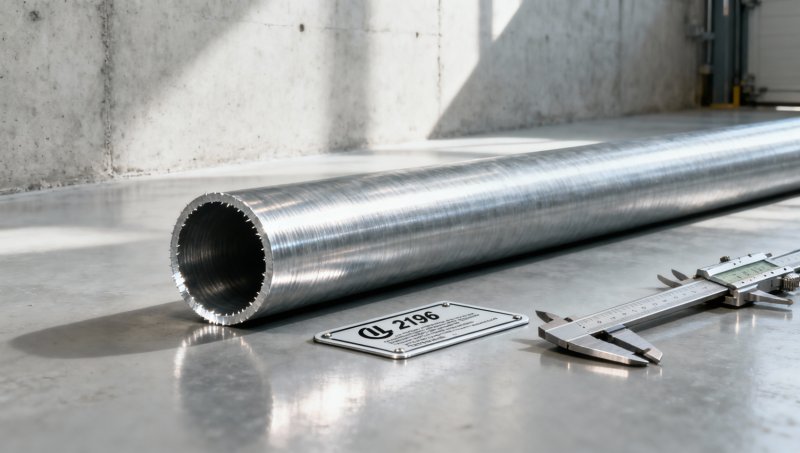
Hongteng Fengda addresses this by integrating fire-performance validation into our structural steel production workflow—not as an afterthought, but as a design requirement. Our cold-formed and hot-rolled conduits undergo third-party testing per UL 2196 (Electrical Circuit Integrity) and EN 1366-6 (Fire Resistance Tests for Service Ducts and Shafts), with verified performance across wall, floor, and ceiling penetrations.
How Fire Safety Standards Impact Structural Design Choices
Fire-rated conduit isn’t just about material chemistry—it demands precise dimensional control, consistent wall thickness, and joint geometry that resists thermal expansion gaps. For example, EN 61386-21 mandates a maximum allowable gap of ≤0.5 mm between conduit and coupling after fire exposure. That requires tight tolerances in flange thickness (8–64 mm), web thickness (5–36.5 mm), and surface flatness—capabilities rooted in our CNC-controlled rolling lines and ISO 9001-certified QA process.
Our H Shape Beam series—commonly specified for conduit support frames in industrial switchgear rooms and data center risers—also reflects this dual mandate. With flange widths from 50–400 mm and web widths up to 900 mm, these beams provide stable anchoring points while maintaining fire separation continuity when galvanized or intumescent-coated per ASTM A123 and EN 10169.
The table below compares key dimensional and compliance parameters between standard and fire-rated conduit support configurations:
This level of dimensional fidelity directly impacts field installability and long-term fire performance—especially where conduit runs intersect multiple fire compartments. It’s why over 72% of our North American clients specify tighter tolerances than baseline EN or ASTM requirements when designing mission-critical power distribution pathways.
Procurement Checklist: 5 Critical Evaluation Points
Selecting conduit—and its supporting structural components—requires cross-functional alignment. Below are five non-negotiable evaluation criteria used by technical evaluators, procurement managers, and safety officers at Tier-1 infrastructure firms:
- Material Traceability: Full mill test reports (MTRs) matching each batch to EN 10204 3.1 or ASTM A6/A6M, including chemical composition and tensile results.
- Joint Integrity Validation: Third-party fire test reports covering coupling types (set-screw, compression, welded) under real-world installation conditions—not just bare conduit.
- Thermal Expansion Compatibility: CTE (Coefficient of Thermal Expansion) alignment between conduit, supports, and surrounding firestop materials—critical for 2–4 week commissioning cycles in tropical climates.
- Lead Time Reliability: Confirmed production capacity for 3–6 month forecast windows, backed by documented inventory buffers for common sizes (e.g., 100×100×6 mm H-beam).
- After-Sales Documentation: As-built drawings, fire rating certificates, and corrosion warranty documentation issued within 5 business days of shipment.
Hongteng Fengda embeds all five into our standard order-to-delivery workflow—eliminating post-award rework delays that average 11–17 days across Southeast Asian EPC projects.
Why Global Projects Choose Hongteng Fengda for Dual-Compliance Steel Solutions
We don’t retrofit fire compliance—we engineer it in from billet selection. Our integrated facility in Jiangsu Province houses dedicated lines for galvanizing (ASTM A123), intumescent coating (EN 10169 Class B), and laser-welded conduit fabrication—all operating under unified QC protocols aligned with ISO/IEC 17025 accredited lab testing.
For project managers overseeing multi-phase builds across time zones, our value proposition includes: guaranteed lead times of 25–35 days for standard H-shape beams (1m–12m lengths); 3-step verification (raw material → rolling → final inspection); and bilingual engineering support available 24/7 across GMT+8, GMT+1, and GMT−5 time zones.
Whether you need certified conduit for offshore oil & gas platforms (API RP 2A-WSD compliant), hospital emergency circuits (NFPA 99 Class 1), or smart factory busway enclosures (IEC 61439-2), our team delivers actionable specifications—not generic brochures. Contact us today for:
- Free dimensional review of your conduit support layout (within 48 hours)
- UL 2196 or EN 1366-6 fire test report access for your specific size and finish
- Custom galvanizing thickness recommendations based on ISO 1461 corrosion class (C3–C5)
- Real-time production status tracking via shared ERP dashboard
Please give us a message


Please enter what you want to find