Why Steel Coil Pipe Fails in Offshore Environments
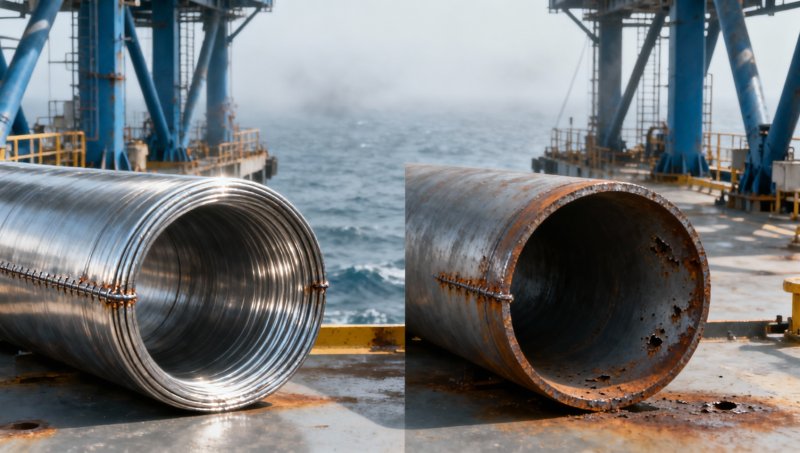
Offshore structural integrity isn’t compromised by a single failure mode—it’s eroded by the convergence of aggressive chemistry, mechanical stress, and material mismatch. When steel coil pipe fails underwater or on marine platforms, it rarely snaps without warning. More often, it degrades silently: pitting breaches the wall, crevices trap seawater, biofilms accelerate localized attack—and suddenly, a pressure test reveals unacceptable thinning or leakage. For quality control and safety managers, this isn’t just a materials issue. It’s a threshold question: Does the pipe specification match the electrochemical reality of its environment?
The short answer is: ASTM A106 carbon steel coil pipe—commonly used for general service—often does not. Its performance gap becomes critical when exposed to continuous immersion, tidal cycling, or high-chloride splash zones. That doesn’t mean A106 is “wrong” in all offshore applications—but it does mean its use requires explicit justification, not default assumption.
Corrosion Mechanisms: Not Just “Rust”
Offshore corrosion isn’t uniform oxidation. It’s selective, accelerated, and often invisible until it’s too late. Three mechanisms dominate:
- Pitting corrosion: Localized chloride attack forms deep, narrow cavities—often beneath surface scale or mill scale remnants. These pits propagate faster than general corrosion and are difficult to detect during visual inspection.
- Crevice corrosion: Occurs where stagnant seawater pools—in gasket interfaces, support brackets, or lap joints. The oxygen depletion and acidification inside these micro-environments break down passive films even on stainless steels.
- Microbiologically influenced corrosion (MIC): Sulfate-reducing bacteria (SRB) colonize pipe interiors, producing hydrogen sulfide that accelerates cathodic reactions. MIC is especially prevalent in stagnant or low-flow subsea pipelines and often coexists with pitting.
Crucially, none of these mechanisms behave linearly. A 5% increase in salinity or a 2°C rise in temperature can double pit initiation rate. And because steel coil pipe is formed from strip—welded longitudinally—the heat-affected zone (HAZ) along the seam becomes a preferential site for all three mechanisms. This isn’t theoretical: NACE case studies show seam welds account for over 70% of early-stage failures in submerged carbon steel coil pipe.
A106 vs. A312: Material Choice Is a Boundary Decision
ASTM A106 Grade B is engineered for strength and weldability—not sustained chloride resistance. Its carbon content (up to 0.30%) and lack of significant chromium or molybdenum leave it vulnerable once protective scale is breached. In contrast, ASTM A312 TP316 stainless steel contains 2–3% molybdenum and 16–18% chromium—elements that stabilize the passive film in chloride-rich environments.
But swapping A106 for A312 isn’t a simple upgrade. It introduces new constraints:
- A312’s higher nickel and molybdenum content increases susceptibility to stress corrosion cracking (SCC) under tensile load and elevated temperatures—especially if residual stresses from coil forming aren’t relieved via post-weld heat treatment (PWHT).
- Galvanic coupling becomes a risk when A312 connects to carbon steel flanges or supports. Without dielectric isolation, accelerated corrosion occurs at the interface—not on the stainless itself.
- Coil pipe geometry complicates A312 qualification: longitudinal seam welds require stricter non-destructive testing (NDT), and cold-forming may reduce ductility below design margins.
In practice, many projects now adopt hybrid strategies—A106 for above-water bracing where coating integrity can be maintained, and A312 for submerged conduits—paired with rigorous electrical isolation and cathodic protection design.
Testing Protocols: Beyond Salt Spray
Standard salt-spray (ASTM B117) testing misleads offshore users. It simulates atmospheric exposure—not immersion, flow dynamics, or biofilm formation. Realistic validation requires layered protocols:
- Electrochemical testing (ASTM G59): Measures breakdown potential and repassivation behavior in synthetic seawater. A material with > +350 mV vs. SCE breakdown potential shows robust pitting resistance.
- Ferric chloride pitting test (ASTM G48 Method A): Quantifies critical pitting temperature (CPT). For offshore coil pipe, CPT must exceed local maximum operating temperature by ≥15°C.
- Sulfide stress cracking (NACE TM0177): Mandatory for sour service—even trace H₂S in seawater-borne microbiological activity demands verification.
- Long-term immersion + MIC inoculation (ISO 15663-2): Simulates real-world biofilm development over 90+ days, followed by ultrasonic thickness mapping to quantify localized loss.
These tests aren’t optional checklists—they’re boundary conditions. If a coil pipe supplier cannot provide full test reports aligned with your project’s specific salinity, temperature, and flow profile, assume the material hasn’t been validated for your environment.
Where Coating Systems Fit—and Where They Don’t
Coatings extend life—but only where they stay intact. For above-water or splash-zone applications, high-performance organic coatings (e.g., epoxy-phenolic or polyurethane systems) backed by zinc-rich primers provide reliable service. However, coil pipe’s inherent geometry—tight radii, seam welds, and variable surface profiles—makes consistent coating application difficult. Pinholes or holiday spots become initiation sites for under-coating corrosion.
In such cases, dual-protection approaches gain traction. For example, Color Coated Galvanized Roof Sheet PPGI demonstrates how galvanization + polymer overlay delivers >25 years of service in coastal construction—where constant wind-driven salt spray would rapidly degrade bare steel. While not a direct substitute for coil pipe, its proven multi-layer barrier strategy informs offshore material selection: galvanic protection (zinc layer) + chemical resistance (polymer topcoat) + adhesion durability (optimized surface prep) creates redundancy that single-layer solutions lack.
What This Means for Your Next Procurement Review
Before approving any steel coil pipe for offshore use, ask three questions:
- Is the specified grade qualified for the actual exposure condition—not just the design category? (e.g., “offshore” ≠ “submerged”; verify immersion depth, flow velocity, and temperature range.)
- Are seam welds included in the testing scope—or treated as a secondary concern? (If test reports reference only base metal properties, reject the submission.)
- Does the supplier provide traceable, project-specific test data—or generic certificates? (Certificates of compliance without test parameters are administrative artifacts, not engineering evidence.)
Material selection here isn’t about cost per tonne. It’s about failure consequence per meter. A $200/m A106 pipe that requires replacement every 4 years due to pitting carries higher lifecycle cost—and far greater operational risk—than a $550/m A312 solution with verified CPT and SCC resistance.
For teams managing structural integrity across marine infrastructure, the takeaway isn’t “avoid carbon steel.” It’s “never assume equivalence across environments.” Corrosion doesn’t respect procurement categories—it responds to chemistry, stress, and microstructure. Match the material to the mechanism. Validate the seam. Test the system—not just the sample.
Please give us a message


Please enter what you want to find