Why does one stainless coil perform flawlessly while another fails under the same conditions? For technical evaluation, surface finish is not cosmetic. It changes corrosion behavior, forming response, welding consistency, cleanability, and long-term reliability in steel applications.
In structural, industrial, and processing environments, stainless coil must match both mechanical demands and exposure conditions. A poor finish choice can increase staining, friction, rework, and maintenance. A correct finish improves durability, appearance stability, and manufacturing efficiency.
This article explains why stainless coil surface finish affects performance, where each finish fits best, and what to review before final material selection in steel-related projects.
Surface Finish as a Functional Property
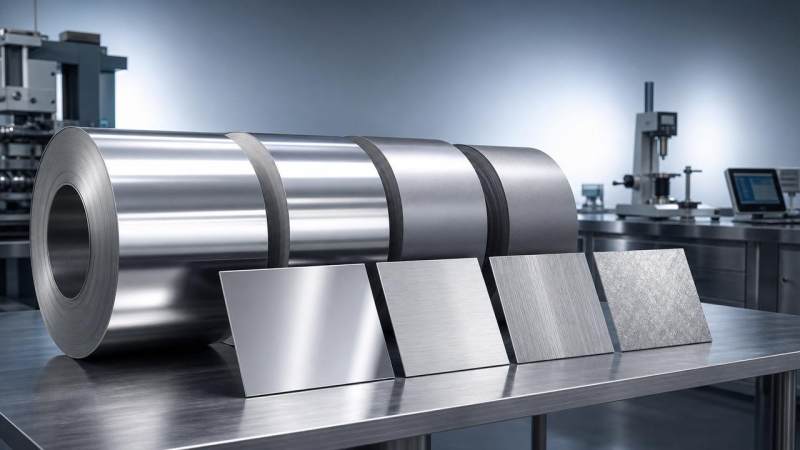
A surface finish is the final condition of the stainless coil surface after rolling, annealing, pickling, polishing, or brushing. It defines roughness, reflectivity, oxide condition, and contact behavior during fabrication and service.
Common finishes include NO.1, 2B, BA, NO.4, HL, 4K, and 8K. Each one changes how moisture stays on the surface, how contamination adheres, and how the material reacts during bending or welding.
For stainless coil, finish selection often affects performance as much as grade selection. Two coils of the same alloy can behave differently if their surfaces have different roughness or processing histories.
Why the finish matters technically
- Smoother surfaces usually hold fewer contaminants.
- Rougher finishes may trap chlorides, oil, or particles.
- Forming friction changes with texture and hardness.
- Weld appearance and heat tint removal vary by finish.
- End-user cleaning and visual acceptance depend on finish uniformity.
Current Industry Focus Around Stainless Coil Performance
Across the steel supply chain, finish control is receiving more attention because service environments are becoming harsher and tolerance for cosmetic variation is lower. This is especially true in visible structures and hygienic equipment.
In export projects, stainless coil is often compared across standards, mills, and processing routes. Surface consistency becomes a practical quality indicator when evaluating long-term value rather than only initial price.
How Surface Finish Changes Real Performance
Corrosion resistance
A smoother stainless coil surface generally supports a more stable passive layer. It is less likely to hold corrosive deposits. In humid, marine, or chemical settings, this difference can strongly affect staining and pitting risk.
Rough finishes are not automatically poor. They may suit high-temperature or heavy industrial use. However, they often require stricter cleaning control where corrosion appearance matters.
Formability and tool interaction
During bending, drawing, or stamping, friction between tooling and stainless coil changes with finish type. Some polished surfaces reduce drag. Others may show scratches more easily during aggressive forming operations.
Consistent finish also helps maintain repeatable forming results. Mixed roughness on the same coil can create uneven flow, visible marks, or localized strain concentration.
Weldability and post-weld appearance
Surface finish does not change the base alloy chemistry, but it affects weld preparation, cleanliness, and visual blending. Fine finishes usually require tighter handling because heat tint, scratches, and grinding marks are easier to detect.
In visible assemblies, matching pre-weld and post-weld finish standards can reduce rework. This is important in architectural, food-contact, and transport components made from stainless coil.
Cleanability and service life
Cleanability is often underestimated. In practice, a finish that allows fast removal of grease, product residue, and airborne particles may deliver lower lifecycle cost than a cheaper but rougher alternative.
This is one reason many processing lines choose smooth stainless coil surfaces for repeated washdown conditions or visible surfaces needing stable appearance over time.
Representative Finish Types and Typical Fit
Each finish supports a different balance of cost, fabrication response, and end-use expectation. The table below gives a practical comparison for stainless coil selection.
Material Example Within Surface-Finish Evaluation
A practical reference is 304 Stainless Steel Coil. This grade is widely used because it balances corrosion resistance, formability, weldability, and broad availability across industrial and structural supply chains.
Typical finish options include BA, 2B, NO.1, NO.4, 4K, HL, and 8K. That range allows the same base alloy to serve food equipment, medical construction, transport parts, conveyor systems, and decorative metalwork.
For performance context, 304 offers tensile strength of at least 520, yield strength of at least 275, elongation around 55-60, and hardness up to 183HB or 100HRB. These values support many forming and general fabrication tasks.
Its strong resistance to rust, alkali solutions, many acids, and elevated temperatures makes finish selection even more valuable. A suitable surface helps preserve those advantages in chemical, food, transport, and equipment environments.
Application Value in Steel and Industrial Use
In steel-related projects, stainless coil surface finish influences more than end appearance. It can affect fabrication yield, part rejection, inspection speed, and expected maintenance intervals after installation.
- Architectural parts need finish consistency and stain resistance.
- Food-contact equipment needs easy cleaning and stable passivation.
- Transport components need durability under vibration and weather exposure.
- Industrial enclosures need balanced cost, forming performance, and corrosion control.
When stainless coil is selected only by thickness and grade, important service risks remain hidden. Finish review helps align the material with fabrication route, environment, and visual standard from the beginning.
Practical Selection and Inspection Points
A reliable finish decision should combine environment, manufacturing process, and acceptance criteria. It should not rely on catalog names alone because finish labels may still vary by producer and market practice.
Key checks before approval
- Confirm the exact finish designation and visual reference sample.
- Review service exposure, including chlorides, humidity, and cleaning chemicals.
- Check whether the stainless coil will be bent, stamped, welded, or polished again.
- Define allowable scratches, reflectivity variation, and protective film needs.
- Verify compliance with ASTM, EN, JIS, or GB requirements where relevant.
It is also useful to inspect sample panels under real lighting. A finish that appears acceptable indoors may show directional marks or color variation after outdoor installation or after welding and cleaning.
Next-Step Considerations for Better Specification
The performance of stainless coil depends on the interaction of grade, finish, fabrication, and environment. Surface finish should therefore be written clearly into material specifications, not treated as a secondary aesthetic detail.
For stronger results, compare finish samples, define inspection criteria early, and match the selected stainless coil to cleaning, welding, and forming requirements. This reduces sourcing uncertainty and improves service reliability in demanding steel applications.
Where stable quality, international standard compliance, and customized steel supply matter, working with an experienced structural steel manufacturer can simplify material matching and reduce performance risk across global projects.
Please give us a message


Please enter what you want to find