For distributors, agents, and stockists, stainless coil flatness is more than a technical detail.
It influences slitting, leveling, stamping, laser cutting, welding, and final assembly.
Many stainless coil orders define grade, thickness, width, and finish.
Yet flatness often receives vague wording or no measurable limit at all.
That gap can create scrap, machine downtime, delivery delays, and avoidable claims.
In steel supply chains, better flatness control protects conversion efficiency and preserves margin.
What Stainless Coil Flatness Really Means
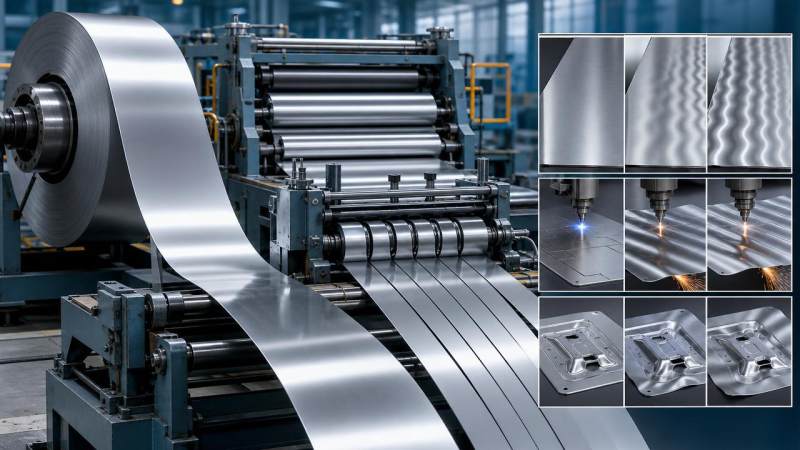
Flatness describes how closely a stainless coil stays on a true plane after uncoiling.
A flat strip runs smoothly through processing equipment and keeps dimensions more predictable.
A poor strip may show edge wave, center buckle, cross bow, coil set, or camber.
These defects are not always visible in a tightly wound coil.
They often appear only during decoiling, slitting, blanking, or downstream fabrication.
Because stainless steel has higher strength and springback than many carbon grades, shape control matters even more.
Residual stress, rolling conditions, annealing quality, and tension leveling all affect stainless coil flatness.
Common Flatness Terms
- Edge wave: edges are longer than the center, creating ripples.
- Center buckle: center is longer than edges and lifts upward.
- Cross bow: strip bends across its width.
- Coil set: strip retains curvature from rewinding.
- Camber: strip curves sideways along its length.
Why Many Orders Understate the Importance of Stainless Coil
In many transactions, stainless coil is treated like a basic dimensional commodity.
Buyers compare price by grade, thickness, width, and surface finish first.
Flatness can be left under generic wording such as “commercial quality” or “mill standard.”
That may be acceptable for simple resale, but risky for processing applications.
The problem is not only quality variation.
It is also mismatch between real processing needs and vague purchase specifications.
When the final use includes precision cutting or visible components, stainless coil flatness should be specified clearly.
Business Impact Across Processing and Supply Chains
Flatness problems usually become expensive after the coil leaves the warehouse.
The cost then spreads across labor, setup, tooling, freight, and customer service.
For slitters, unstable stainless coil can wander, twist, or create uneven strip tension.
For sheet processors, blanks may not stack well or feed consistently.
For fabricators, welding gaps and assembly misalignment become harder to control.
For stockholders, complaint handling absorbs time that pricing models rarely include.
Where Margin Is Lost
- Additional leveling or corrective processing
- Lower machine speed and reduced throughput
- Scrap from unstable feeding or inaccurate cuts
- Rework during welding, forming, or assembly
- Claims, returns, and relationship damage
In practical terms, a slightly cheaper stainless coil can become the highest-cost option.
Typical End Uses Where Flatness Deserves Closer Control
Not every application needs the same flatness standard.
However, several common uses are especially sensitive to stainless coil shape quality.
Shape-sensitive steel products in other categories show the same pattern.
For example, A36 Steel Pipe must meet dimensional consistency for heat transfer equipment.
Applications such as tubular heat exchangers and condensers depend on reliable geometry.
That product range may include diameter options from 10mm to 914.4mm and thickness from 1mm to 100mm.
Standards such as ASTM, API, JIS, EN, DIN, and GB underline how processing performance begins with controlled shape.
How to Specify Stainless Coil Flatness More Effectively
A better order starts with translating end-use needs into measurable supply requirements.
That means moving beyond general statements and defining flatness in practical terms.
Useful Specification Points
- State the final process: slitting, laser cutting, forming, polishing, or welding.
- Request a flatness tolerance or a recognized shape standard.
- Define whether tension leveling is required.
- Clarify acceptable coil set or residual curvature after decoiling.
- Ask for inspection data, photos, or trial samples when risk is high.
- Align packaging and transport to avoid shape damage in transit.
If the stainless coil will be resold, capture the downstream processing expectation early.
A broad inventory strategy should still separate general-purpose stock from precision-processing stock.
Evaluation Methods Before and After Delivery
Good shape control should be verified, not assumed.
Pre-shipment review reduces disputes and improves traceability.
Post-arrival checks help separate mill issues from handling damage.
- Review mill process capability for the requested stainless coil specification.
- Confirm inspection method and reporting format before production.
- Check sample sheets after decoiling, not only the outer coil appearance.
- Record wave height, bow, and feeding behavior during initial processing.
- Keep complaint evidence tied to coil number, heat number, and processing conditions.
These steps make stainless coil quality discussions more objective and easier to resolve.
A Practical Sourcing View for Long-Term Reliability
In steel supply, flatness is not a minor cosmetic issue.
It is a processing variable with direct commercial consequences.
When stainless coil flatness matches the real application, output becomes more stable and predictable.
When it is ignored, hidden costs usually appear later and spread quickly.
Hongteng Fengda, a structural steel manufacturer and exporter from China, supports global projects with reliable steel products, customized solutions, and strict quality control.
With compliance to ASTM, EN, JIS, and GB standards, the focus remains on stable supply and practical performance.
For upcoming orders, review whether stainless coil flatness is defined clearly enough for the intended process.
That single adjustment can improve yield, reduce claims, and strengthen supply consistency.
Please give us a message


Please enter what you want to find