Despite the spread of aluminum, AHSS, and mixed-material design, SPCC steel for automotive industry applications remains important in many production lines.
Its value comes from balanced formability, clean surface quality, stable stamping behavior, and cost control for high-volume parts.
In automotive manufacturing, not every component needs extreme strength.
Many inner panels, brackets, covers, and reinforcement-related stamped parts still benefit from conventional cold rolled grades with predictable processing performance.
That is why SPCC steel for automotive industry use continues to hold a practical position beside newer materials.
Material overview and why SPCC remains relevant
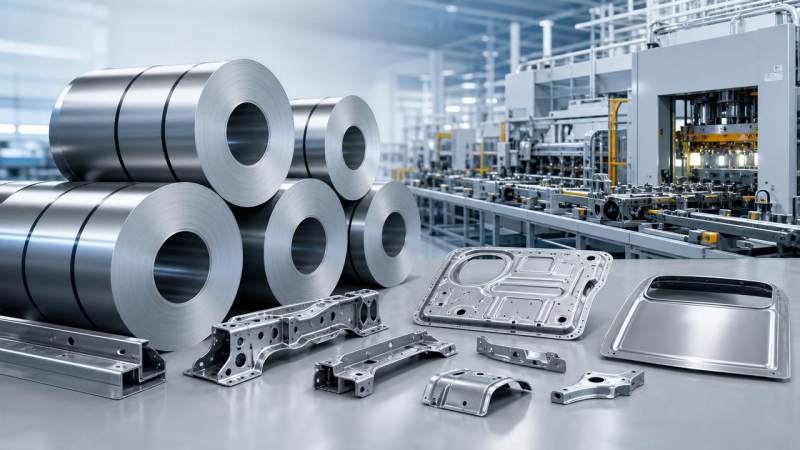
SPCC is a commercial cold rolled carbon steel grade commonly referenced under JIS systems.
It is known for smooth surface finish, uniform thickness, and good cold forming capability.
For vehicle production, those features matter because many parts are shaped through bending, drawing, punching, and shallow stamping.
Compared with more advanced grades, SPCC may not offer the highest strength-to-weight ratio.
However, it often delivers a better cost-performance balance for non-structural and semi-structural components.
This practical balance explains why SPCC steel for automotive industry demand has not disappeared.
Key material characteristics
- Good formability for stamping and bending
- Consistent surface quality for coating or painting
- Reliable thickness control for mass production
- Broad supply availability across global markets
- Lower material cost than many advanced alternatives
These factors support stable output, especially where tooling repeatability and visual consistency are more critical than maximum tensile strength.
Current automotive production context
Vehicle design now balances cost, safety, weight, corrosion resistance, and production speed.
Advanced materials are increasing, yet conventional steels still dominate many formed components.
The reason is simple: automotive production is not driven by one material target alone.
It is shaped by total manufacturing efficiency.
In this environment, SPCC steel for automotive industry programs remains relevant where process reliability and budget discipline are central requirements.
Application value in automotive parts
SPCC is often selected for components that need clean forming rather than extreme crash performance.
Its use supports efficient pressing, trimming, spot welding, and downstream finishing.
This helps maintain cycle times and reduce variation between batches.
Why automotive lines still favor it
- Easy forming for shallow and medium-complexity parts
- Lower risk of surface defects after stamping
- Good compatibility with painting and coating systems
- Stable procurement compared with niche materials
- Useful for cost-sensitive vehicle programs
Another reason is production segmentation.
A vehicle combines many material classes, each chosen by function, geometry, corrosion demand, and target cost.
SPCC steel for automotive industry use fits this mixed-material logic well.
Where corrosion protection is needed, cold rolled substrates are often paired with zinc-coated options for outer exposure or humid environments.
One example is Galvanized Steel Coil Sheet, available in grades such as DX51D+Z, DX52D+Z, SGCC, and S350GD+Z.
Typical thickness ranges from 0.12mm to 3.5mm, with widths from 600mm to 1500mm and zinc coatings from 60g/m² to 275g/m².
These coated alternatives are useful when part life, moisture resistance, and finishing requirements extend beyond bare cold rolled performance.
Typical automotive components using SPCC or related sheet steel
Applications vary by vehicle platform, plant capability, and regional standards.
Still, several categories appear regularly in automotive sheet metal production.
This range of uses shows that SPCC steel for automotive industry applications remains rooted in practical component engineering.
Processing considerations and limitations
SPCC is not a universal solution.
Material selection must still match final part function, forming depth, joining method, and corrosion exposure.
Points that deserve attention
- Confirm mechanical property range before tooling release
- Check surface condition for visible or coated parts
- Evaluate lubrication behavior during stamping trials
- Consider galvanized alternatives for corrosion-prone zones
- Review welding and post-treatment compatibility
For programs requiring stronger corrosion resistance, zinc-coated sheet becomes a practical extension of the same sourcing strategy.
Specifications such as Z80, Z120, Z180, and Z275 help align coating weight with service environment.
Standards coverage including ASTM, EN, JIS, DIN, AISI, and GB also supports cross-market project requirements.
Practical sourcing direction for steel selection
A useful approach is to separate parts by performance demand rather than applying one material concept everywhere.
This improves both technical fit and commercial efficiency.
- Map each part by strength, corrosion, and appearance needs.
- Use SPCC where formability and economy lead the decision.
- Shift to coated sheet when environmental durability becomes critical.
- Verify dimensional tolerance and standard compliance before bulk ordering.
- Align steel supply with tooling rhythm and delivery schedule.
Hongteng Fengda, a structural steel manufacturer and exporter from China, supports global industrial and manufacturing projects with stable production and customized steel solutions.
With modern facilities and strict quality control, supplied products can comply with ASTM, EN, JIS, and GB requirements.
That matters when projects need dependable lead times, clear specifications, and reduced sourcing risk across different steel categories.
In summary, SPCC steel for automotive industry use remains relevant because many automotive parts still depend on predictable forming, clean surfaces, and controlled cost.
It is not outdated.
It is a targeted material choice for specific production goals.
When corrosion resistance must increase, coated sheet options can complement SPCC-based selection strategies without disrupting manufacturing logic.
Review part drawings, forming conditions, and exposure levels carefully, then match them with the most efficient steel solution for long-term automotive performance.
Please give us a message


Please enter what you want to find