In mining operations, choosing the right Steel Wire for mining applications is critical to safety, durability, and overall project efficiency. From heavy-load lifting to abrasive environments, the correct wire grade helps project managers reduce downtime, control maintenance costs, and improve operational reliability. Understanding how steel wire performance affects demanding mining conditions is essential for making smarter procurement and engineering decisions.
Why the right wire grade matters more than price alone
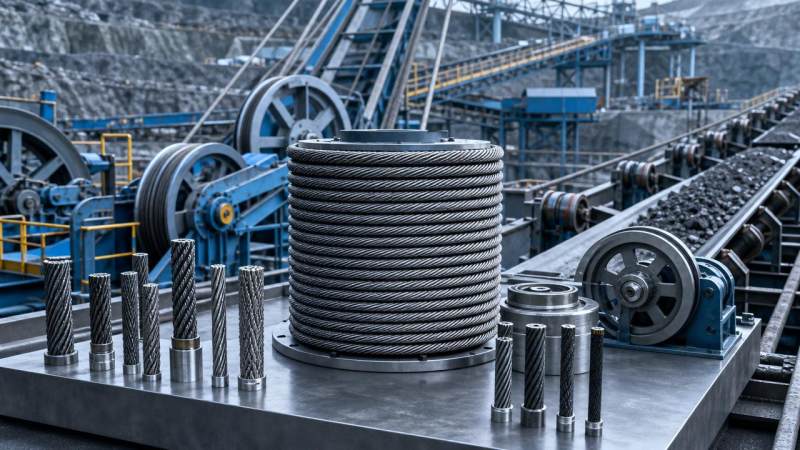
For mining projects, steel wire is not a minor consumable. It often supports lifting, hauling, screening, reinforcement, and mechanical transmission under extreme operating stress.
That means the wrong grade can create problems far beyond early wear. It can trigger unplanned shutdowns, safety incidents, replacement delays, and higher total operating costs.
Project managers usually face pressure to control procurement budgets. However, in mining environments, the lowest initial price rarely delivers the best long-term value.
The better question is whether a wire grade matches the site’s actual mechanical load, corrosion risk, abrasion level, bending frequency, and maintenance conditions.
If it does not, even a product that meets a basic specification may fail too early. That failure can affect equipment availability, workforce safety, and project delivery schedules.
For this reason, selecting Steel Wire for mining applications should be treated as a risk-management decision, not just a purchasing task.
What project managers really need to evaluate before ordering
Most mining buyers do not need a metallurgy lecture. They need a practical framework that helps them compare options, avoid hidden risks, and justify decisions internally.
The first issue is application type. Steel wire used in hoisting systems faces very different stress from wire used in mesh, conveyor support, screening, or anchoring systems.
The second issue is load profile. Static loads, dynamic shock loads, repeated bending, and vibration all affect how a wire grade performs over time.
The third issue is environment. Underground mines, open-pit operations, coastal sites, wet processing plants, and chemically aggressive conditions all change material requirements.
The fourth issue is service life expectation. Some operations can tolerate scheduled replacement, while others need longer maintenance intervals because downtime is very expensive.
The fifth issue is standard compliance and supplier consistency. A strong sample means little if batch quality varies or traceability is weak.
When these five factors are reviewed together, buyers can make decisions based on operational fit instead of relying on generic product descriptions.
How mining conditions affect steel wire performance
Mining is one of the harshest industrial environments for steel products. Wire components are often exposed to abrasive particles, impact loads, moisture, mud, heat, and corrosive agents.
Abrasion is especially important. In many mines, constant contact with ore, rock, and dust gradually removes protective surfaces and weakens the wire.
Corrosion is another major concern. Water, humidity, salts, and process chemicals can reduce service life quickly if the wire grade or coating is unsuitable.
Fatigue failure is also common in applications involving repeated movement. A wire may appear strong in tensile testing but still fail early under cyclic bending.
Temperature variation matters too. Surface operations in hot climates and underground zones with different thermal conditions can affect mechanical stability and protective layers.
This is why project managers should not ask only, “How strong is the wire?” They should also ask, “How will it behave after months of real mining exposure?”
Key steel wire properties that directly influence project outcomes
Several technical properties have a direct business impact. Understanding them helps non-specialist decision makers ask better questions during supplier evaluation and procurement reviews.
Tensile strength determines how much load the wire can bear before breaking. For heavy-duty mining use, this is essential, but higher strength alone is not always better.
If strength increases while flexibility drops too much, the wire may become less suitable for bending or dynamic movement. The ideal grade balances strength with working performance.
Ductility affects how the wire deforms under stress. Good ductility can improve resistance to cracking, especially where shock loading or movement is frequent.
Fatigue resistance is critical in pulleys, drums, and moving equipment. A wire grade with poor fatigue behavior may create repeated replacement problems.
Surface protection also matters. Galvanized or specially coated wire may perform better in wet or corrosive conditions, depending on the application.
Dimensional consistency and manufacturing precision support stable installation, predictable behavior, and better compatibility with equipment systems.
Common mistakes that lead to wire failure in mining projects
One common mistake is buying by nominal specification only. Two products may share similar dimensions but differ significantly in raw material quality and process control.
Another mistake is underestimating dynamic loading. Procurement teams sometimes evaluate average load capacity without considering shock events or repeated stress cycles.
Many failures also come from ignoring the environment. Standard wire may seem acceptable on paper, yet perform poorly in acidic, wet, or highly abrasive conditions.
Insufficient supplier qualification is another issue. Without reviewing certificates, standards, production consistency, and inspection methods, buyers take unnecessary risks.
Some projects also fail to coordinate engineering and purchasing. When technical requirements are not translated clearly into procurement documents, unsuitable substitutions may happen.
Finally, replacement planning is often too reactive. Waiting for visible deterioration instead of monitoring expected service life can increase operational disruption.
How to compare suppliers beyond product brochures
For project managers, supplier reliability is as important as wire specification. Mining projects depend on stable delivery, traceable quality, and fast technical communication.
Start by checking which international standards the supplier can meet consistently. Compliance with ASTM, EN, JIS, or GB should be supported by real documentation.
Then review production capability. A supplier with modern facilities and clear quality control procedures is more likely to deliver consistent batches over time.
Inspection and testing processes are also important. Ask about tensile testing, coating checks, dimensional inspections, and traceability from raw material to shipment.
Lead time performance matters more than many buyers expect. In mining, a late replacement shipment can cost far more than the price difference between suppliers.
It is also valuable to work with manufacturers that support customization. Some mining applications require tailored dimensions, coatings, or mechanical properties.
For global buyers, exporters with cross-border shipping experience can reduce documentation errors, packaging issues, and sourcing uncertainty.
Why total cost of ownership should guide procurement decisions
Project managers are often judged on budget performance, but purchase price alone is a narrow metric. The more meaningful measure is total cost of ownership.
This includes procurement cost, freight, installation time, replacement frequency, maintenance labor, downtime impact, and potential safety-related losses.
A slightly higher-grade wire may last longer, reduce stoppages, and lower maintenance interventions. In many mining operations, that delivers a better return than cheaper alternatives.
Longer service life can also improve planning. When replacement intervals are more predictable, maintenance teams can coordinate shutdowns more efficiently.
Reduced failure risk supports safety performance as well. This benefit may be hard to quantify upfront, but it is extremely important in high-liability environments.
Procurement decisions become stronger when buyers compare lifecycle outcomes instead of unit price alone. That approach aligns better with real mining economics.
Practical questions to ask before specifying Steel Wire for mining applications
A practical procurement process begins with the right questions. These questions help project teams define needs clearly before requesting quotations or approving supply.
What is the exact operating function of the wire, and what are the maximum and normal working loads?
Will the wire face static tension, repeated bending, impact loading, or continuous vibration during service?
What are the site conditions regarding moisture, corrosion, chemicals, dust, abrasion, and temperature?
Is a standard grade sufficient, or does the application require a customized specification, special coating, or tighter dimensional tolerance?
What service life is expected, and how costly is replacement downtime for this specific application?
Which international standards, inspection reports, and traceability records must the supplier provide before approval?
These questions create a much better basis for evaluating Steel Wire for mining applications in a way that supports both engineering and commercial goals.
Integrating supporting steel materials into broader project planning
Mining projects rarely rely on one steel product alone. Procurement teams often coordinate wire, structural sections, fabricated components, and building envelope materials together.
For example, mine-related workshops, storage units, maintenance buildings, and site facilities often require durable roofing and cladding materials that handle demanding exposure.
In such cases, Color Coated Galvanized Roof Sheet PPGI can be a practical option for supporting infrastructure.
It is available in PPGI and PPGL models, with thickness from 0.2mm to 1.2mm, width from 600mm to 1250mm, and service life exceeding 25 years.
Its corrosion resistance, easy installation, strong adhesion, and heat resistance above 300 degrees make it suitable for construction, public buildings, transportation, and agricultural use.
For project managers overseeing complete mining sites, using reliable steel materials across both equipment-related and facility-related applications can simplify sourcing and quality management.
What a reliable sourcing partner should contribute to mining projects
Mining buyers need more than a catalog. They need a supplier that understands specification control, international standards, customization, and delivery reliability.
A professional structural steel manufacturer and exporter can support projects by reducing sourcing risks and improving supply predictability across multiple steel categories.
Companies serving global markets should be able to provide stable production capacity, consistent quality, and documentation that matches project and regional requirements.
This is particularly useful when buyers need angle steel, channel steel, steel beams, cold formed profiles, and custom steel components alongside mining-related wire products.
Manufacturers with strict quality control and export experience are generally better positioned to support international contractors and industrial project teams.
For project leaders, the value is not only product supply. It is also smoother communication, fewer surprises, and better alignment between specification, production, and delivery.
Conclusion: the right grade protects schedules, budgets, and safety
The right steel wire grade is a strategic choice in mining, not a minor technical detail. It affects operational reliability, maintenance planning, safety performance, and lifecycle cost.
For project managers, the most effective approach is to match wire properties to real operating conditions instead of choosing by price or basic specification alone.
When evaluating Steel Wire for mining applications, focus on load profile, environment, fatigue resistance, corrosion protection, supplier consistency, and total cost of ownership.
That process leads to better procurement decisions, fewer failures, and stronger project outcomes. In demanding mining operations, the right wire grade helps keep the whole project moving.
Please give us a message


Please enter what you want to find