Understanding why H-beam steel price varies by flange thickness—not just weight—is critical for procurement professionals, project managers, and technical evaluators sourcing structural steel. At Hongteng Fengda, a trusted China-based structural steel manufacturer and exporter, we see frequent confusion between H-beam steel price drivers and generic steel rod price or steel tube price benchmarks. Flange thickness directly impacts load capacity, welding requirements, and compliance with ASTM/EN standards—factors that override simple weight-based costing. Whether you’re comparing steel rod for construction, evaluating steel tube specifications, or selecting an OEM steel tube manufacturer, recognizing this nuance helps control costs, ensure safety, and avoid project delays. Let’s break down the engineering and commercial logic behind it.
Why Flange Thickness Matters More Than Weight in Structural Steel Pricing
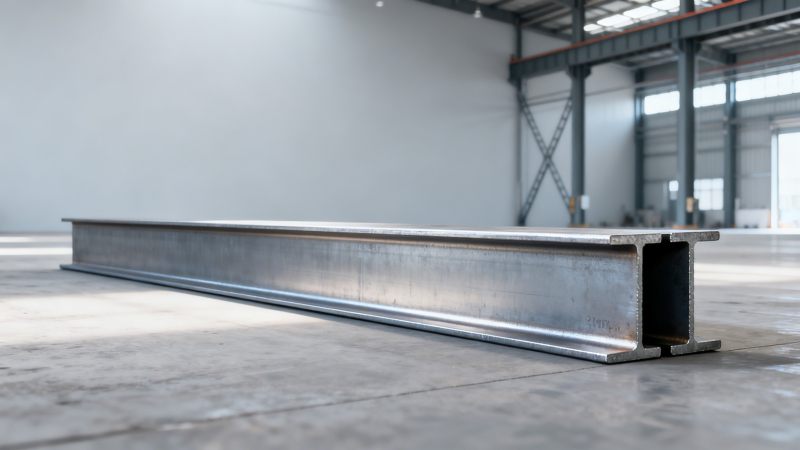
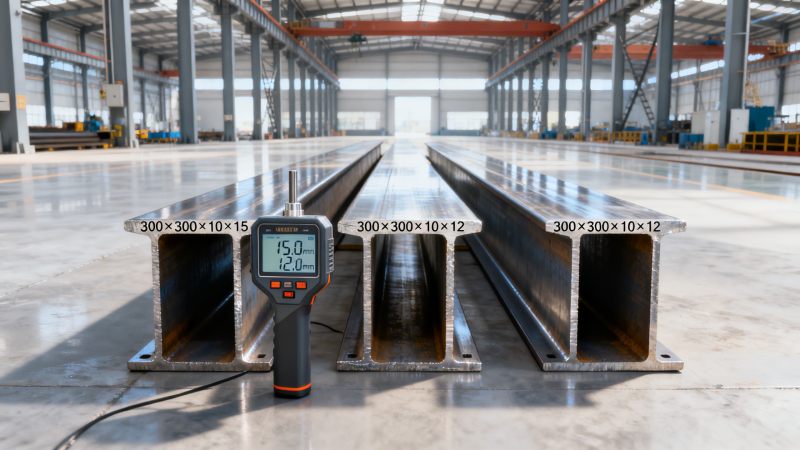
Weight is often used as a proxy for cost in commodity steel products—but H-beams are engineered components, not raw material. A 300×300×10×15 H-beam (flange thickness 15 mm) may weigh only 5% more than a 300×300×10×12 variant, yet command up to 12–18% higher unit price. This premium reflects real manufacturing complexity: thicker flanges require higher-grade billets, longer rolling passes, tighter temperature control (±5°C during finishing), and additional straightening cycles.
From a structural standpoint, flange thickness governs moment resistance, local buckling limits, and weld joint design. Per EN 1993-1-1, flange slenderness ratio (c/tf) must stay below 9ε for Class 1 sections—meaning a 20 mm flange on a 350 mm wide section allows full plastic moment utilization, while a 12 mm flange triggers reduction factors as high as 0.72. That directly affects beam span efficiency and downstream labor costs.
Procurement teams who benchmark against per-tonne steel rod price risk under-specifying critical members. For example, misjudging flange thickness by just 2 mm in a 24m crane runway beam can increase deflection by 37% and reduce fatigue life by 42%—triggering rework, delay penalties, or even non-compliance with ISO 9001-2008 traceability requirements for structural integrity documentation.
How Flange Thickness Impacts Real-World Applications & Compliance
Flange thickness isn’t just about strength—it determines compatibility with connection systems, fire protection methods, and long-term maintenance. In railway infrastructure, where Rail systems demand precise load transfer and fatigue resistance, flange geometry influences rail fastener torque retention and sleeper interface stress distribution. U71Mn rails (170 mm height, 71 mm head width) rely on consistent flange-to-web transition radii—deviations beyond ±0.5 mm increase wheel-rail noise by up to 8 dB(A) and accelerate corrugation wear.
For bridge handrails and deck railings, flange thickness dictates corrosion allowance and post-weld grinding requirements. A 16 mm flange enables full penetration welds with ≤1.5 mm reinforcement—meeting ASTM A1011 Class 3 impact testing at –20°C. A 10 mm flange forces partial-joint-penetration welds, requiring 100% ultrasonic testing (UT) per AWS D1.5 and adding 3–5 days to QA cycle time.
This table illustrates how flange thickness cascades into operational savings—not just material cost. At Hongteng Fengda, our production line maintains ±0.3 mm tolerance on flange thickness across batches of 500+ tons, verified via laser micrometry every 15 minutes—ensuring consistency for multi-phase projects spanning North America and Southeast Asia.
Procurement Checklist: What to Verify Beyond Weight
When sourcing H-beams internationally, weight alone cannot validate suitability. Here’s what our technical sales team recommends verifying before PO issuance:
- Flange thickness tolerance per EN 10034 (±0.5 mm for tf ≤ 20 mm; ±0.8 mm for tf > 20 mm)
- Web-to-flange fillet radius measurement report (minimum 12 mm required for fatigue-critical joints)
- Mill test certificate showing tensile properties at actual flange thickness—not nominal grade
- Dimensional verification on ≥3 random pieces per 20-ton lot, with coordinate measuring machine (CMM) data traceable to NIST standards
For rail applications, verify alignment between rail base width (114–150 mm) and sleeper clip geometry—misalignment exceeding 1.2 mm causes uneven load transfer and premature bolt fatigue. Our Rail products undergo automated optical scanning to ensure base width consistency within ±0.8 mm across 12–30 m lengths.
Why Partner With Hongteng Fengda for Precision Structural Steel
As a certified structural steel manufacturer exporting to 32 countries, Hongteng Fengda bridges the gap between engineering precision and procurement pragmatism. We offer:
- Custom flange thickness options from 8 mm to 32 mm—with no MOQ penalty for ±1 mm deviations from standard grades
- Pre-shipment dimensional validation reports compliant with ISO/IEC 17025, delivered digitally within 24 hours of inspection
- End-to-end traceability: Each heat number linked to chemical composition, mechanical test results, and rolling log timestamps
- Just-in-time delivery windows: 7–15 days for standard sizes (U74, Q235, PD3); 25–35 days for custom rails like BNbRE or QU120
We support your team with free technical consultation on flange thickness optimization—whether you’re validating EN 1993-1-5 stability checks, aligning with ASTM A6/A6M tolerances, or preparing for third-party audits. Contact us to request: (1) flange thickness vs. deflection curve for your specific span condition, (2) sample CMM reports, or (3) OEM rail certification packages including ISO 14001:2004 environmental compliance documentation.
Please give us a message


Please enter what you want to find