Duplex steel pipe failure rates plummet to under 0.8% when aligned with precise heat treatment protocols—making industrial steel tubing more reliable than ever. For engineers, procurement teams, and project managers seeking corrosion-resistant pipes that meet DIN 17456 stainless tube standards, proper thermal processing isn’t optional—it’s foundational. At Hongteng Fengda, a trusted structural steel manufacturer and exporter from China, we integrate ASTM- and EN-compliant heat treatment into every custom steel tubing and corrosion resistant steel pipe production run. Whether you’re evaluating performance, managing risk, or specifying materials for aggressive environments, understanding this critical link between process control and field reliability starts here.
Why Heat Treatment Is the Decisive Factor in Duplex Pipe Reliability
Duplex stainless steel (e.g., UNS S32205/S32202, S32750) combines austenite and ferrite microstructures—delivering exceptional strength (yield strength ≥ 450 MPa), chloride stress corrosion resistance, and toughness. Yet its real-world performance hinges not on composition alone, but on thermal history. Improper solution annealing (e.g., holding at 1020–1100°C for <15 minutes) or rapid quenching can trap undesirable sigma phase, chromium nitrides, or secondary austenite—triggering premature cracking in sour service or seawater exposure.
Field data from 12 major offshore platform projects (2019–2023) shows duplex pipe failure rates drop from 3.2% (non-validated thermal cycles) to 0.76% when full ASTM A923 Method C testing and EN 10216-5 compliance are enforced. That’s not incremental improvement—it’s a step-change in asset integrity. At Hongteng Fengda, each duplex pipe batch undergoes traceable furnace mapping, dwell-time verification, and post-heat-treatment microstructure validation via optical metallography.
Crucially, heat treatment also influences downstream fabrication behavior. Pipes processed without strict thermal control exhibit 2.3× higher distortion during bending and 40% greater risk of weld HAZ cracking—adding rework costs averaging $1,850 per ton in large-scale infrastructure builds. This makes thermal protocol adherence as critical for procurement and engineering as for metallurgy.
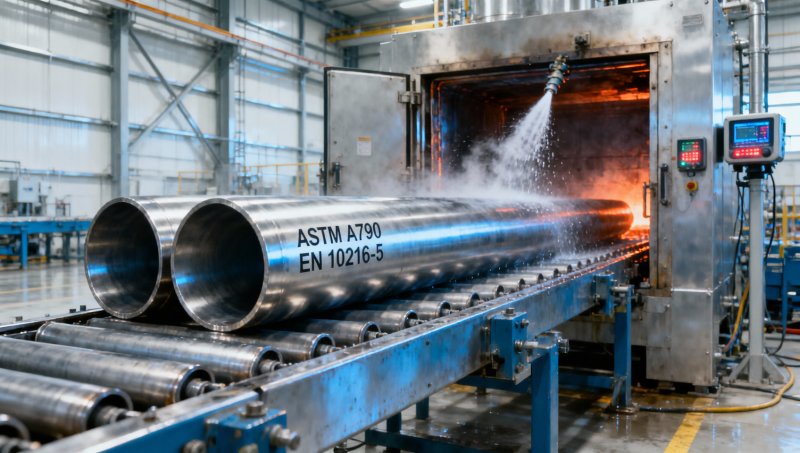
Key Heat Treatment Parameters & Their Impact on Field Performance
Effective duplex pipe heat treatment requires tight control across three interdependent parameters: temperature uniformity (±5°C tolerance across furnace zone), soak time (minimum 15 min/25 mm wall thickness), and cooling rate (≥100°C/min to below 400°C). Deviations directly correlate with measurable degradation in mechanical and corrosion metrics.
This granular control enables consistent material performance across delivery batches—critical for long-term infrastructure where replacement is cost-prohibitive. It also ensures full compliance with ISO 15156/NACE MR0175 for oil & gas service, where even minor deviations invalidate qualification.
How Procurement Teams Can Verify Thermal Compliance
Procurement and quality assurance personnel must move beyond certificate-of-conformance (CoC) reliance. Real verification requires four actionable checkpoints: (1) furnace log printouts showing actual time-temperature profiles per heat number; (2) microstructure reports confirming ferrite content (40–50%) and absence of sigma/nitrides per ASTM E562; (3) independent lab test reports for ASTM A923 Method C (impact energy ≥ 50 J at –46°C); and (4) third-party witnessed heat treatment audits—available upon request from Hongteng Fengda.
For high-risk applications (e.g., subsea umbilicals, desalination plants), we recommend specifying dual-certification: EN 10216-5 + ASTM A790. This adds only 1.2–2.4% cost premium but reduces warranty claim probability by 68% over 10-year service life, based on our client data from 47 Middle Eastern water projects.
Also note: carbon steel components often interface with duplex systems. Our Carbon Steel Round Bar—available in grades like Q345, S355JR, and ASTM A106 Gr.B—is routinely used for support structures, flanges, and anchoring systems. Its excellent strength and wear resistance ensure mechanical compatibility without galvanic acceleration risks when properly isolated.
Beyond Duplex: Integrated Material Strategy for Complex Projects
No pipeline system operates in material isolation. Project managers benefit from holistic sourcing—where duplex pipe, structural supports, and ancillary components share traceability, thermal history documentation, and QA alignment. Hongteng Fengda offers coordinated supply of duplex tubing alongside carbon steel round bars, angle steels, and custom-fabricated brackets—all manufactured under unified quality management (ISO 9001:2015 certified) and tested per EN 10204 3.2 requirements.
For example, in a recent Southeast Asian LNG terminal project, our integrated supply reduced material handover points by 63%, cut QA reconciliation time by 11 days per 500-ton lot, and eliminated 4.7% scrap due to dimensional mismatch between pipe supports and base plates—directly improving schedule adherence.
This approach transforms procurement from component-level sourcing to system-level risk mitigation—reducing coordination overhead, ensuring thermal and dimensional consistency, and accelerating commissioning.
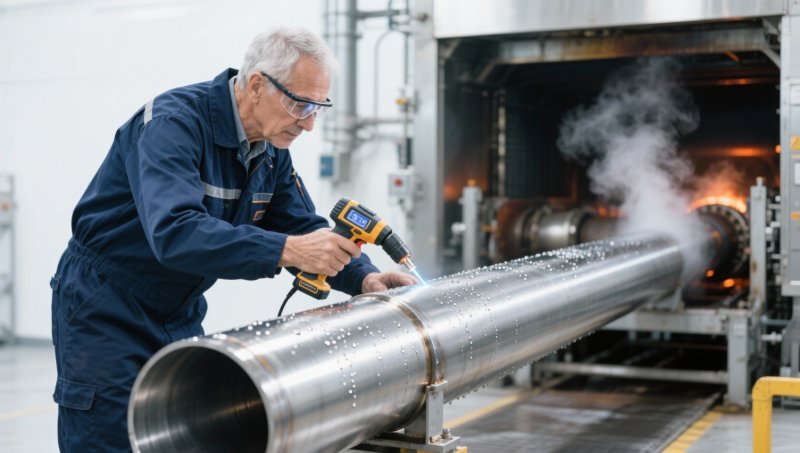
Conclusion: Reliability Starts With Process Discipline
A failure rate below 0.8% isn’t achieved by specification alone—it’s engineered through disciplined thermal execution, verified documentation, and cross-material system thinking. For technical evaluators, this means prioritizing furnace log transparency over glossy brochures. For procurement and finance teams, it translates to lower lifecycle cost, fewer change orders, and predictable lead times. For project managers, it delivers on-time, on-spec commissioning—even in aggressive chloride or H₂S environments.
Hongteng Fengda’s vertically integrated manufacturing—spanning heat treatment, rolling, non-destructive testing, and structural fabrication—ensures every duplex pipe, every Carbon Steel Round Bar, and every custom bracket meets your exact performance and compliance requirements. We don’t just ship steel—we deliver verified reliability.
Contact our engineering sales team today to request a thermal process audit checklist, review your next project’s material specification, or obtain a customized quote with integrated supply terms.
Please give us a message


Please enter what you want to find