For technical evaluators, ASTM certification is more than a label—it is a practical benchmark for verifying carbon steel pipe quality, consistency, and project suitability. Choosing an ASTM certified carbon steel pipe supplier helps reduce compliance risks, simplify specification review, and support reliable performance in construction and industrial applications where material standards directly affect safety, durability, and procurement confidence.
Why ASTM certification matters for carbon steel pipe
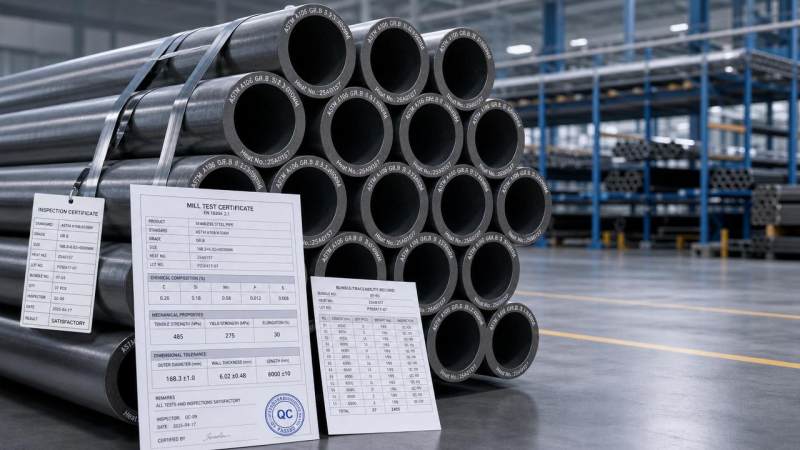
ASTM standards create a shared technical language for carbon steel pipe selection, testing, and acceptance across global steel supply chains.
When a project specifies ASTM grades, dimensions, and test methods, the review process becomes clearer and less dependent on subjective claims.
That is why an ASTM certified carbon steel pipe supplier is often preferred for construction, fabrication, utility, and industrial support systems.
Certification does not replace engineering judgment, but it gives a verified baseline for chemistry, mechanical properties, tolerances, and inspection records.
In steel procurement, that baseline directly affects risk control, bid clarity, and the long-term reliability of fabricated assemblies.
Why a checklist approach improves evaluation
ASTM documents can look straightforward, yet many sourcing problems come from missed details rather than missing certificates.
A checklist helps confirm whether the supplied carbon steel pipe actually matches the stated standard, intended application, and downstream fabrication method.
It also makes it easier to compare offers from more than one ASTM certified carbon steel pipe supplier without relying only on price.
Core checklist for ASTM certified carbon steel pipe review
- Confirm the exact ASTM specification, grade, and product form, because ASTM A53, A106, A500, and similar standards serve different structural and industrial purposes.
- Check the mill test certificate against the purchase order, and verify heat number, chemical composition, tensile strength, yield strength, and elongation values.
- Review dimensional tolerance data, including outside diameter, wall thickness, length, straightness, and end condition, since fabrication fit depends on these details.
- Verify testing scope, such as hydrostatic testing, non-destructive examination, flattening, or bend tests, according to the applicable ASTM requirement.
- Inspect coating, surface finish, and corrosion protection requirements, especially when carbon steel pipe will be stored outdoors or exposed to humid environments.
- Match the pipe standard with the project code and destination market, because regional acceptance may also require EN, JIS, or local compliance references.
- Ask for traceability controls from raw material to finished bundle, since reliable marking and documentation reduce substitution and mixed-grade risks.
- Compare manufacturing capability, lead time stability, and packaging quality, not just the certificate itself, before selecting an ASTM certified carbon steel pipe supplier.
What the certificate should help you verify
- Material identity and grade consistency
- Mechanical performance within standard limits
- Dimensional compliance for fabrication accuracy
- Inspection history and batch traceability
- Suitability for the actual service environment
Application notes for construction and industrial use
Structural support and building frameworks
In structural applications, ASTM certification helps verify that carbon steel pipe can meet required strength and tolerance expectations for welded or bolted assemblies.
This matters when pipe is used for columns, braces, frames, guard systems, or secondary structural members in industrial buildings.
Mechanical fabrication and equipment support
For mechanical supports, handling frames, and equipment bases, ASTM consistency reduces mismatch during cutting, drilling, welding, and assembly.
Projects often combine pipe with formed sections. In these cases, compatible steel documentation across product categories improves quality review.
For example, a formed section such as Z-beam may be used in workshops, wall beams, lightweight roofs, brackets, or light manufacturing frames.
Available in thicknesses from 6-25mm and lengths from 2-12m or customized, it supports perforated and non-perforated options with galvanized coating and roll forming accuracy.
Export projects and cross-border procurement
In export business, certification value increases because the buyer may not inspect every production stage directly at the mill.
An ASTM certified carbon steel pipe supplier with stable production records, clear documents, and dependable packaging lowers logistics and customs-related uncertainty.
Hongteng Fengda, a structural steel manufacturer and exporter from China, supports global projects with products aligned to ASTM, EN, JIS, and GB standards.
Its manufacturing and export experience across North America, Europe, the Middle East, and Southeast Asia helps improve supply continuity and specification matching.
Common oversights that create avoidable risk
Assume no certificate is enough by itself. A document can be valid in format but still fail to match the required grade, process, or testing scope.
Ignore end-use conditions at your own cost. Carbon steel pipe for dry indoor framing faces very different exposure risks than pipe used outdoors or in corrosive plants.
Treat dimensional tolerance as a secondary issue and fabrication delays often follow. Slight wall or straightness variation can affect welding quality and fit-up speed.
Overlook traceability and mixed bundles become difficult to detect. This is especially risky when several similar grades move through one warehouse or project site.
Choose only by lowest offer and hidden costs may appear later through rework, extra inspection, delayed installation, or replacement shipments.
Practical execution steps before placing an order
- List the required ASTM standard, grade, size range, testing method, and coating needs directly on the inquiry sheet.
- Request sample mill certificates and recent inspection records from each ASTM certified carbon steel pipe supplier under consideration.
- Compare document completeness, not just compliance claims, including heat traceability, tolerances, and packaging descriptions.
- Check whether the supplier also handles related structural steel items if the project uses mixed sections and fabricated assemblies.
- Confirm delivery format, bundle marking, and export packing details to reduce receiving errors and site-level identification problems.
Conclusion and next action
ASTM certification matters for carbon steel pipe because it converts broad quality claims into measurable, reviewable technical evidence.
A careful checklist makes that evidence more useful by connecting standards, dimensions, testing, and traceability to the real project application.
When evaluating an ASTM certified carbon steel pipe supplier, focus on specification accuracy, documentation quality, and supply reliability together.
That approach helps control sourcing risk, protect fabrication efficiency, and support dependable performance across structural and industrial steel projects.
Please give us a message


Please enter what you want to find